
Analyzing Talent Management Practices for Long-Term Employee Development and the Retention of Specialists
Pascale Keller, 2026
Art der Arbeit Bachelor Thesis
Auftraggebende Swiss Precision Manufacturing Company
Betreuende Dozierende Anne Jansen
Views: 6
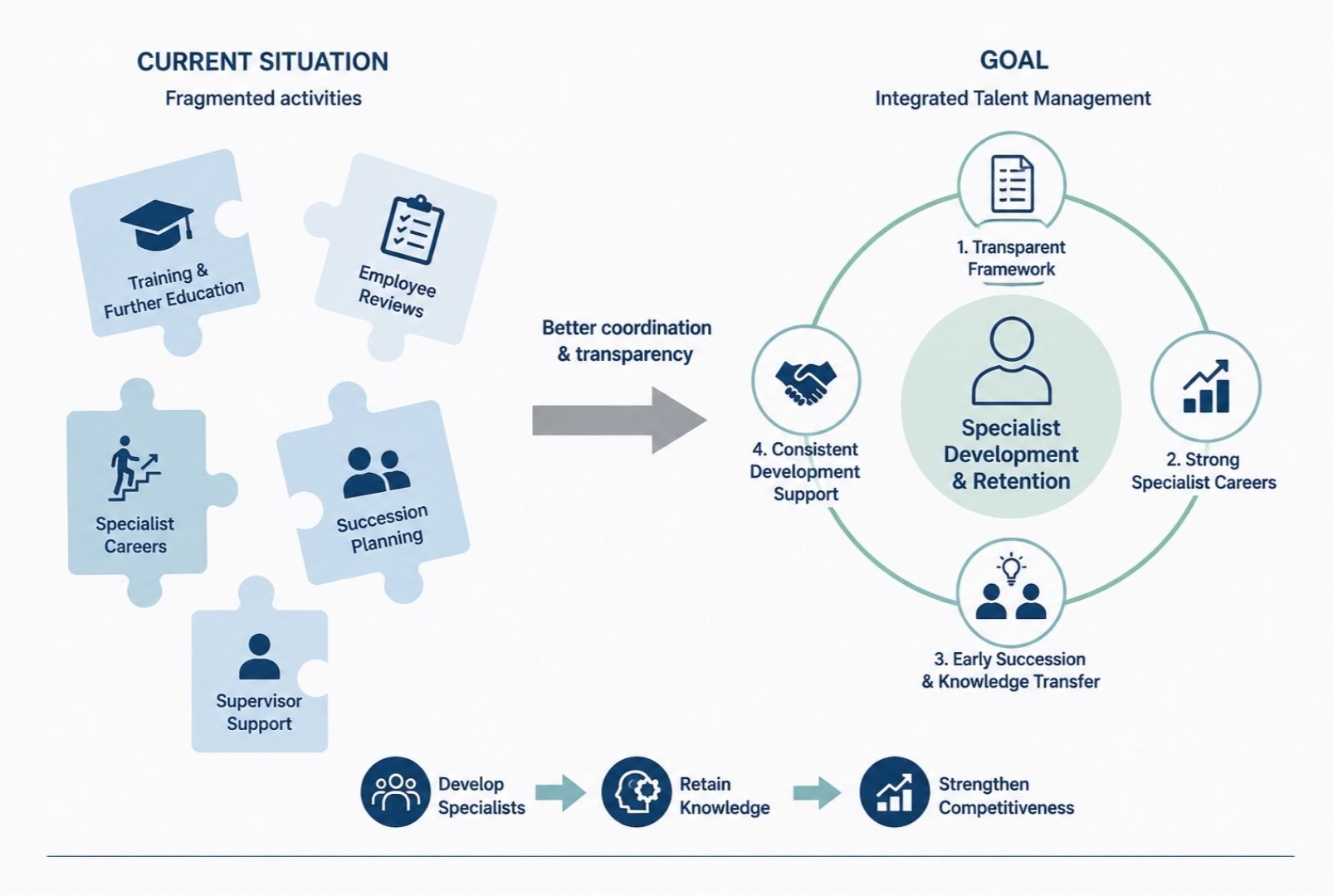
A Swiss precision manufacturing company depends on specialists whose expertise is developed over many years and is difficult to replace. Demographic change, retirements, and the shortage of skilled labor increase the risk of losing critical knowledge. Although the company offers apprenticeships, training, further education, and succession management, these activities are not integrated into one clearly structured talent management framework.
The study used a qualitative research design combining document analysis with nine semi-structured interviews. The documents covered employee reviews, development processes, training and education regulations, internal development programs, and succession management. Interviewees included HR specialists, line managers, former apprentices, apprentices planning to leave, and long-tenured employees. The data were transcribed, coded, and analyzed using qualitative content analysis. Findings were compared to the theoretical framework to identify gaps and formulate recommendations.
The main challenge is not the absence of talent-management activities, but their insufficient coordination. Employees value training, education, meaningful work, and autonomy. However, development depends heavily on individual initiative, supervisor support, and departmental conditions. Specialist career paths exist, but are less visible and recognized than leadership careers. Employees are also unsure how further education connects to future roles within the company.The study recommends four priorities:• Establish a transparent talent management framework and create a central development catalog• Strengthen specialist careers through clearly defined levels and individual development plans• Start succession planning earlier and improve knowledge transfer• Standardize supervisor support and introduce protected learning timeImplementation should begin with pilot projects in some departments, followed by broader rollout and systematic evaluation. The recommendations provide a practical basis for improving coordination and visibility across existing activities. Since it is based on a single case and nine interviews, the measures should be tested and refined during implementation.
Studiengang: Business Administration International Management (Bachelor)
Keywords Talent Management, Human Resources, Industrial Company, Specialists
Vertraulichkeit: vertraulich
Art der Arbeit
Bachelor Thesis
Auftraggebende
Swiss Precision Manufacturing Company
Autorinnen und Autoren
Pascale Keller
Betreuende Dozierende
Anne Jansen
Publikationsjahr
2026
Sprache der Arbeit
Englisch
Vertraulichkeit
vertraulich
Studiengang
Business Administration International Management (Bachelor)
Standort Studiengang
Olten
Keywords
Talent Management, Human Resources, Industrial Company, Specialists