
Fuel Price Formaion, Price Transformation and Taxation
Ilaria Resta & Iman Najmi, 2026
Art der Arbeit Bachelor Thesis
Auftraggebende Preisüberwachung (PUE)
Betreuende Dozierende Mathias Binswanger
Views: 5
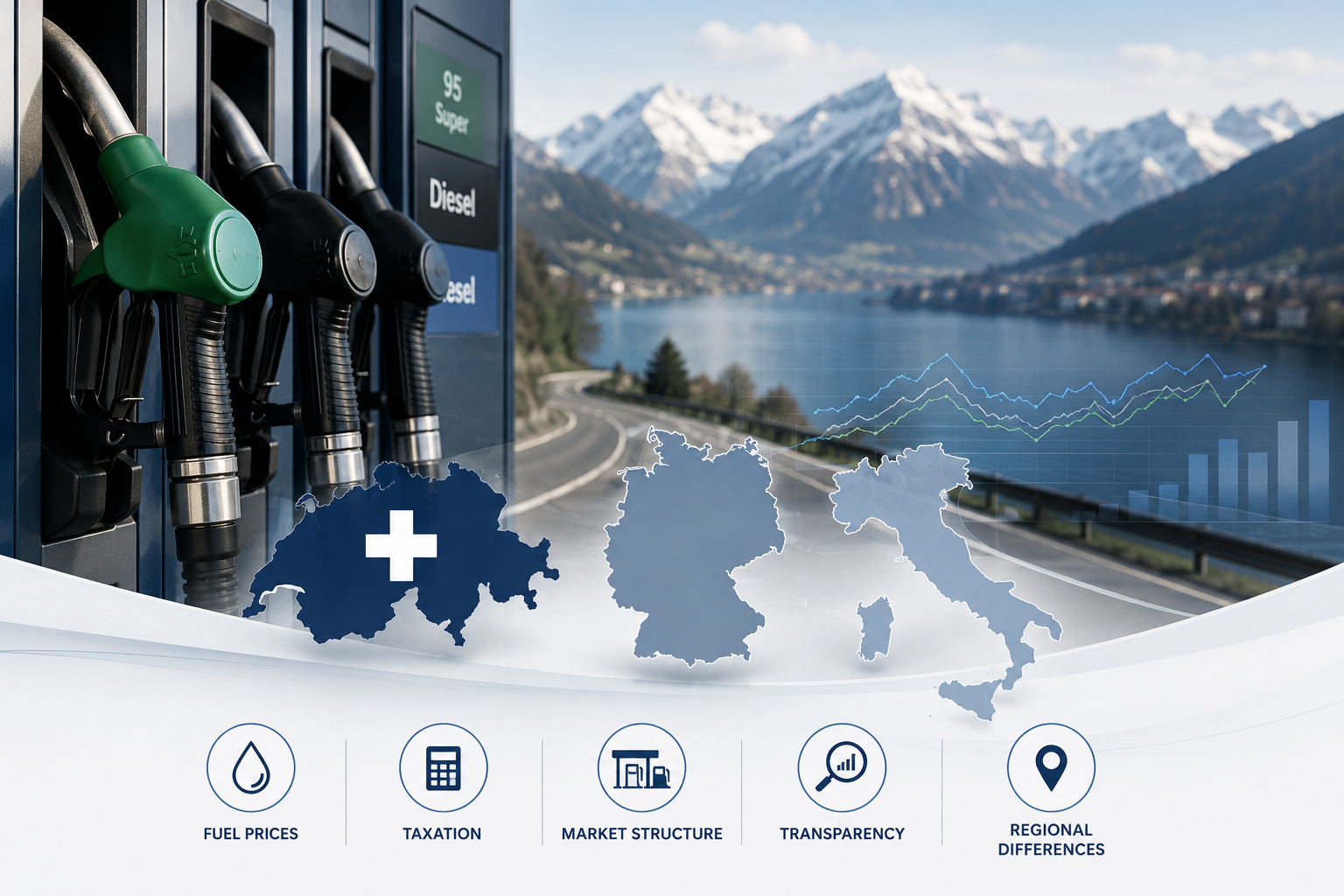
Fuel prices are influenced by a variety of factors, including the cost of crude oil, taxation, market structures and competitive conditions. Despite being exposed to similar international oil market developments, fuel prices and their regional variation differ considerably between neighbouring countries such as Switzerland, Germany and Italy. At the same time, these countries have different tax systems and approaches to fuel price transparency. These differences provide a basis for analysing how national and regional conditions influence the prices paid by consumers.
This study combines a literature review with a quantitative analysis of fuel prices in Switzerland, Germany, and Italy. Price data for petrol and diesel are analysed at national and regional levels to identify differences in price levels and trends over time. The analysis also compares the three countries' taxation, market structures and price transparency systems. These findings are then used to assess the potential implications for Switzerland.
The Swiss data set has significant limitations: BFS fuel prices are derived from CPI data collection and are not intended for direct inter-period comparisons. Meanwhile, TCS cantonal data is voluntary and only provides static averages for 2025. The calculated residual margin encompasses the entire post-crude supply chain and should not be interpreted as retail net profit. Taking these limitations into account, Switzerland exhibits the highest regional price dispersion and residual margin. However, the data do not permit these findings to be attributed to market power. Germany shows the lowest regional dispersion, followed by Italy, although the number and size of regional units differ. While this pattern is consistent with the countries’ transparency systems, no causal effect can be established. For Switzerland, the implementation of a mandatory reporting system is therefore recommended, primarily to improve market monitoring and competition assessment, rather than to directly reduce fuel prices. These findings reflect the authors’ views and not those of the Swiss Price Surveillance Office (PUE).
Studiengang: Business Administration International Management (Bachelor)
Keywords Fuel Prices, Fuel taxation
Vertraulichkeit: vertraulich
Art der Arbeit
Bachelor Thesis
Auftraggebende
Preisüberwachung (PUE), Bern
Autorinnen und Autoren
Ilaria Resta & Iman Najmi
Betreuende Dozierende
Mathias Binswanger
Publikationsjahr
2026
Sprache der Arbeit
Englisch
Vertraulichkeit
vertraulich
Studiengang
Business Administration International Management (Bachelor)
Standort Studiengang
Olten
Keywords
Fuel Prices, Fuel taxation