
Redesign of Digital Ethics in Business Information Technology: Insights from Student and Lecturer Perspectives
Armir Lecaj, 2026
Art der Arbeit Bachelor Thesis
Auftraggebende University of Applied Sciences and Arts Northwestern Switzerland
Betreuende Dozierende Frank Grimberg
Views: 6
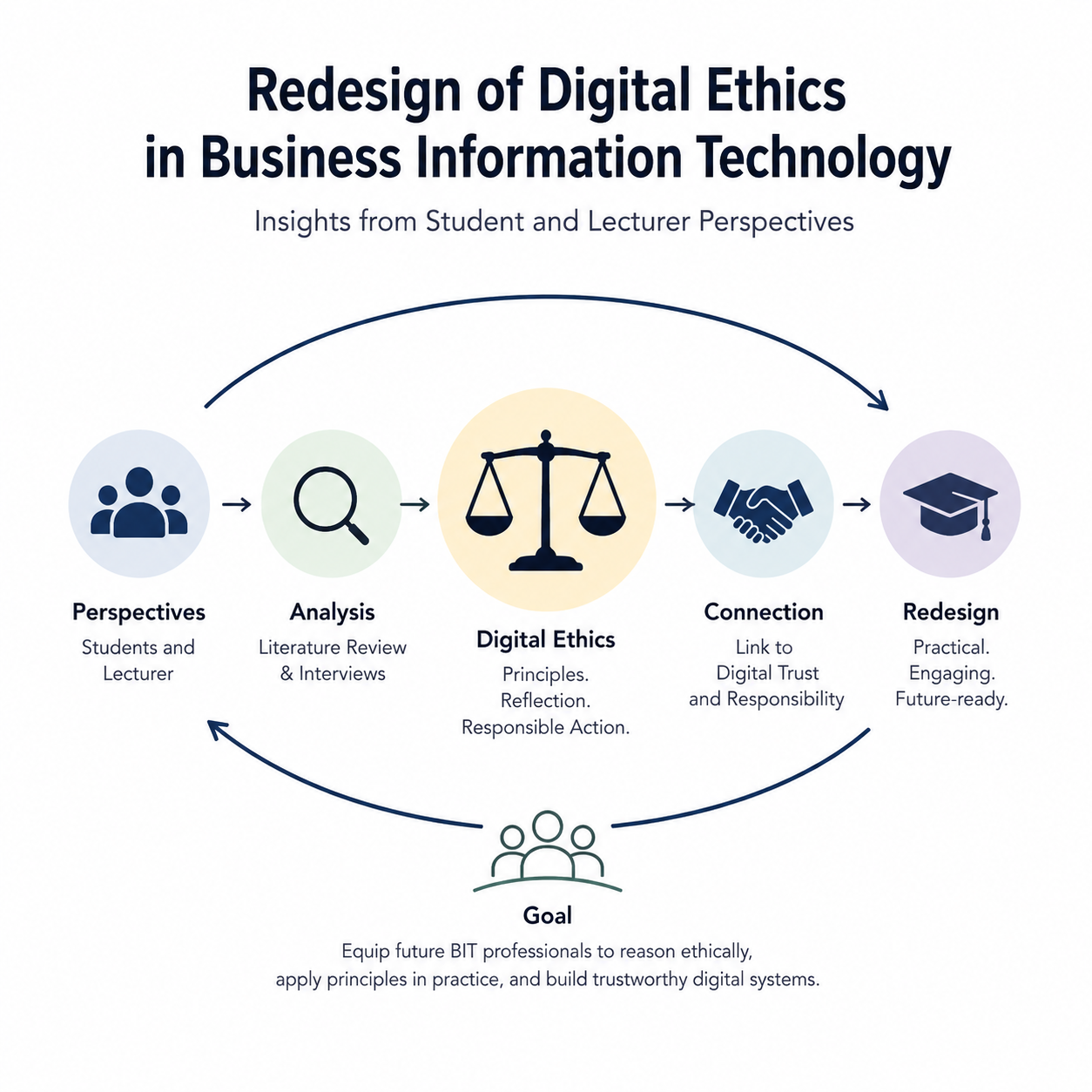
Until now, ethics has been taught in the FHNW Business Information Technology program as part of a shared 5-ECTS Ethics and Law module, with 24 lessons for the ethics component. From autumn 2026, ethics becomes a standalone 3-ECTS Digital Ethics module alongside a planned Digital Trust specialization. The redesign left three gaps open. These are the scope of digital ethics as a field, evidence of which pedagogical elements of the former module actually worked, and the link to digital trust.
The thesis follows a mixed qualitative design. A structured literature review, prioritizing peer-reviewed sources and supplemented by recognized policy frameworks, addresses the conceptual questions on the scope of digital ethics and its link to digital trust. Semi-structured interviews with eight part-time students from the spring 2025 Windisch cohort and the lecturer who taught the ethics component address the pedagogical question. Both interview guides used parallel thematic blocks so that student and lecturer perspectives could be compared directly.
Digital ethics is a layered field building on classical normative theory (deontology, consequentialism, virtue ethics) and extending into current debates on AI and governance. Its central debate is the principles-to-practice gap. Organizations converge on transparency, fairness, and accountability but diverge in how those principles are honored. The interviews produced a clear convergence. Case-based discussion stayed with students longer than abstract theory, with the self-driving car dilemma recalled unprompted by five of eight students. Small-group role-play with assigned stakeholder positions was independently proposed by both the lecturer and several students as the format that worked best. All eight students indicated a preference for alternative assessment formats fitting the lecturer perspective. Digital ethics and digital trust connect through a four-step chain. Ethics supplies the principles, digital responsibility translates them into governance, assessment frameworks make that responsibility verifiable, and digital trust is the outcome stakeholders extend when the chain is demonstrable. The findings shape a twelve-session syllabus proposal.
Studiengang: Business Information Technology (Bachelor)
Keywords Digital Ethics, Ethics Education, AI Ethics, Digital Trust, Business Information Technology, Curriculum Redesign, Qualitative Interviews
Vertraulichkeit: vertraulich
Art der Arbeit
Bachelor Thesis
Auftraggebende
University of Applied Sciences and Arts Northwestern Switzerland, Peter Merian-Strasse 86, 4002 Basel
Autorinnen und Autoren
Armir Lecaj
Betreuende Dozierende
Frank Grimberg
Publikationsjahr
2026
Sprache der Arbeit
Englisch
Vertraulichkeit
vertraulich
Studiengang
Business Information Technology (Bachelor)
Standort Studiengang
Brugg-Windisch
Keywords
Digital Ethics, Ethics Education, AI Ethics, Digital Trust, Business Information Technology, Curriculum Redesign, Qualitative Interviews