
Reaching the Unaware: Increasing Awareness of the CEI's Entrepreneurship Offerings among FHNW Students
Julia Toorchi, 2026
Art der Arbeit Bachelor Thesis
Auftraggebende Center for Entrepreneurship und Innovation, FHNW
Betreuende Dozierende Dario Meyer & Rolf Meyer
Views: 5
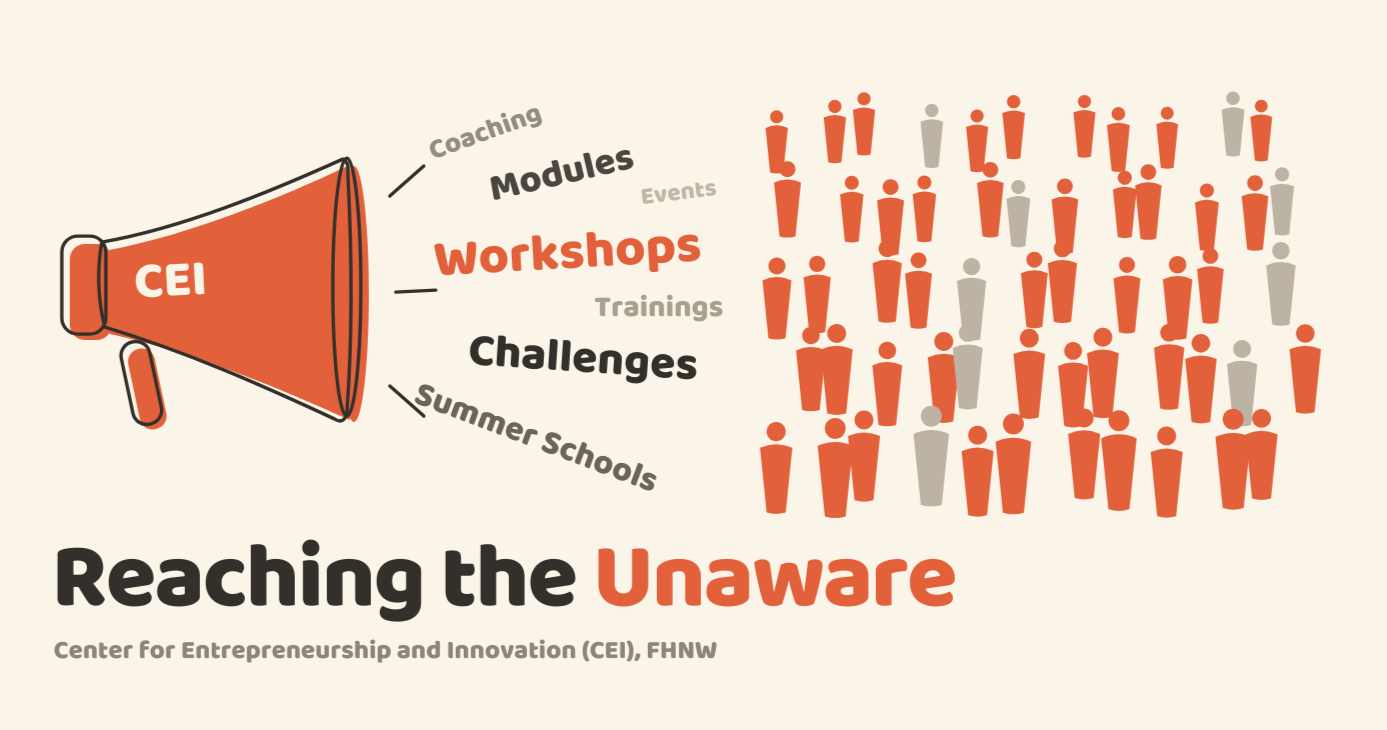
Entrepreneurship drives the Swiss economy, and universities play a central role in preparing students for it. Nearly half of all Swiss founders hold an academic degree, and 20.2% of students plan to found within five years of graduating. Yet research shows that many students never learn which support their own university offers. The Center for Entrepreneurship and Innovation (CEI) of the FHNW School of Business runs nine offerings open to all ten FHNW schools, but their visibility had never been measured. This thesis provides that measurement with the first FHNW-wide student survey.
The data comes from a bilingual online survey of 452 Bachelor and Master students from nine of the ten FHNW schools, recruited as a convenience sample. Entrepreneurial interest was measured with an index derived from an established, validated instrument, awareness as recognition of the nine CEI offerings. The survey also captured preferred channels, offering types, and participation barriers. The data was analyzed descriptively and with linear and logistic regression models to compare schools and identify the channels and content through which interested students want to be reached.
The results overturn the assumption the project started from: interest is not the scarce resource. Interest is solid in every school (mean 4.49 of 7) and highest in the small creative schools. Favorable attitude (4.83) outruns concrete intention (3.99): many students value entrepreneurial skills without planning a venture, so visibility and wording matter more than persuasion. Awareness, by contrast, is low. Students recognize fewer than three of the nine offerings on average, one in five knows none, and interest and awareness are statistically independent. The CEI faces a reach problem, not a persuasion problem. E-mail leads in every school (75%), lecturers follow (47%), and the top barrier among aware non-participants is that they knew too little (44%). The readiness for direct contact exists: 357 students (79%) opted into a newsletter that did not yet exist. The recommendations follow directly: a kick-off interview with key people at each school settles timing and contacts, then one consolidated e-mail per semester travels each school's own route, with lecturers as multipliers and tailored priorities per school. Success is measured through sign-ups and future survey waves.
Studiengang: Betriebsökonomie (Bachelor)
Keywords CEI, Center for Entrepreneurship and Innovation, Entrepreneurship Angebote, Bekanntheit, unternehmerisches Interesse, Studierendenbefragung, Awareness-Studie, Hochschulmarketing, Gründungsförderung Hochschule
Vertraulichkeit: vertraulich
Art der Arbeit
Bachelor Thesis
Auftraggebende
Center for Entrepreneurship und Innovation, FHNW, Brugg-Windisch
Autorinnen und Autoren
Julia Toorchi
Betreuende Dozierende
Dario Meyer & Rolf Meyer
Publikationsjahr
2026
Sprache der Arbeit
Englisch
Vertraulichkeit
vertraulich
Studiengang
Betriebsökonomie (Bachelor)
Standort Studiengang
Basel
Keywords
CEI, Center for Entrepreneurship and Innovation, Entrepreneurship Angebote, Bekanntheit, unternehmerisches Interesse, Studierendenbefragung, Awareness-Studie, Hochschulmarketing, Gründungsförderung Hochschule