
Fair Automated Allocation of Students to School Offers
Laura Gjokaj & Thamilini Jegatheesan, 2026
Art der Arbeit Bachelor Thesis
Auftraggebende Neue Kantonsschule Aarau
Betreuende Dozierende Lorenz Hilfiker
Views: 40
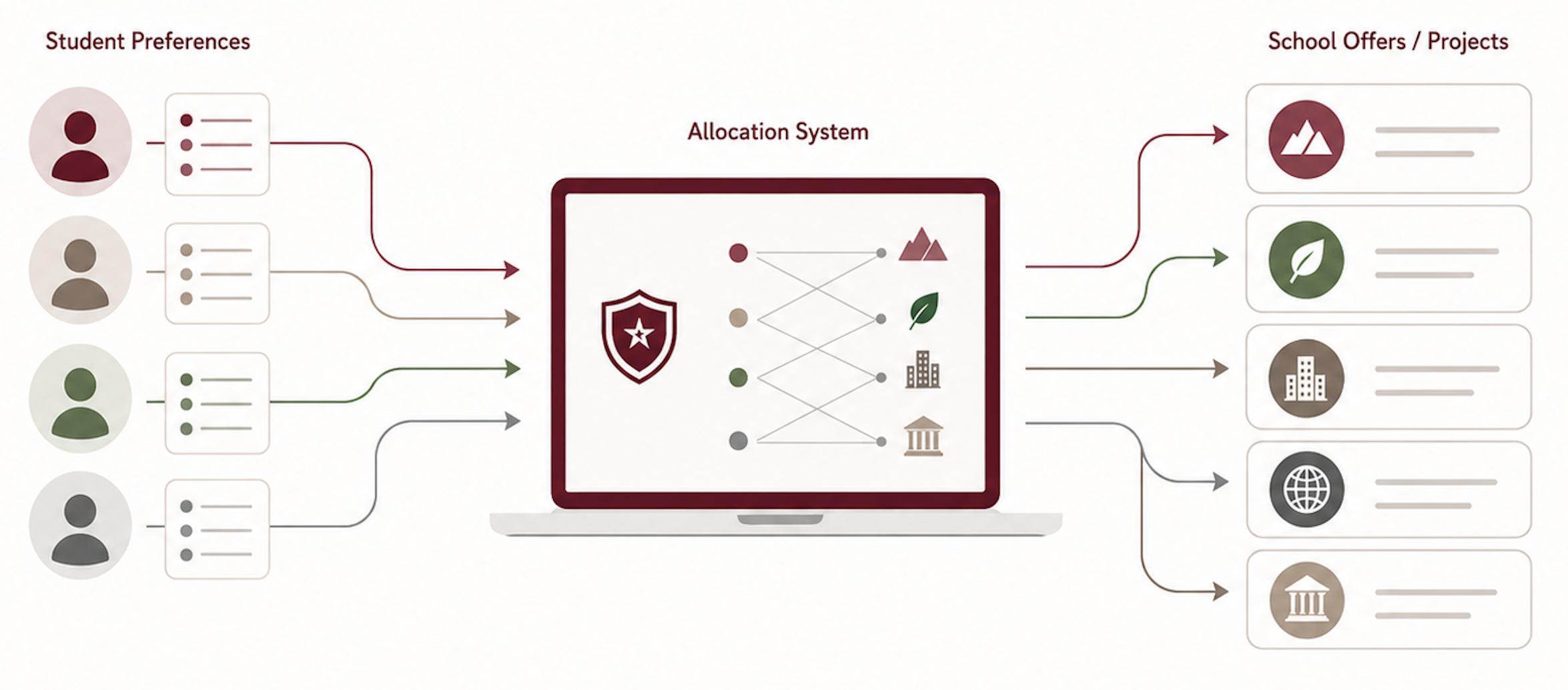
Every year, NKSA allocates around 900 students to project weeks and programmes based on their priorities. The process involves matching registrations against capacities and school rules, identifying under-booked offers, running a second registration round and resolving special cases. Allocation is supported by a tool developed by a teacher that only they can operate, creating a dependency on their technical knowledge. The administration therefore lacks an independently operable and repeatable process, so parts must be reinvented yearly, and consistent treatment is difficult to demonstrate.
Following a Design Science Research approach, the thesis first develops the theoretical grounding: one-sided matching theory, fairness concepts such as justified envy, and transparent decision support design. This becomes a system architecture and an integer linear programming model that maximises student satisfaction subject to NKSA's rules on capacities, eligibility and a fairness cap. Evaluation used correctness validation, scenario walkthroughs and sensitivity analyses.
The evaluation shows that the tool works reliably not only under ideal conditions, but also under the tighter, more realistic conditions NKSA is likely to encounter. The sensitivity analyses make visible how the allocation responds as constraints tighten, and the diagnostic output makes near-infeasible configurations traceable. NKSA is therefore recommended to adopt the tool in place of its existing process: it saves the administration significant time each allocation round and makes the fairness of the outcome explicit and easier to justify to students, teachers and parents. As a decision support system rather than an autonomous decision-maker, its logic remains inspectable and adjustable by school staff without specialised technical knowledge. Beyond NKSA, the work offers a worked example of translating matching-theory and fairness concepts into a practical, constraint-rich system.
Studiengang: Business Administration International Management (Bachelor)
Keywords Allocation, Student-Allocation, Integer Linear Programming, Decision Support System
Vertraulichkeit: vertraulich
Art der Arbeit
Bachelor Thesis
Auftraggebende
Neue Kantonsschule Aarau, Aarau
Autorinnen und Autoren
Laura Gjokaj & Thamilini Jegatheesan
Betreuende Dozierende
Lorenz Hilfiker
Publikationsjahr
2026
Sprache der Arbeit
Englisch
Vertraulichkeit
vertraulich
Studiengang
Business Administration International Management (Bachelor)
Standort Studiengang
Olten
Keywords
Allocation, Student-Allocation, Integer Linear Programming, Decision Support System