
Turning Employee Ideas into Improvements: A Systematic Employee Idea Management Framework for Operations
Samira Johler, 2026
Art der Arbeit Bachelor Thesis
Auftraggebende Franke Management AG
Betreuende Dozierende Laila Kabous
Views: 10
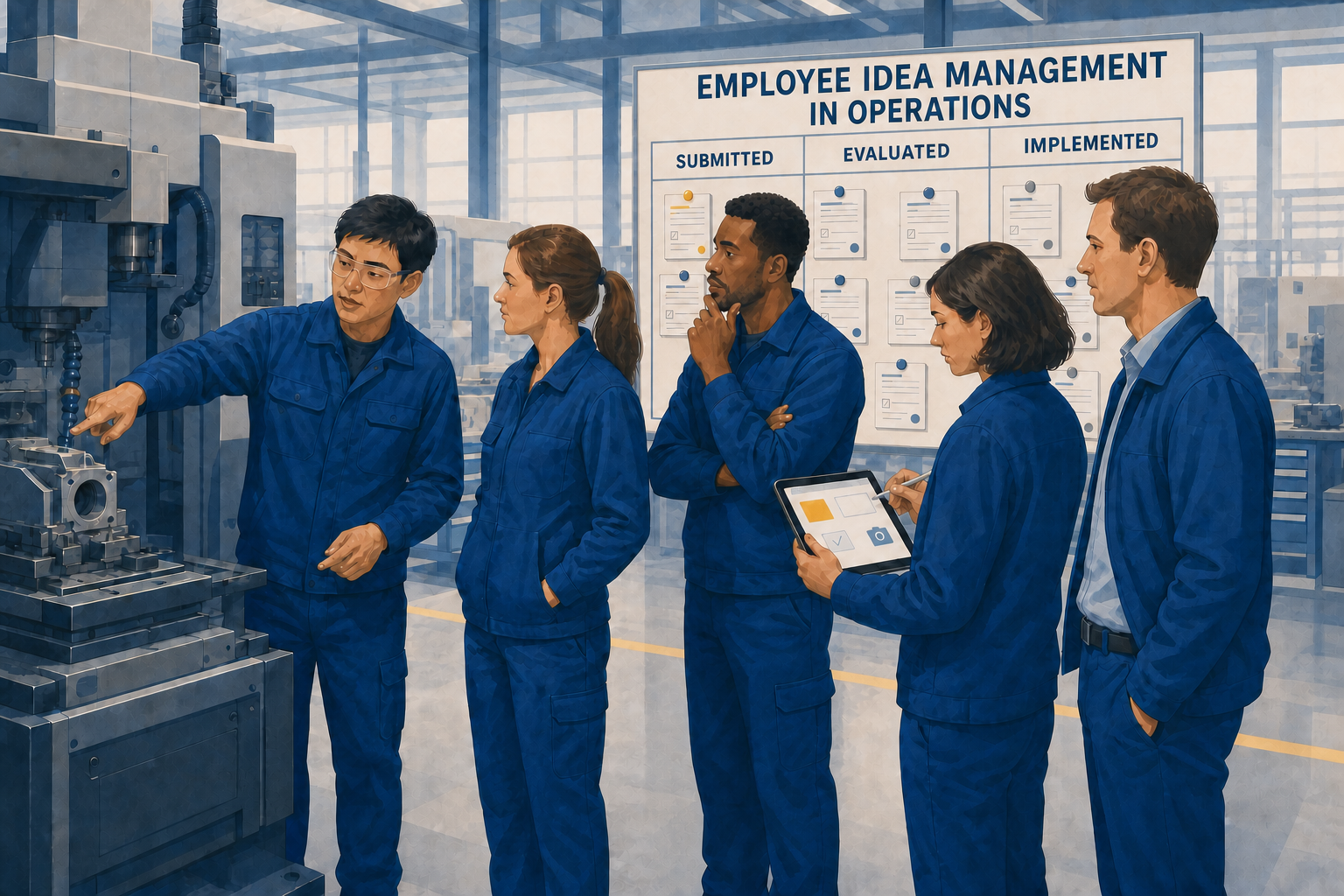
A global industrial company manages employee ideas across its production sites through centrally defined standards and locally established practices. However, there was limited consolidated understanding of how these approaches differed, which process elements supported effective evaluation and implementation, or how successful practices and implemented ideas could be shared across sites. The thesis therefore analyzed current practices and challenges to derive requirements for a systematic employee idea framework.
The study combined a structured literature review on employee idea management, continuous improvement, participation, and employee-driven innovation with an empirical case study at two production sites. Data were collected through semi-structured interviews conducted with representatives from various functions and hierarchical levels, supplemented by internal plant documents and a consultation with a Lean expert, and subsequently triangulated with the existing literature.
The analysis shows that the company has a solid foundation: formal production-system guidance, several submission channels, local evaluation and implementation routines, and feedback and recognition practices. The main opportunity is to maintain continuity throughout the idea journey. Ideas need to remain visible through clear ownership, documented decisions, reliable handovers, status updates, feedback, and formal closure. The proposed framework therefore connects three dimensions: (1) a common employee idea journey from capture to closure, (2) organizational embedding and governance, and (3) performance measurement and selective cross-site learning. It defines common minimum standards while allowing sites to retain locally suitable channels, routines, evaluation arrangements, and recognition practices. This gives the company a practical basis for increasing participation, improving implementation, identifying bottlenecks and realized benefits, and reusing successful ideas across production sites.
Studiengang: Business Administration International Management (Bachelor)
Keywords Employee Idea Management, Continuous Improvement, Employee Engagement, Idea Management Systems, Manufacturing Operations
Vertraulichkeit: vertraulich
Art der Arbeit
Bachelor Thesis
Auftraggebende
Franke Management AG, Aarburg
Autorinnen und Autoren
Samira Johler
Betreuende Dozierende
Laila Kabous
Publikationsjahr
2026
Sprache der Arbeit
Englisch
Vertraulichkeit
vertraulich
Studiengang
Business Administration International Management (Bachelor)
Standort Studiengang
Olten
Keywords
Employee Idea Management, Continuous Improvement, Employee Engagement, Idea Management Systems, Manufacturing Operations