
AI Regression Model for Budgeting Process
Loic Bösch, 2026
Art der Arbeit Bachelor Thesis
Auftraggebende Motorfahrzeugkontrolle Basel-Landschaft
Betreuende Dozierende Stephan Jüngling
Views: 19
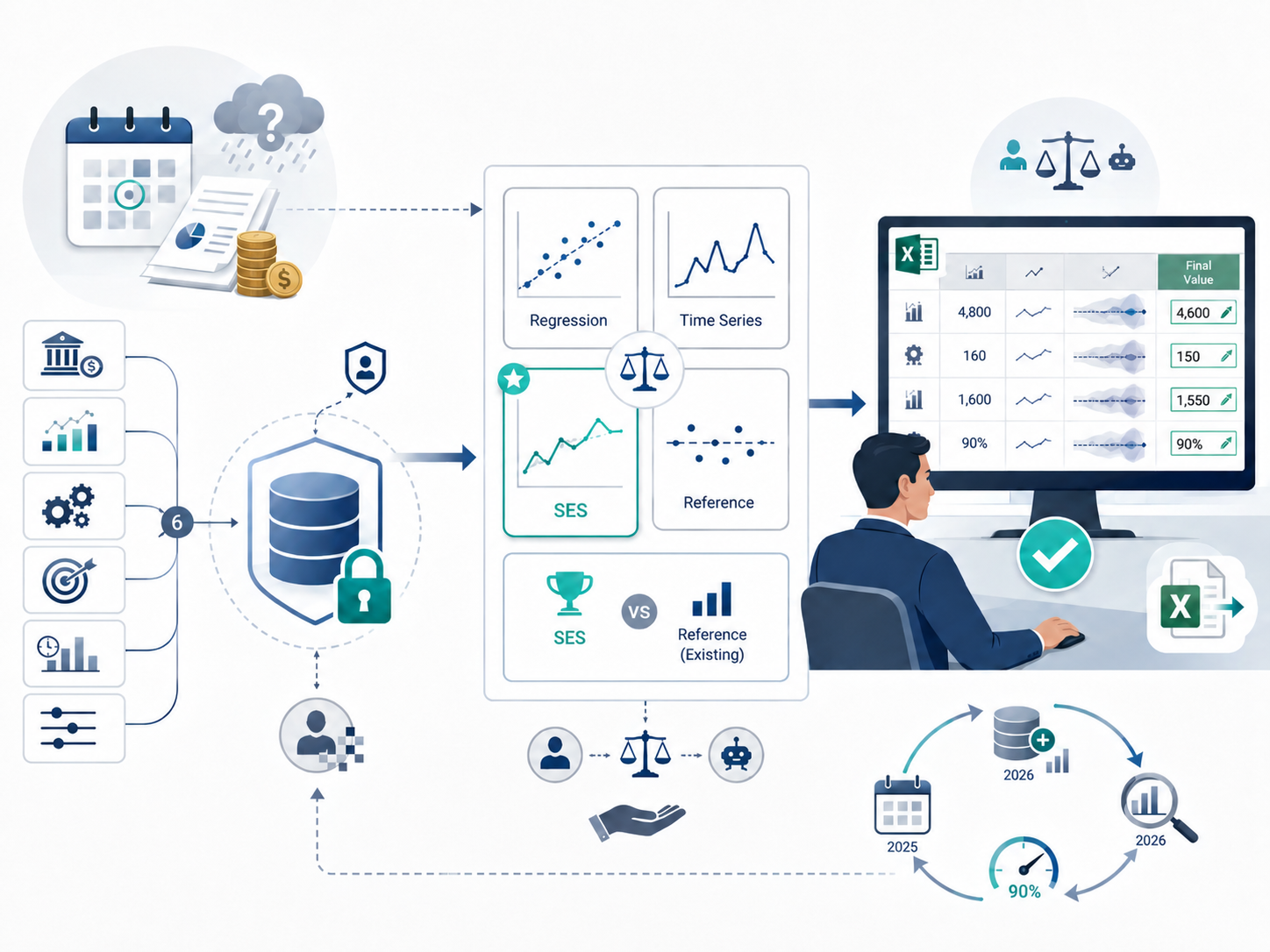
Initial budget forecasts are prepared early in the budgeting process, when future developments are still uncertain. Estimates depend heavily on expert knowledge and manual analysis, while the required data is distributed across several systems. The study therefore examined whether historical data could provide more consistent forecast suggestions while accounting for limited data availability, process constraints and data-protection requirements, and while retaining final decision authority with financial experts.
A case applied mixed-methods approach was used. The budgeting process, stakeholders, systems and user requirements were analysed through documents and semi-structured interviews. Six pseudonymised data sources were integrated into a dataset containing 4,800 historical forecast cases across 160 budget positions. Regression, time-series, hybrid and reference methods were compared using walk-forward validation. A Python artefact, an on-premises application concept and a matching graphical user interface were subsequently developed.
Simple Exponential Smoothing was the strongest developed formal model. However, a simple three-period historical mean achieved an average absolute forecast error around 14% lower, showing that the more complex formal models did not outperform the strongest reference method. The results therefore provide no evidence that forecasting models should replace professional judgement. Instead, they can provide an additional, reproducible reference within the budgeting process. The executable forecasting artefact generated 1,600 pending forecasts and empirical forecast ranges for 90% of cases. For the Motorfahrzeugkontrolle Basel-Landschaft, the main benefits are a consistent and transparent decision-support process with input validation, documented uncertainty, Excel-based outputs and full user control over final values. A future pilot could compare the forecasting model with the existing budgeting approach and reassess performance after each budgeting cycle. Newly available actual values should also be incorporated annually in line with the proposed data roles to assess whether a growing historical dataset improves forecast accuracy.
Studiengang: Business Information Technology (Bachelor)
Keywords Artificial Intelligence; Forecasting; Budgeting; Machine Learning; Time Series Analysis; Regression Models; Decision Support; Public Sector; Financial Planning;
Vertraulichkeit: vertraulich
Art der Arbeit
Bachelor Thesis
Auftraggebende
Motorfahrzeugkontrolle Basel-Landschaft, Füllinsdorf
Autorinnen und Autoren
Loic Bösch
Betreuende Dozierende
Stephan Jüngling
Publikationsjahr
2026
Sprache der Arbeit
Englisch
Vertraulichkeit
vertraulich
Studiengang
Business Information Technology (Bachelor)
Standort Studiengang
Basel
Keywords
Artificial Intelligence; Forecasting; Budgeting; Machine Learning; Time Series Analysis; Regression Models; Decision Support; Public Sector; Financial Planning;