
Beyond Observability: Ontology-Based Runtime Governance for Microservice Architectures
Christian Bieri, 2026
Art der Arbeit Master Thesis
Auftraggebende
Betreuende Dozierende Devid Montecchiari & Andrea Polini
Views: 6 - Downloads: 4
Although static, dynamic, hybrid and ontology-based analysis approaches exist, they remain fragmented in scope and integration and, therefore, provide only partial support for automated governance validation. Empirical observations further indicate that telemetry data are predominantly used for operational monitoring, whereas automated, policy-aware semantic reasoning at runtime remains uncommon, despite many of the most severe and difficult-to-detect architectural anti-patterns manifesting only at runtime and, thus, remaining invisible to purely static analysis.
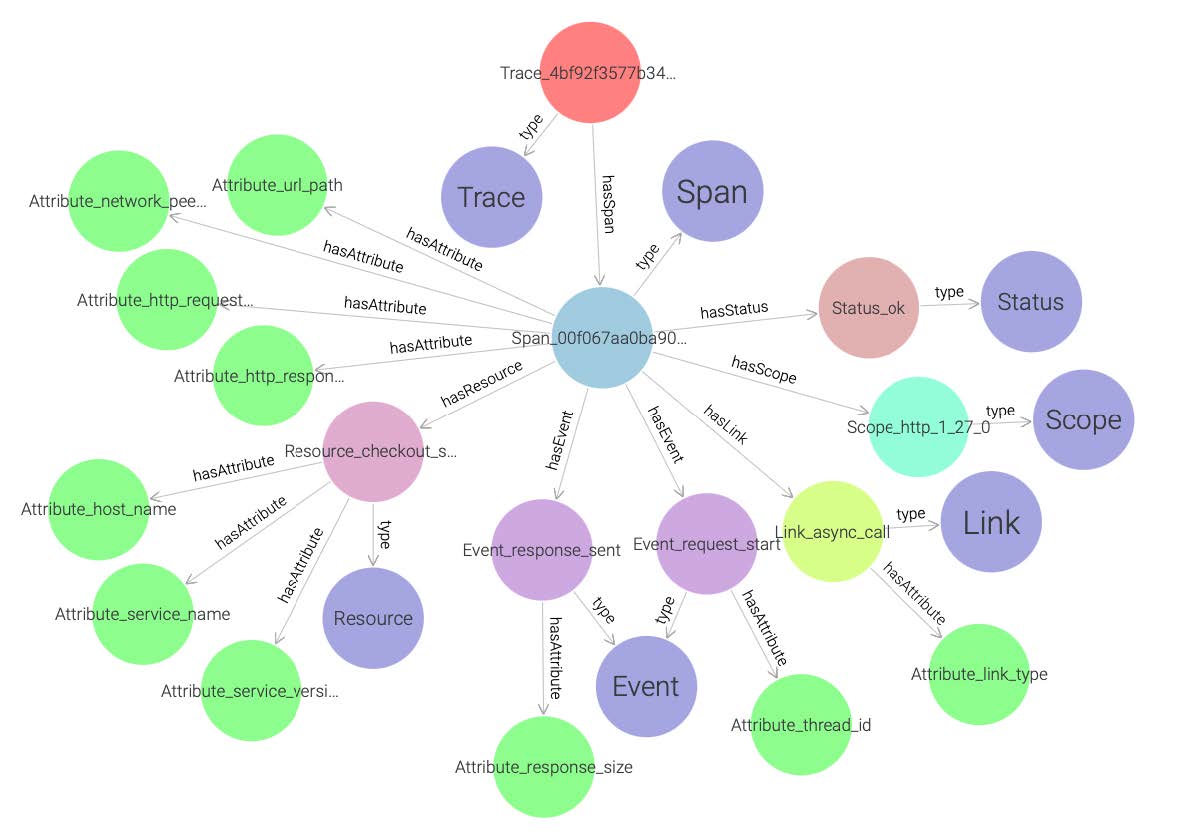
To address the outlined research gap, this research investigates how ontologies, combined with telemetry data and policy-aware semantic reasoning, enable automated runtime governance validation in Kubernetes-based microservice architectures. The proposed approach formally represents runtime-relevant architectural knowledge derived from telemetry data and enables the automated detection of governance violations at runtime through an ontology-based knowledge model, a semantic lifting pipeline and a policyaware semantic reasoning layer.The research follows the design science research framework, in which the artefact is designed, implemented and evaluated using synthetic test cases and real-world telemetry data to assess correctness, expressiveness, feasibility, performance and scalability.
The results demonstrate that telemetry data can be transformed into formal knowledge representations suitable for semantic reasoning and that policy-aware semantic reasoning enables automated detection of governance violations at runtime. The proposed approach extends traditional observability towards semantic runtime governance validation and provides a foundation for preventing architectural degradation in Kubernetes-based microservice architectures.
Studiengang: Business Information Systems (Master)
Keywords anti-pattern detection, architectural degradation, architectural smells, decentralized systems, distributedtracing, dynamic analysis, governance validation, knowledge graph, microservice architecture, microservice monitoring,microservice principles, monolithic architecture, observability, ontology-based reasoning, runtime analysis, semanticinteroperability, software architecture reconstruction, software quality, static analysis, telemetry data, Web OntologyLanguage
Vertraulichkeit: öffentlich
Art der Arbeit
Master Thesis
Autorinnen und Autoren
Christian Bieri
Betreuende Dozierende
Devid Montecchiari & Andrea Polini
Publikationsjahr
2026
Sprache der Arbeit
Englisch
Vertraulichkeit
öffentlich
Studiengang
Business Information Systems (Master)
Standort Studiengang
Olten
Keywords
anti-pattern detection, architectural degradation, architectural smells, decentralized systems, distributedtracing, dynamic analysis, governance validation, knowledge graph, microservice architecture, microservice monitoring,microservice principles, monolithic architecture, observability, ontology-based reasoning, runtime analysis, semanticinteroperability, software architecture reconstruction, software quality, static analysis, telemetry data, Web OntologyLanguage