
Development of a positioning matrix to classify sustainability and regulatory requirements in the Swiss chocolate industry with Chocolate Camille Bloch
Len Gygax, 2026
Art der Arbeit Bachelor Thesis
Auftraggebende Chocolats Camille Bloch SA
Betreuende Dozierende Gianreto Gamboni
Views: 13
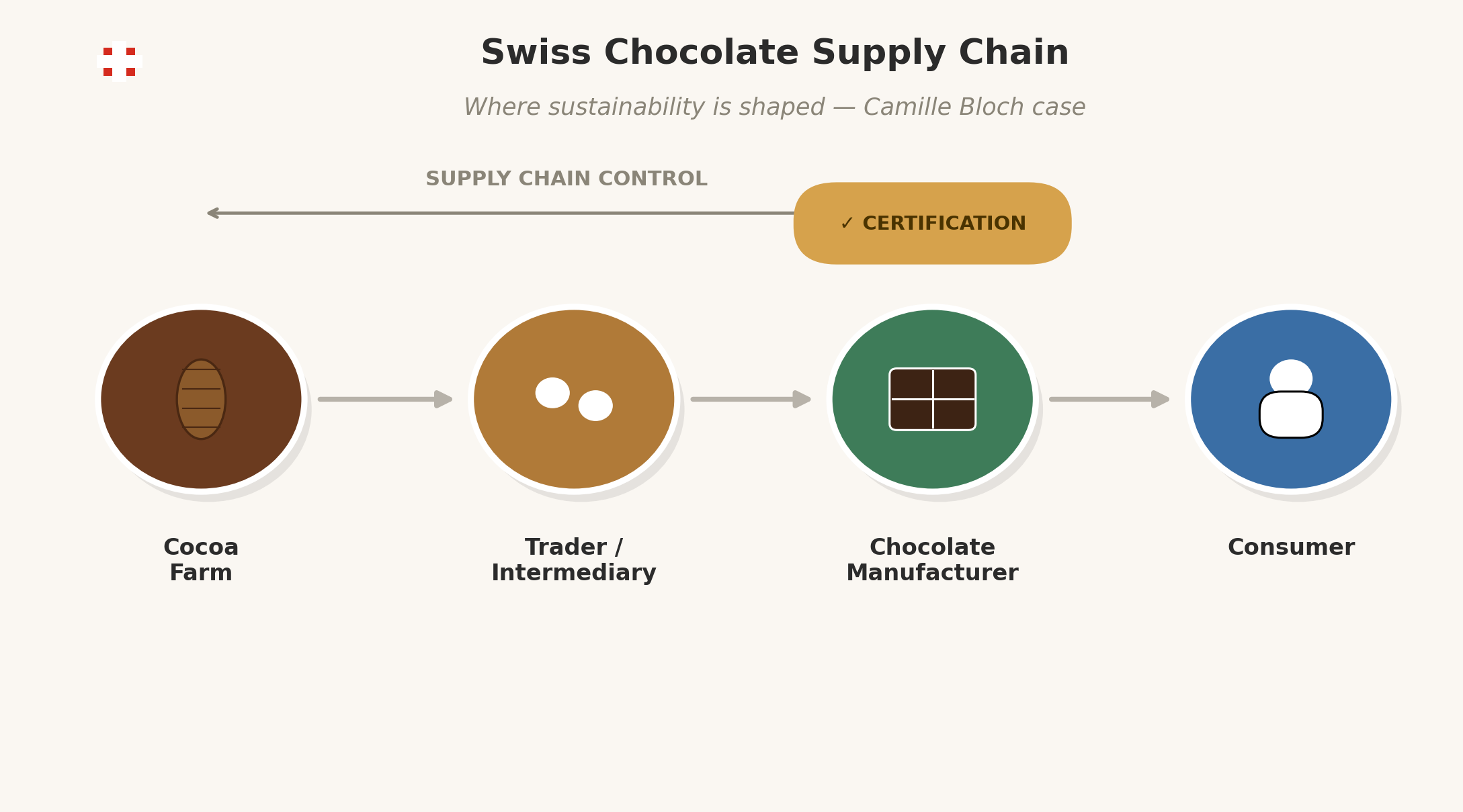
The Swiss chocolate industry faces growing pressure to make cocoa supply chains more sustainable, driven by rising regulatory requirements and consumer expectations. Chocolats Camille Bloch currently sources cocoa mostly indirectly through traders and lacks third-party certification, while competitors like Hug AG or companies with direct sourcing are further ahead. It remains unclear how strongly supply chain control actually relates to sustainability performance and which strategy suits Camille Bloch best.
This thesis follows a qualitative approach. Semi-structured interviews with Chocolate Company X, Hug AG, Camille Bloch and Emmi AG were used to assess their supply chain control and sustainability measures. This was complemented by a document analysis of company sustainability reports and the SWISSCO Roadmap 2030. Based on these findings, an original positioning matrix was developed, comparing each company's supply chain control against its sustainability performance. From this, concrete recommendations for Camille Bloch were derived.
The analysis shows that the relationship between supply chain control and sustainability performance is positive but not straightforward. Chocolate Company X combines the highest control score with the highest sustainability score, confirming that direct farm relationships support strong implementation. Camille Bloch, despite having the second-highest control score, sits at the exact midpoint of the sustainability scale, while Hug AG, with only moderate control, scores higher, carried almost entirely by its full certification coverage. The gap holding Camille Bloch back is not a lack of control but the absence of third-party certification, its lowest-scoring dimension. Based on this, the thesis recommends a two-pillar strategy: pursuing third-party certification (most plausibly Rainforest Alliance) for a defined share of cocoa volume as a fast, low-risk first step, since Camille Bloch already has full traceability and an established trader relationship. In parallel, its exploration of direct sourcing should be formalised into a structured due diligence process, clarifying open questions on certification, carbon footprint, and labour standards before any commitment is made.
Studiengang: Business Administration International Management (Bachelor)
Keywords Sustainability Supply Chain Management, Cocoa Supply Chain, Swiss Chocolate Industry, Supply Chain Control, Sustainability Performance, Third-Party Certification, Positioning Matrix, Direct vs Indirect Sourcing, Corporate Sustainability Reporting, Camille
Vertraulichkeit: vertraulich
Art der Arbeit
Bachelor Thesis
Auftraggebende
Chocolats Camille Bloch SA, Courtlary
Autorinnen und Autoren
Len Gygax
Betreuende Dozierende
Gianreto Gamboni
Publikationsjahr
2026
Sprache der Arbeit
Englisch
Vertraulichkeit
vertraulich
Studiengang
Business Administration International Management (Bachelor)
Standort Studiengang
Olten
Keywords
Sustainability Supply Chain Management, Cocoa Supply Chain, Swiss Chocolate Industry, Supply Chain Control, Sustainability Performance, Third-Party Certification, Positioning Matrix, Direct vs Indirect Sourcing, Corporate Sustainability Reporting, Camille