
Rule-Based Process Automation Framework for the Bank for International Settlements
Mike Zwicky, 2026
Art der Arbeit Bachelor Thesis
Auftraggebende Bank for International Settlements
Betreuende Dozierende Pragati Siddhanti
Views: 15
Like many regulated organisations, the client, an international financial institution, handles a large volume of routine administrative work governed by clear rules. At the same time, the range of available automation approaches has expanded from workflow automation and robotic process automation to AI based and agentic systems. This variety has made it harder to determine which approach fits a given process. What was missing was not another tool, but a structured way to assess which processes suit automation based on explicit rules and when other approaches are more appropriate.
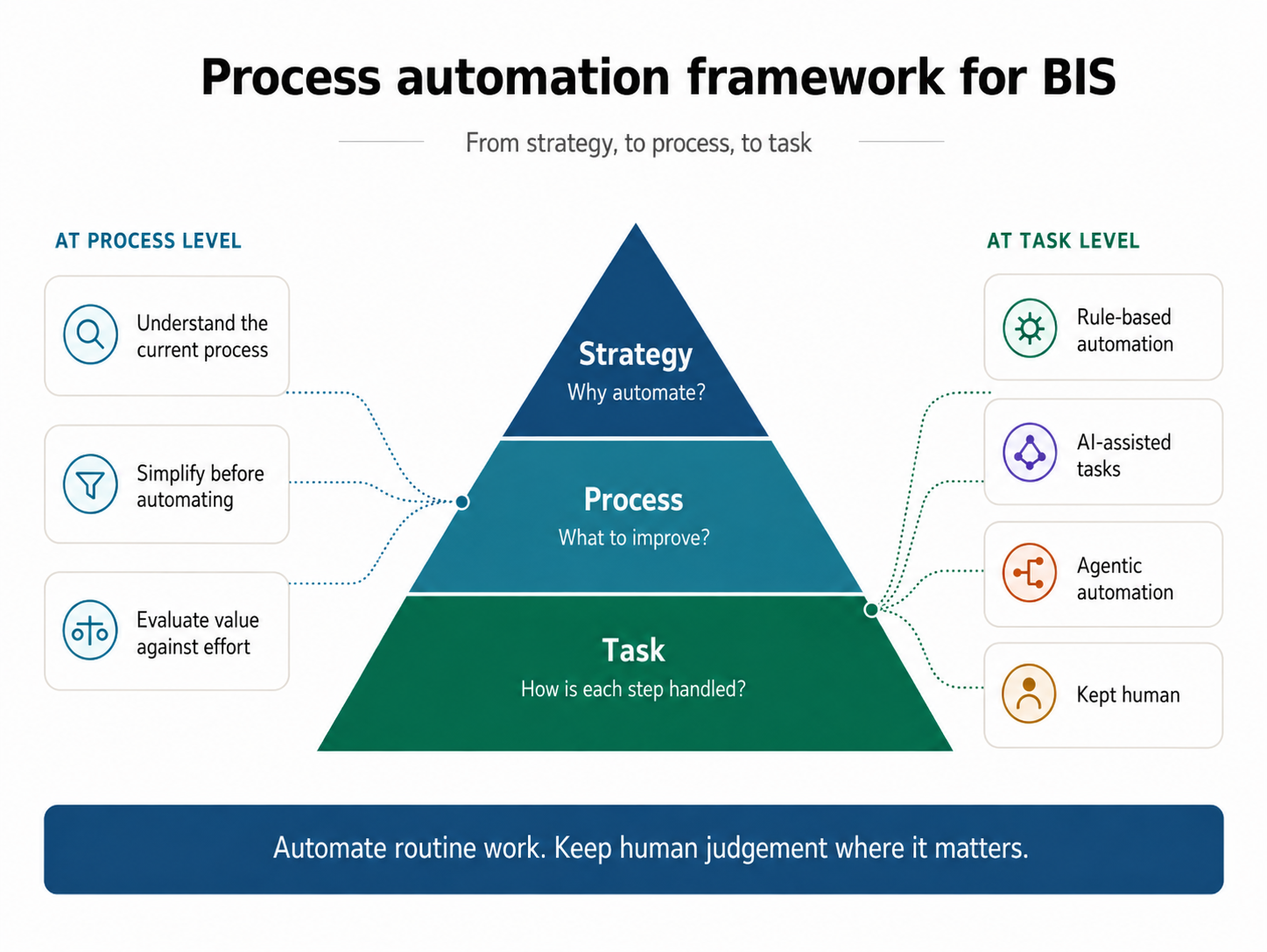
The framework was developed through a design science approach. Its criteria were drawn from the academic literature and from expert interviews, and it was demonstrated on a real administrative process at the client organisation. It is organised as a three-level pyramid running from strategy to process to task. At the process level it weighs the working time a candidate would free against the effort to automate it. At the task level it matches each step to a form of automation, taking the rule-based branch as the default and moving to a more autonomous one only where the work demands it.
The result is a transparent, auditable and transferable way to decide where rule-based automation fits. Its starting point is a truth that is easily forgotten: automation does not improve a process. It carries out whatever process it is given faster and at scale, so a process that has not first been understood and streamlined merely fails faster. Seen this way, deterministic automation is not a primitive fallback beneath more advanced methods. It is where most administrative work in a regulated institution belongs, because such work is better served by an explicit, auditable rule than by a probabilistic model whose reasoning cannot be inspected. What results in practice is almost never a single technology but a hybrid: a rule-based backbone carrying the process, more capable methods added only where they earn their place, and people keeping the decisions that turn on responsibility or judgement. The demonstration also showed that what decides whether an automation succeeds is rarely the capability of the technology but the organisational conditions around it.
Studiengang: Business Information Technology (Bachelor)
Keywords rule-based automation, process automation, business process management, decision rules, workflow automation, robotic process automation
Vertraulichkeit: vertraulich
Art der Arbeit
Bachelor Thesis
Auftraggebende
Bank for International Settlements, Basel
Autorinnen und Autoren
Mike Zwicky
Betreuende Dozierende
Pragati Siddhanti
Publikationsjahr
2026
Sprache der Arbeit
Englisch
Vertraulichkeit
vertraulich
Studiengang
Business Information Technology (Bachelor)
Standort Studiengang
Basel
Keywords
rule-based automation, process automation, business process management, decision rules, workflow automation, robotic process automation