
Knowledge and Attitudes Towards Measurement-Based Care (MBC) in Swiss Psychiatric Services: A Qualitative Study Based on Expert Interviews
Karshiny Selvarajah, 2026
Art der Arbeit Bachelor Thesis
Auftraggebende University of Applied Sciences and Arts Northwestern Switzerland (FHNW)
Betreuende Dozierende Sabina Heuss
Views: 9 - Downloads: 0
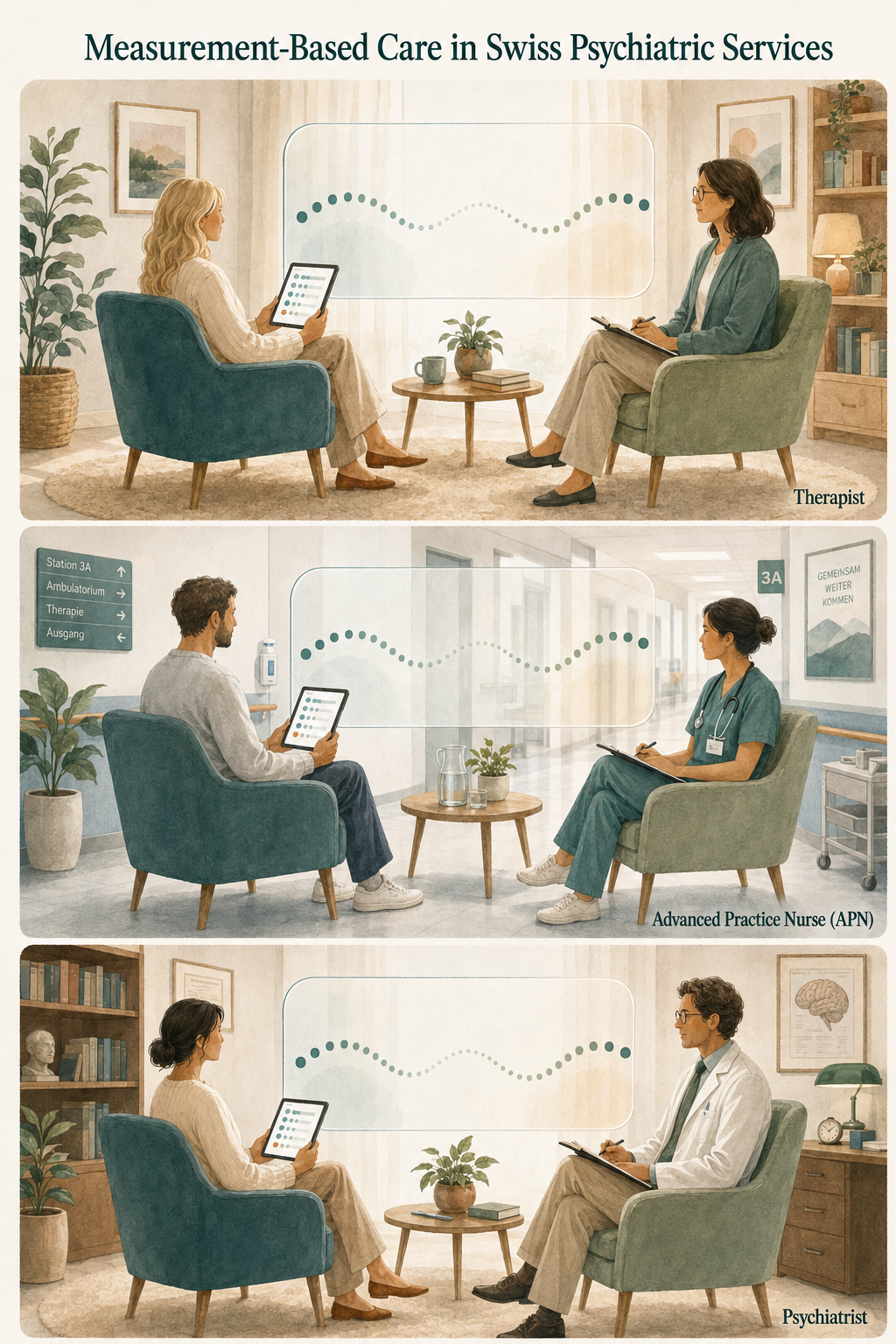
Systematic outcome data barely exists: national quality measurement covers inpatient care only, and only at admission and discharge. What happens during treatment is not recorded anywhere. Cost pressure in Swiss healthcare is rising, and with it the demand for psychiatric services and the pressure to show that treatment works. Measurement-Based Care (MBC) means measuring symptoms repeatedly during treatment and feeding the results back in time for the session. It is researched internationally, but has found no application in Switzerland. No study had asked Swiss professionals what they think.
A qualitative, exploratory design was chosen, as no Swiss data existed. Seven semi-structured expert interviews were conducted: two psychiatrists, two psychologists and two advanced practice nurses working in inpatient and outpatient settings in Switzerland, and one key informant from the United States who already works with MBC. The interviews were transcribed and analysed using structured qualitative content analysis in MAXQDA, resulting in eight categories that answer the main question: How do psychiatric professionals in Switzerland perceive MBC and its potential use in their practice?
MBC was largely unknown as a term. Half of the participants used standardised questionnaires, but almost exclusively when patients arrived, rather than repeatedly during treatment. Opinions varied more within the same profession than between the three professional groups, shaped by prior experience with questionnaires, therapeutic orientation and clinical setting.The main barriers differed from those shown in the international literature. Data protection, training and cost were mentioned, but rarely seen as most important. What mattered was purpose: who would receive the data afterwards, and whether the instrument would help clinicians in their own work. Several participants questioned not how MBC would be implemented, but what it measures and where the data goes afterwards.The experts from the study did not reject systematic measurement as such, but a symptom-focused, uniform model introduced without a clearly defined purpose. Acceptance depended on trust. The study recommends clarifying purpose and data access first, designing an instrument that goes beyond symptoms, and opening a professional discussion based on a concrete instrument before implementation is considered.
Studiengang: Business Administration International Management (Bachelor)
Keywords Measurement-Based Care, Psychiatric Services, Repeated Standardised Measurement, Qualitative Research, Expert Interviews, Switzerland
Vertraulichkeit: öffentlich
Art der Arbeit
Bachelor Thesis
Auftraggebende
University of Applied Sciences and Arts Northwestern Switzerland (FHNW), Olten
Autorinnen und Autoren
Karshiny Selvarajah
Betreuende Dozierende
Sabina Heuss
Publikationsjahr
2026
Sprache der Arbeit
Englisch
Vertraulichkeit
öffentlich
Studiengang
Business Administration International Management (Bachelor)
Standort Studiengang
Olten
Keywords
Measurement-Based Care, Psychiatric Services, Repeated Standardised Measurement, Qualitative Research, Expert Interviews, Switzerland