
AI Applications for Sustainable Urban Development
Saidu Marah, 2026
Art der Arbeit Bachelor Thesis
Auftraggebende Kantons- und Stadtentwicklung, Präsidialdepartement des Kantons Basel-Stadt
Betreuende Dozierende Hermann Grieder
Views: 20
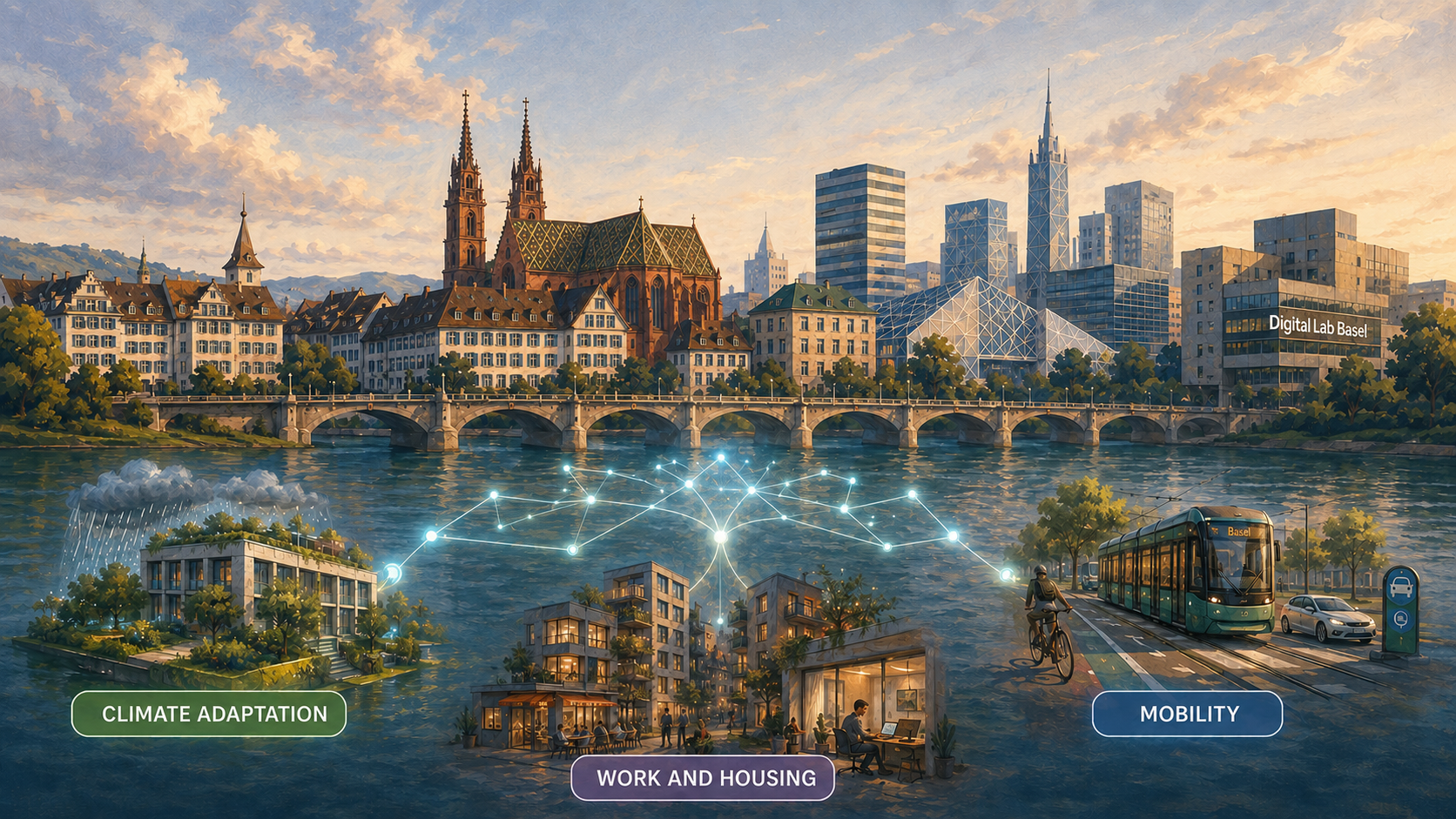
The Simulationsmodell Nachhaltigkeit (SimoNa) initiative seeks a digital urban development model to simulate sustainable development and generate prospective insights for optimising projects. Artificial intelligence (AI) is increasingly recognised as a tool for addressing complex urban sustainability challenges, and numerous European cities have already begun piloting AI-driven solutions accordingly. However, no systematic overview exists of which AI applications from comparable cities are relevant to BS or under which conditions they could realistically be transferred to its specific context.
This thesis addresses that gap by asking which AI applications in climate adaptation, mobility, and work and housing, identified from comparable cities, are relevant and transferable to BS within the strategic context of Digital Lab Basel and SimoNa. It pursues three objectives: identifying and describing applications from a set of comparison cities through a literature review and expert interviews; assessing their transferability to BS using a weighted scoreboard evaluation matrix; and deriving practical recommendations using a Prioritisation Matrix.
Across Hamburg, Munich, Copenhagen, Vienna, and Zurich, 25 AI applications were identified and assessed. Eight were classified as quick wins and five as strategic projects; combining both instruments, six applications spanning all three thematic fields were translated into concrete recommendations, each with a named responsible party, required conditions, and a next step. Among them, Copenhagen's AI-supported flexible heating solution achieved the highest transferability score, followed closely by Munich's aerial-image-based recognition and Zurich's internal AI assistant ZüriA. The thesis's primary contribution to BS is this prioritised, actionable shortlist, grounded directly in BS's own strategic, technological, and regulatory context, together with a reusable evaluation framework for assessing future AI applications. Looking ahead, the recommended quick wins point toward scoping pilots, while the two strategic projects call for joint feasibility studies with the relevant BS utility and permitting authority; extending the expert interviews to Vienna and Zurich offers a natural direction for further research.
Studiengang: Business Information Technology (Bachelor)
Keywords Artificial Intelligence, Smart City, Climate Adaptation
Vertraulichkeit: öffentlich
Art der Arbeit
Bachelor Thesis
Auftraggebende
Kantons- und Stadtentwicklung, Präsidialdepartement des Kantons Basel-Stadt , Basel-Stadt
Autorinnen und Autoren
Saidu Marah
Betreuende Dozierende
Hermann Grieder
Publikationsjahr
2026
Sprache der Arbeit
Englisch
Vertraulichkeit
öffentlich
Studiengang
Business Information Technology (Bachelor)
Standort Studiengang
Basel
Keywords
Artificial Intelligence, Smart City, Climate Adaptation