
The Impact of a Standardized UX Library on Efficiency, Interface Consistency, and Team Learning
Leonida Gjidoda, 2026
Art der Arbeit Bachelor Thesis
Auftraggebende SIX Group AG
Betreuende Dozierende Safak Korkut
Views: 20
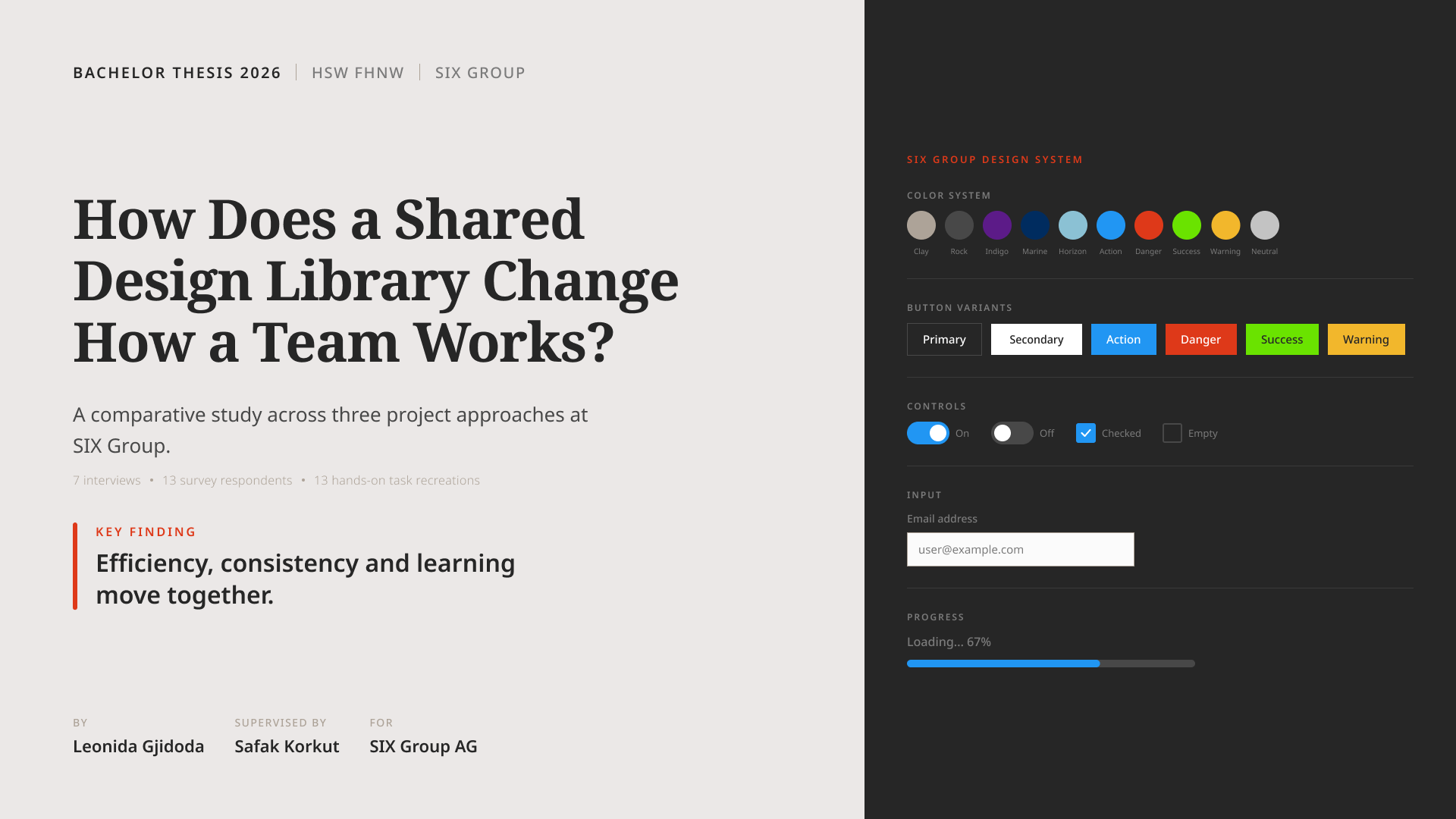
User interfaces at SIX Group have been developed across many projects by external agencies and internal teams, with no shared design resource. The result is fragmented interfaces, repeated design work, and UX knowledge that leaves the organisation with agency contracts or stays with individual practitioners. This thesis asks how projects using a standardised Figma UI component library differ from externally commissioned and internally ad hoc projects in terms of efficiency, interface consistency, and team learning.The study compares three real-world SIX projects.
The study compares three real-world SIX projects: one led by an external agency, one internal project without a shared library, and one internal project using the Figma component library developed for this thesis. Data were collected through seven semi-structured interviews with practitioners across the three projects, a technology acceptance survey with 13 respondents based on the TAM framework (Davis, 1989), seven observational shadowing sessions, and 13 hands-on task recreations. Interview transcripts were analysed using value coding (Saldaña, 2013).
Across all three dimensions, efficiency, consistency, and learning followed the same pattern: highest in the library-supported project, lowest in the ad hoc project. The library-supported project showed reduced rework, clearer designer-developer handoff, and reuse of components rather than recreation. The ad hoc project spent effort on stakeholder alignment without visual references. The agency project maintained consistency while the external designer was engaged and drifted after the engagement ended. Survey respondents rated the library's usefulness at 4.72 out of 5 and its support for visual consistency at 5.00, the only unanimous rating in the survey. All 13 task recreations were immediately recognisable as SIX interfaces. The findings point to a common mechanism: efficiency, consistency, and learning vary together with how firmly design knowledge is externalised into a maintained, shared artefact. Practical recommendations for SIX include assigning explicit library ownership, improving component search and categorisation, investing in onboarding, and involving design from the first planning phase.
Studiengang: Business Information Technology (Bachelor)
Keywords UX Design, Design System, Component Library, Figma, Technology Acceptance Model, Financial Market Infrastructure, Efficiency, Consistency, Design Knowledge Transfer
Vertraulichkeit: vertraulich
Art der Arbeit
Bachelor Thesis
Auftraggebende
SIX Group AG, Zürich
Autorinnen und Autoren
Leonida Gjidoda
Betreuende Dozierende
Safak Korkut
Publikationsjahr
2026
Sprache der Arbeit
Englisch
Vertraulichkeit
vertraulich
Studiengang
Business Information Technology (Bachelor)
Standort Studiengang
Brugg-Windisch
Keywords
UX Design, Design System, Component Library, Figma, Technology Acceptance Model, Financial Market Infrastructure, Efficiency, Consistency, Design Knowledge Transfer