
Process Automation with Artificial Intelligence
Jason Jimenez, 2026
Art der Arbeit Bachelor Thesis
Auftraggebende Bank for International Settlements
Betreuende Dozierende Pragati Siddhanti
Views: 27
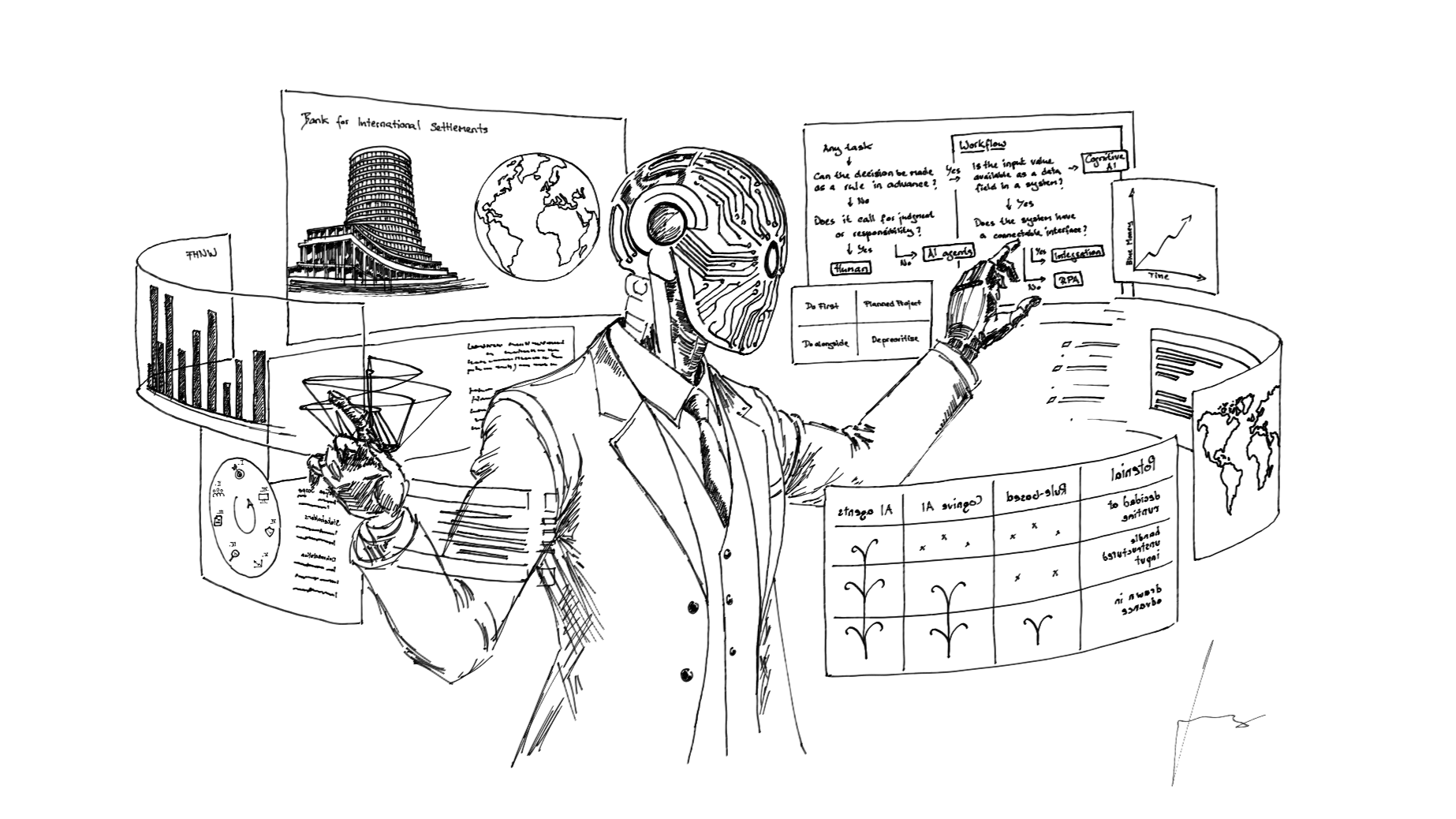
Automation was long a question of technical feasibility. What could be expressed as fixed rules was automated, everything else stayed manual. Artificial intelligence and autonomous agents remove that boundary. Almost anything is now technically possible, and possible is not the same as sensible. For rule-based automation, structured methods for judging which processes are suitable are well established. For AI-based automation, they are not.
A review of the academic literature, market analysis and expert interviews form the basis. The requirements, the method and the framework that puts it into practice are derived from them. In doing so, the thesis answers whether and how organisations should automate their processes with AI.The method reaches a decision in four steps. First understand the process, then streamline it, then judge whether automation is worthwhile, and only then automate.
The tool is the last decision, not the first. Automating a process that is not understood or not streamlined makes it run faster without making it more efficient. Streamlining alone often delivers more than any software could.Whether to automate is decided for the process as a whole. The form of automation is chosen task by task, since a process rarely calls for the same technology throughout. The choice falls on the least autonomous form that still fits the work because greater autonomy comes at the cost of predictability and auditability.What proves decisive is not the capability of the technology but organisational conditions. The quality of the data, the readiness of staff and the commitment of leadership determine whether automation succeeds. The framework supplies the line of reasoning, and each organisation adapts it to itself.The central finding is that research, practice and the vendor market each hold their own conception of how a process should be automated. The framework's real contribution is to reconcile them into a single ordered procedure.
Studiengang: Business Artificial Intelligence (Bachelor)
Keywords Process Automation
Vertraulichkeit: vertraulich
Art der Arbeit
Bachelor Thesis
Auftraggebende
Bank for International Settlements, Basel
Autorinnen und Autoren
Jason Jimenez
Betreuende Dozierende
Pragati Siddhanti
Publikationsjahr
2026
Sprache der Arbeit
Englisch
Vertraulichkeit
vertraulich
Studiengang
Business Artificial Intelligence (Bachelor)
Standort Studiengang
Olten
Keywords
Process Automation