
Long-Term Memory for Large Language Model-Based Agents
Noah Agostinis, 2026
Art der Arbeit Bachelor Thesis
Auftraggebende AI-Future AG
Betreuende Dozierende Erich Studerus
Views: 12
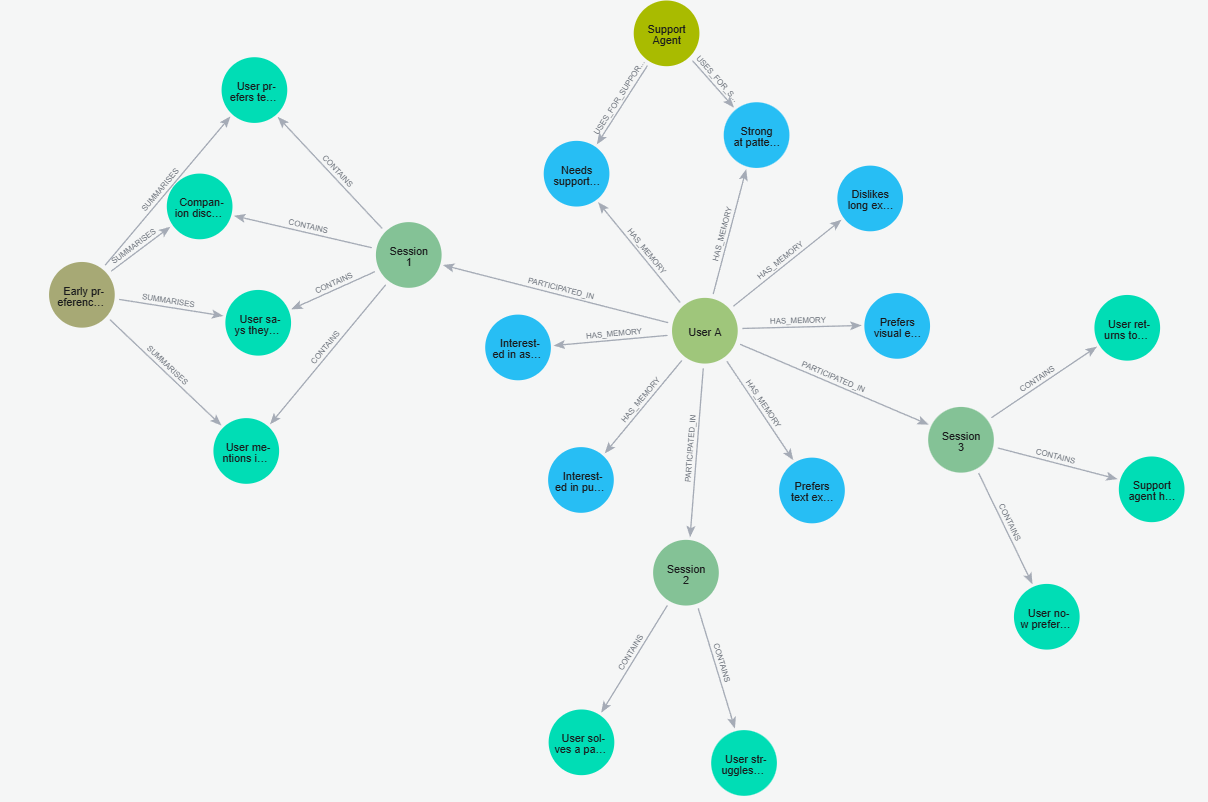
AI-Future AG develops an AI-powered learning game where the AI agents should provide continuous and personalised interactions over time. However, the context window of large language models is limited, which means that they cannot provide reliable long-term memory across past sessions by themselves. This project examined what the game’s long-term memory requirements are and which solution fits best for storing, updating and retrieving the relevant memories according to the current in-game situation, while controlling what information is stored and used.
The project started with an academic literature review on long-term memory for AI agents. Then the memory requirements for the game were derived from the reviewed literature, an analysis of the prototype and stakeholder discussions. These requirements were then used to design a conceptual long-term memory architecture. In the last step, four selected software frameworks for long-term memory, namely Mem0, Graphiti, Zep and Cognee, were implemented and evaluated in a controlled simulation using comparable scenarios for memory writing, retrieval and management.
The study and experiment indicate that a software framework alone is not sufficient to provide reliable long-term memory for the game. Application data whose state is explicitly controlled by the game should remain outside the long-term memory system or only be referenced by it. Long-term information such as player interests or memories related to past conversations should be managed by a dedicated memory system with a software framework at its core. All four evaluated software frameworks provided relevant memory capabilities, but each showed different strengths and limitations. The evaluation showed that the most promising approach combines source preservation, temporal relationships, scoped retrieval and an inspectable graph representation with direct control over stored memories and the graph. However, in addition to the software framework, the memory system needs a memory service that links the framework to the game and adds functionality such as admission rules, filtering, access control, deletion and updating. The project therefore provides AI-Future AG with a promising technology candidate and an architectural foundation for further evaluation and implementation.
Studiengang: Business Information Technology (Bachelor)
Keywords Long-term memory, Large language models, AI agents, Memory frameworks, Knowledge graphs, Personalisation, AI-powered learning game
Vertraulichkeit: vertraulich
Art der Arbeit
Bachelor Thesis
Auftraggebende
AI-Future AG, Basel
Autorinnen und Autoren
Noah Agostinis
Betreuende Dozierende
Erich Studerus
Publikationsjahr
2026
Sprache der Arbeit
Englisch
Vertraulichkeit
vertraulich
Studiengang
Business Information Technology (Bachelor)
Standort Studiengang
Basel
Keywords
Long-term memory, Large language models, AI agents, Memory frameworks, Knowledge graphs, Personalisation, AI-powered learning game