
Knowledge-based design requirements for social robots in addiction therapy
Bader Rahil, 2026
Art der Arbeit Bachelor Thesis
Auftraggebende Fachhochschule Nordwestschweiz FHNW
Betreuende Dozierende Erich Studerus & Stephan Vonschallen
Views: 12
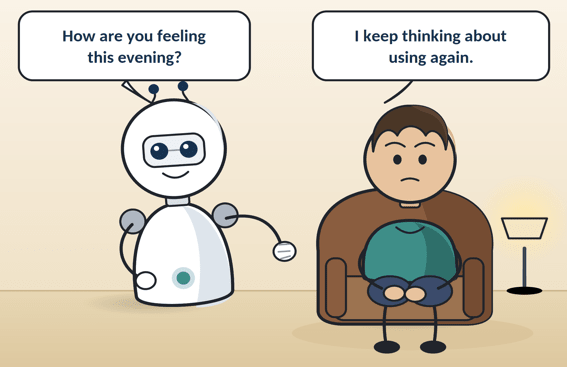
Patients recovering from addiction often lack support between therapy sessions, when cravings, relapse risk or emotional distress can occur. Generative social robots could offer reminders, motivation and coping support at home. But they also carry risks: they may share information inappropriately, give inaccurate advice, encourage dependency or overstep the therapist's role. This thesis asks what such a robot should know about itself, the patient and the therapy context to behave responsibly and effectively, and what behaviour patients and professionals actually expect from it.
Five semi-structured interviews were conducted with one patient and four addiction professionals (a social worker, two psychotherapists and an assistant doctor). Participants were introduced to the use case and shown a short video of the Reachy Mini robot. The interviews covered expected robot behaviour and the self-knowledge, user-knowledge and context-knowledge the robot would need. All interviews were transcribed and analysed with Qualitative Content Analysis in MAXQDA, resulting in 303 coded segments grouped into 17 subcategories.
The findings show the robot should act as a supportive assistant, not a therapist: non-judgemental, patient, empathetic and only as assertive as needed to encourage without pushing. It needs consent-based knowledge of the patient's emotional state, addiction history and personal background to personalise support and context knowledge of the therapy plan, coping strategies and support services to stay grounded in the patient's real situation. It should recognise relapse risk and crisis signs but always escalate serious situations to human professionals rather than intervening alone. Responsible sharing of information requires the patient's explicit consent at every step. For addiction clinics and technology developers, the study offers a practical basis for designing robots that support recovery between sessions at home without replacing therapists, doctors or the patient's own responsibility. It also gives addiction therapy clinics concrete requirements to evaluate before piloting such a robot in a clinical setting and shows where the knowledge-based design approach used in eldercare and education needs to be adapted for a more sensitive healthcare context.
Studiengang: Business Information Technology (Bachelor)
Keywords Knowledge-based design , social robots , Generative AI in addiction therapy
Vertraulichkeit: öffentlich
Art der Arbeit
Bachelor Thesis
Auftraggebende
Fachhochschule Nordwestschweiz FHNW, Peter Merian-Strasse 86, 4002 Basel
Autorinnen und Autoren
Bader Rahil
Betreuende Dozierende
Erich Studerus & Stephan Vonschallen
Publikationsjahr
2026
Sprache der Arbeit
Englisch
Vertraulichkeit
öffentlich
Studiengang
Business Information Technology (Bachelor)
Standort Studiengang
Basel
Keywords
Knowledge-based design , social robots , Generative AI in addiction therapy