
Outbound AI Voice Agents: Private Customer Acceptance in the Swiss Insurance Industry
Andreea Butnarciuc, 2026
Art der Arbeit Bachelor Thesis
Auftraggebende Swiss insurance company
Betreuende Dozierende Nikolina Fuduric
Views: 22
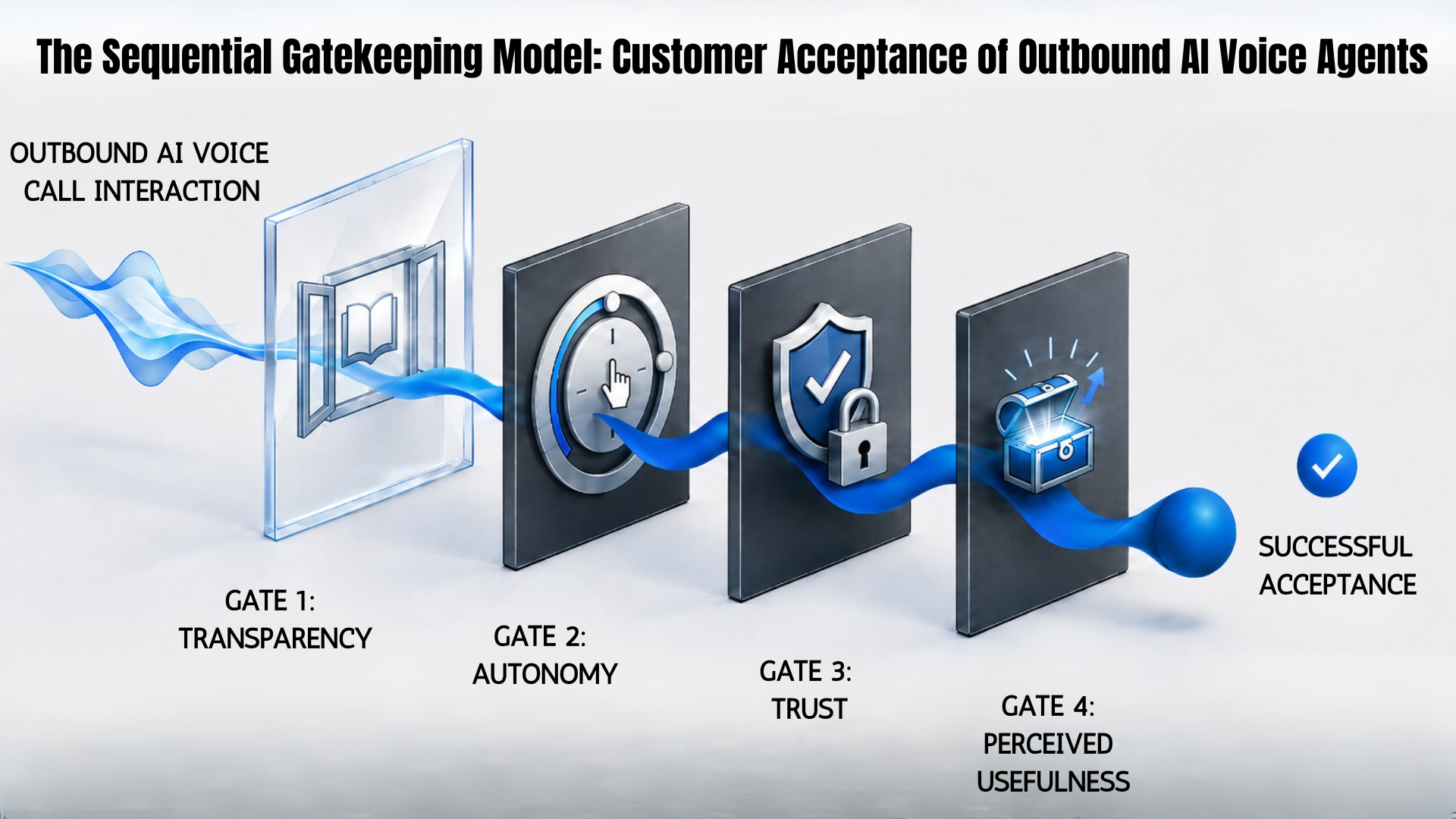
While inbound AI voice agents are increasingly common, insurer-initiated outbound AI voice calls represent a new frontier where the technology approaches customers unprompted. This unrequested contact increases perceived intrusiveness, can trigger psychological reactance, raises fraud concerns since an unsolicited AI call is hard to distinguish from a scam, and challenges customers' preference for human contact. For the insurer, though, the real appeal is not cutting costs or efficiency, but unlocking a new kind of proactive, higher-value service altogether.
The study used a sequential mixed-methods design. A quantitative survey of 241 Swiss insurance customers analysed acceptance factors by adapting and extending the Unified Theory of Acceptance and Use of Technology 2 (UTAUT2) with constructs for trust, transparency, and reactance. These findings were then set against four semi-structured expert interviews covering strategic, technical, customer service, and external perspectives, comparing the insurer's readiness against what customers are actually willing to accept.
The findings show that customers care more about transparency, control, and trust than usefulness. Nine in ten customers demand immediate self-disclosure, and most value the ability to reach a human or end the call more than the call's usefulness. Customers are split on trust, so any rollout should start small, with an opt-in group, not the full customer base. Only a handful of use cases are seen as acceptable at all, such as appointment confirmations, claim payment notifications, and hazard warnings. Sales-oriented or emotionally sensitive calls are clearly rejected. This research equips the insurer with three concrete tools. The Sequential Gatekeeping Model explains exactly what has to be true before customers accept an AI call. A ranked list shows which use cases customers actually find acceptable today. An evidence-based recommendation advises against implementing outbound AI voice agents at this time. Together, these give the insurer a clear basis for judging when this channel might become viable and which conditions still need to be met.
Studiengang: Business Administration International Management (Bachelor)
Keywords outbound AI voice agents; customer acceptance; insurance; UTAUT2; transparency; trust; psychological reactance;
Vertraulichkeit: vertraulich
Art der Arbeit
Bachelor Thesis
Auftraggebende
Swiss insurance company
Autorinnen und Autoren
Andreea Butnarciuc
Betreuende Dozierende
Nikolina Fuduric
Publikationsjahr
2026
Sprache der Arbeit
Englisch
Vertraulichkeit
vertraulich
Studiengang
Business Administration International Management (Bachelor)
Standort Studiengang
Olten
Keywords
outbound AI voice agents; customer acceptance; insurance; UTAUT2; transparency; trust; psychological reactance;