
Smart Eyes: Building an AI visual assistant for real-world technical inspections
Teodor Glisic, 2026
Art der Arbeit Bachelor Thesis
Auftraggebende Swiss Safety Center AG
Betreuende Dozierende Yannick Raphael Suter
Views: 53
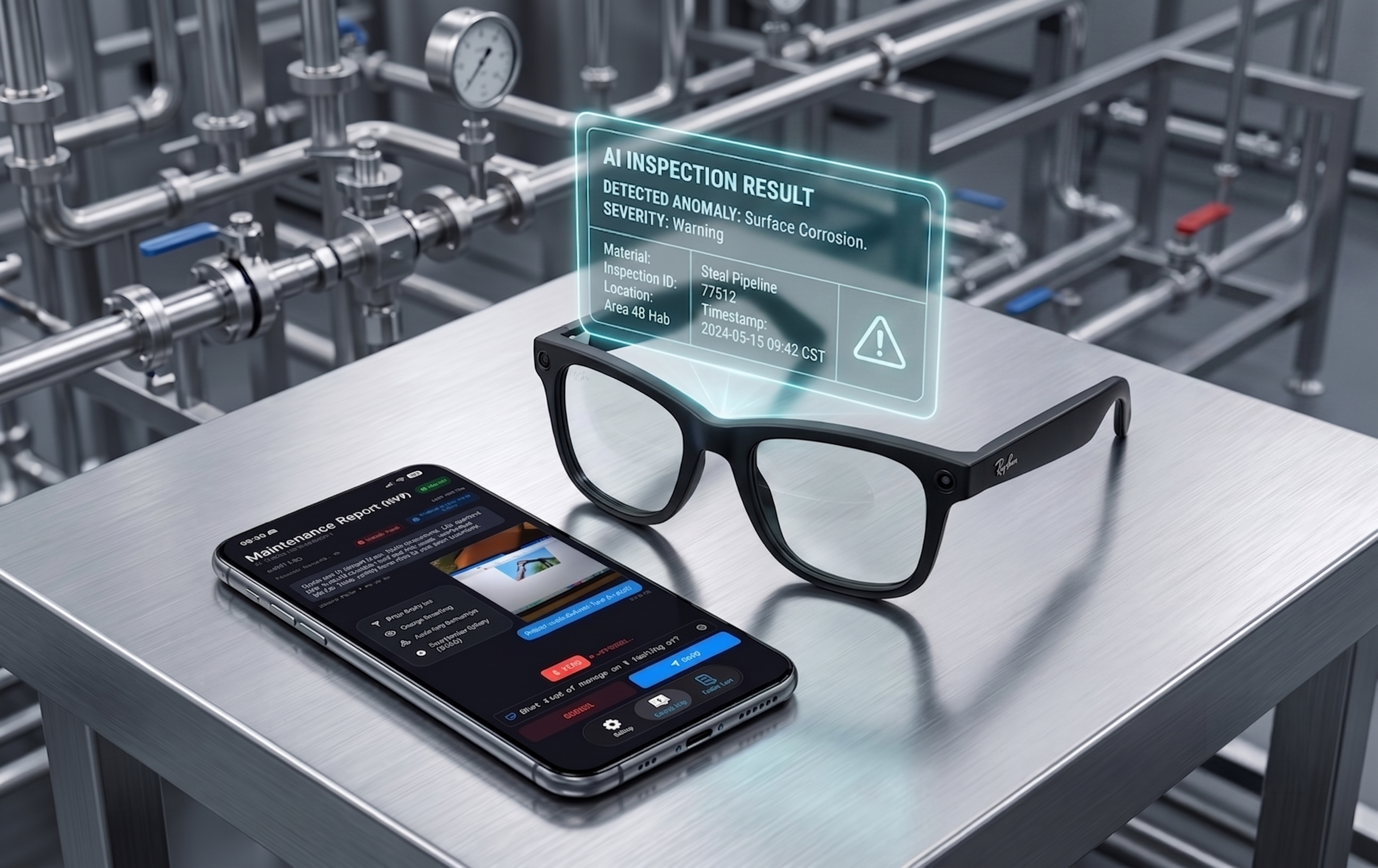
Visual inspection is the fundamental first step in assessing industrial assets, yet it relies almost entirely on the human eye without real-time technological support. While human perception is powerful, it is susceptible to fatigue, distraction, and subjectivity, risking overlooked defects. Camera-equipped smart glasses paired with AI promise a hands-free solution. However, the practical viability of using consumer-grade hardware and generic vision models in strict, safety-critical industrial environments was unknown before this study.
Four wearable platforms were compared in a weighted analysis and the Ray-Ban Meta Wayfarer Gen 2 chosen. A custom iOS integration was then built on Meta's Device Access Toolkit and Google's Gemini vision models. A testing prototype app first measured performance, latency, and cost across everyday objects, industrial components, and degraded conditions, compared against the native software. Building on this, an MVP concept application demonstrated real-world use cases such as voice dictation, specialised inspection modes like gauge reading, and active web grounding for contextual answers.
The study shows a technology that is promising but not yet dependable. Under favourable conditions it handles simpler recognition tasks, but reliability falls away on precise readings like analogue gauges and in the uncontrolled conditions of real fieldwork. The weaknesses are structural: poor lighting, cloud dependence, a camera resolution capped below the sensor, and a model that states wrong answers with full confidence. It is therefore not yet ready for unsupervised, safety-critical deployment. Instead it is a proof of value: a supervised assistant for hands-free dictation, structured documentation, and web-grounded safety checks. For Swiss Safety Center AG, the benefit is clarity: an honest picture of where AI vision can and cannot be trusted today, guarding against premature investment. A production system would need open, full-resolution hardware and a locally hosted, domain-specific model, ideally trained or grounded via RAG on the client's inspection data, to keep data sovereign and confidential. The inspector stays at the centre: these glasses are support tools that extend judgement, not replace it, leaving the inspector solely responsible and accountable for the outcome.
Studiengang: Wirtschaftsinformatik (Bachelor)
Keywords AI smart glasses, wearable AI, multimodal vision models, technical inspection, computer vision, feasibility study, human-in-the-loop, automation bias, data sovereignty, industrial safety
Vertraulichkeit: öffentlich
Art der Arbeit
Bachelor Thesis
Auftraggebende
Swiss Safety Center AG, Wallisellen
Autorinnen und Autoren
Teodor Glisic
Betreuende Dozierende
Yannick Raphael Suter
Publikationsjahr
2026
Sprache der Arbeit
Englisch
Vertraulichkeit
öffentlich
Studiengang
Wirtschaftsinformatik (Bachelor)
Standort Studiengang
Olten
Keywords
AI smart glasses, wearable AI, multimodal vision models, technical inspection, computer vision, feasibility study, human-in-the-loop, automation bias, data sovereignty, industrial safety