
Boosting Participation in a Student Survey
Samira Xandra Abt & Jennifer Kohler, 2026
Art der Arbeit Bachelor Thesis
Auftraggebende FHNW University of Applied Sciences and Arts Northwestern Switzerland
Betreuende Dozierende Susan Göldi
Views: 22
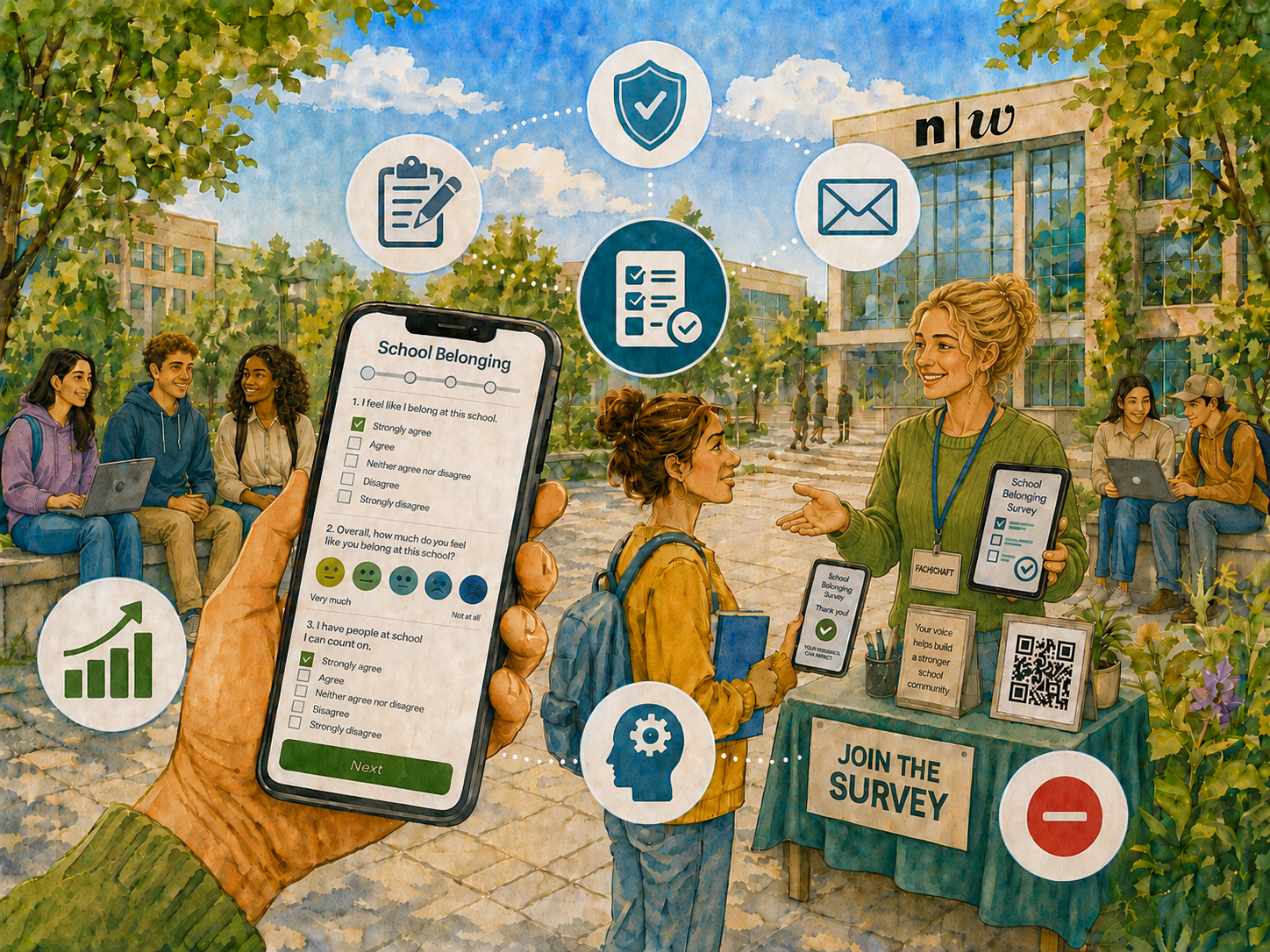
The FHNW School Belonging Survey was developed to generate reliable insights into students’ sense of belonging. However, limited participation in the pilot yielded a small dataset and raised uncertainty about whether the target population's diversity was adequately represented. Therefore, this thesis asks: Why do students decide to participate or not, and how can design, communication, and distribution be improved for future roll-outs?
The study followed an exploratory qualitative design centred on the student perspective. 29 students participated in semi-structured interviews across three scenarios: previous survey participants, non-participants, and students completing the questionnaire in a think-aloud setting. The material was analysed using a qualitative content analysis with a self-developed seven-sphere framework. Survey non-response formed the central sphere, complemented by six interrelated spheres. Additional students were recruited to expand the existing survey dataset.
The findings show that survey participation results from the interaction of relevance, expected impact, effort, distribution, trust, and questionnaire design. Expected impact was more influential than incentives. Students were more willing to participate when the survey’s purpose, use of results, and value of their contribution were clear. Timing, reminders, and personal contact also affected participation. Institutional trust reduced concerns about data handling but did not independently motivate participation. During completion, unclear or repetitive questions, sensitive content, and insufficient information on progress increased respondent burden. For FHNW’s future roll-out, the questionnaire should be shortened by removing repetitive questions and introducing clearly labelled sections. Unclear or sensitive items require further clarification. The expected completion time, purpose, and use of results should be communicated transparently, while incentives remain secondary. Invitations and reminders should be carefully timed and tested before wider implementation. After completion of the project, FHNW should communicate the survey’s impact and final outputs.
Studiengang: Business Administration International Management (Bachelor)
Keywords School Belonging, Survey, Survey Design, Non-Response, Response Rate, Survey Fatigue
Vertraulichkeit: öffentlich
Art der Arbeit
Bachelor Thesis
Auftraggebende
FHNW University of Applied Sciences and Arts Northwestern Switzerland, Olten
Autorinnen und Autoren
Samira Xandra Abt & Jennifer Kohler
Betreuende Dozierende
Susan Göldi
Publikationsjahr
2026
Sprache der Arbeit
Englisch
Vertraulichkeit
öffentlich
Studiengang
Business Administration International Management (Bachelor)
Standort Studiengang
Olten
Keywords
School Belonging, Survey, Survey Design, Non-Response, Response Rate, Survey Fatigue