
Enhancing Employer Branding and Talent Acquisition for Fintechs in Germany – A Data-Driven Strategy leveraging Recruiting Analytics for iwoca
Sarah Huynh & Jiaqi Huang, 2026
Art der Arbeit Bachelor Thesis
Auftraggebende iwoca Deutschland GmbH
Betreuende Dozierende Susanne Dornemann
Views: 25
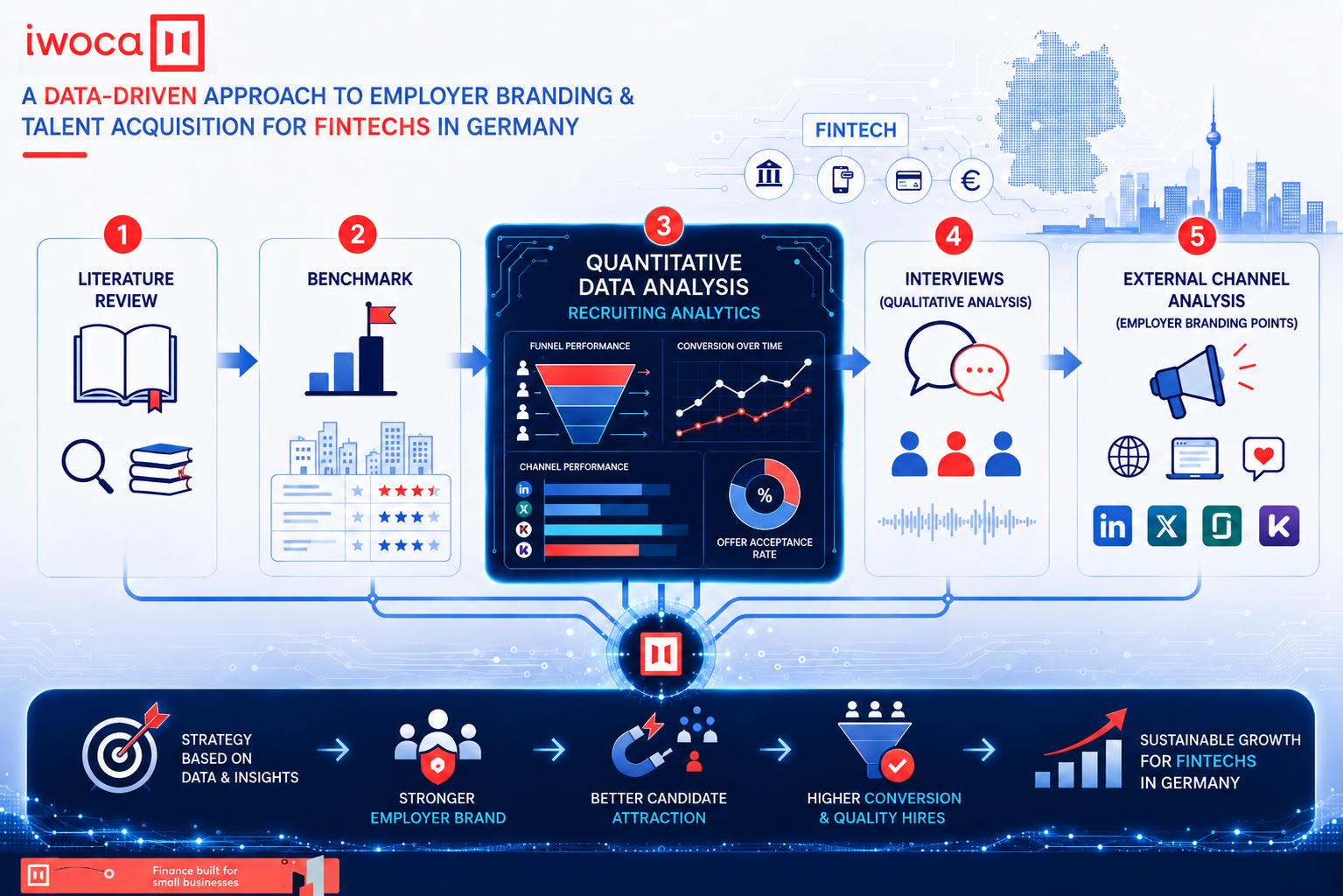
The German fintech labour market is characterised by intense competition for qualified professionals amid a broader war for talent driven by demographic change. As a UK-based company still relatively unknown in Germany, iwoca receives insufficient organic applications for its growth and relies heavily on a narrow set of channels. It lacks actionable insight into where candidates disengage, which channels perform best locally, and how its employer brand is perceived relative to competitors. Low brand awareness, candidate risk aversion, and volume-quality mismatches compound the bottlenecks.
The thesis follows a mixed-methods design. A quantitative analysis of iwoca's funnel data identifies conversion and drop-off rates across role types and seasons, while evaluating channel effectiveness. This is complemented by semi-structured interviews with HR/brand managers and employees, analysed using thematic coding. A review of external employer branding touchpoints, a competitor benchmark, and a comparison with the literature on employer branding, candidate decision-making, the German market, fintech, and recruiting analytics complete the approach.
Quantitatively, the data analysis reveals a critical bottleneck at an early recruitment stage and a marked volume-quality mismatch across channels: some channels generate substantial volume but convert only a small share into hires, while certain lower-volume channels convert disproportionately well. However, the offer acceptance rate is very high, confirming a compelling EVP once candidates reach the final stage.Qualitatively, the interviews reveal genuine internal strengths related to culture and working environment, but not yet fully reflected externally. This issue is compounded by low brand awareness and candidate risk aversion in Germany. Moreover, no consolidated, externally communicable employer value proposition (EVP) exists for the German market, and messaging remains generic relative to competitors. Finally, compensation communication is a content gap, not a presentation issue.The thesis develops a refined EVP, a prioritised channel and communication strategy, and a 12-month roadmap with milestones and success indicators (KPIs), giving HR/branding teams an actionable foundation for enhancing candidate attraction and conversion.
Studiengang: Business Administration International Management (Bachelor)
Keywords Fintech, Recruiting Analytics, Employer Branding, Employer Value Proposition (EVP), Talent Acquisition, German labour market
Vertraulichkeit: vertraulich
Art der Arbeit
Bachelor Thesis
Auftraggebende
iwoca Deutschland GmbH, Frankfurt am Main
Autorinnen und Autoren
Sarah Huynh & Jiaqi Huang
Betreuende Dozierende
Susanne Dornemann
Publikationsjahr
2026
Sprache der Arbeit
Englisch
Vertraulichkeit
vertraulich
Studiengang
Business Administration International Management (Bachelor)
Standort Studiengang
Brugg-Windisch
Keywords
Fintech, Recruiting Analytics, Employer Branding, Employer Value Proposition (EVP), Talent Acquisition, German labour market