
WhereIsIt: An Object Reminder Assistant for Blind and Visually Impaired People
Damian Huckele, 2026
Art der Arbeit Bachelor Thesis
Auftraggebende Fachhochschule Nordwestschweiz
Betreuende Dozierende Oliver Bendel
Views: 46 - Downloads: 0
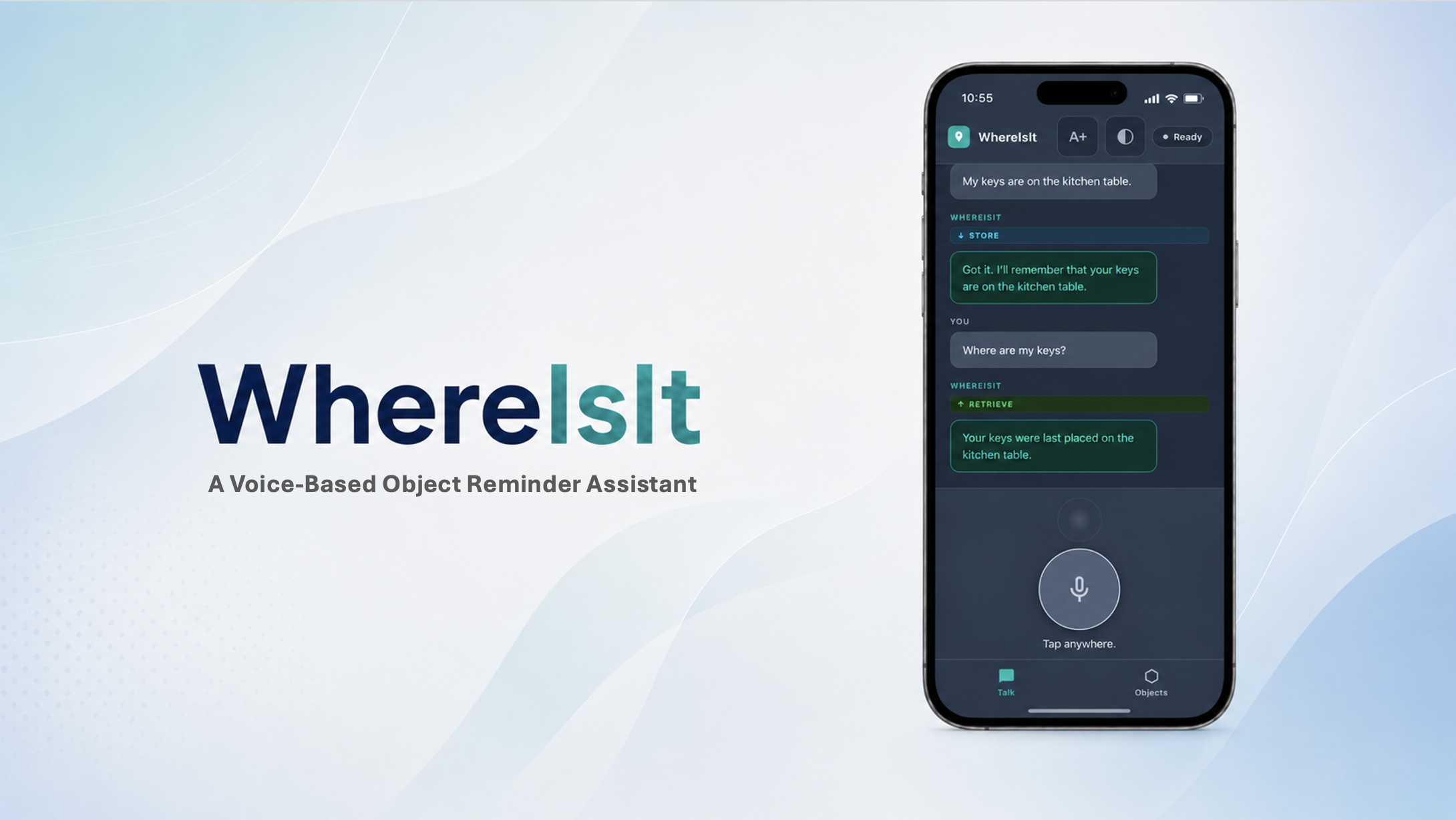
Blind and severely visually impaired people often rely on routines and memory to locate everyday objects. When keys, medication, documents or assistive devices are misplaced, searching can cause stress, time loss and increased dependence on others. Existing assistive technologies mainly support navigation, immediate object recognition or physical localisation and may require cameras, cloud services, specialised hardware or attached tags. Lightweight systems that store and retrieve object-location information over time remain underexplored.
The thesis combined a literature review, requirements engineering and input from a blind accessibility expert. The findings were translated into functional and non-functional requirements for accessibility, usability, privacy and reliability. Based on these requirements, a modular prototype was implemented using local speech recognition, language processing, SQLite storage and speech synthesis. The system was evaluated with 12 participants across 16 task-based scenarios.
The evaluation confirmed the technical feasibility of WhereIsIt. Most test cases were completed successfully, with basic recording, storage, retrieval and error-handling tasks performing particularly well. More complex operations and fully non-visual use were less reliable, highlighting the need for clearer feedback, confirmation and error recovery. Overall, the prototype demonstrates the potential of a lightweight, privacy-conscious and locally operated assistive system, although further testing with blind users is required.
Studiengang: Wirtschaftsinformatik (Bachelor)
Keywords Assistive Technology, Inclusive AI, Voice Interaction, Object-Location Memory, Speech Recognition, Natural Language Processing (NLP), Text-to-Speech (TTS), Accessibility, Privacy, AI, Speech-to-Text (STT), Large Language Model (LLM)
Vertraulichkeit: öffentlich
Art der Arbeit
Bachelor Thesis
Auftraggebende
Fachhochschule Nordwestschweiz, Windisch
Autorinnen und Autoren
Damian Huckele
Betreuende Dozierende
Oliver Bendel
Publikationsjahr
2026
Sprache der Arbeit
Englisch
Vertraulichkeit
öffentlich
Studiengang
Wirtschaftsinformatik (Bachelor)
Standort Studiengang
Olten
Keywords
Assistive Technology, Inclusive AI, Voice Interaction, Object-Location Memory, Speech Recognition, Natural Language Processing (NLP), Text-to-Speech (TTS), Accessibility, Privacy, AI, Speech-to-Text (STT), Large Language Model (LLM)