
Modelling Airline Investment in Sustainable Fuels
Pascal Wyss, 2025
Art der Arbeit Master Thesis
Auftraggebende
Betreuende Dozierende Manuel Renold
Views: 15 - Downloads: 9
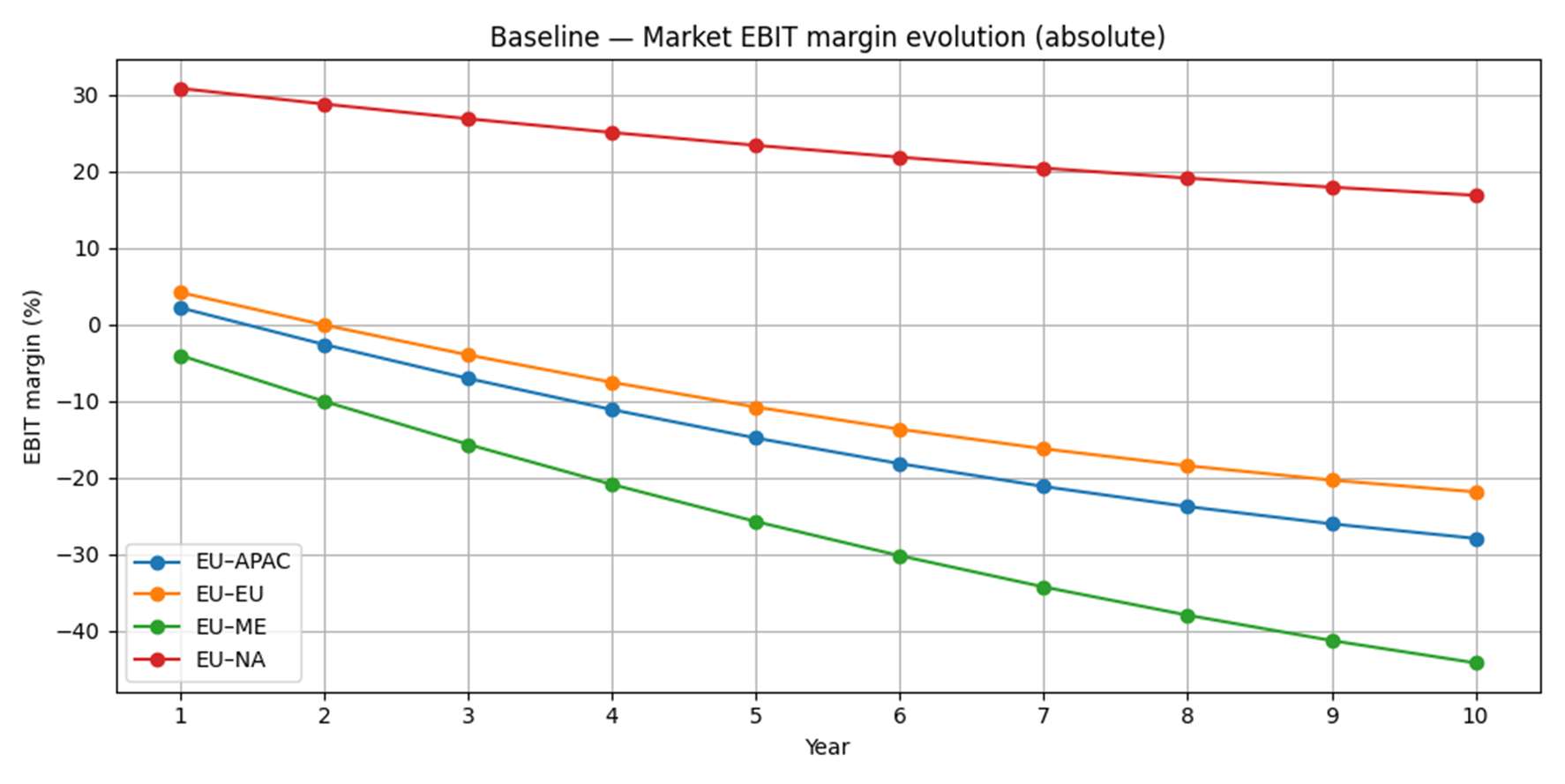
This thesis develops a scenario-based Decision Support System (DSS) to assess the economic implications of SAF adoption for a representative European carrier. The model integrates operational flight activity, region-specific SAF mandates, blended fuel price trajectories, efficiency improvements, and airline financial accounting within a transparent simulation. Passenger demand and fares are treated exogenously, positioning the model as a feasibility tool rather than a predictive demand model.
This thesis develops a scenario-based Decision Support System (DSS) to assess the economic implications of SAF adoption for a representative European carrier. The model integrates operational flight activity, region-specific SAF mandates, blended fuel price trajectories, efficiency improvements, and airline financial accounting within a transparent simulation. Passenger demand and fares are treated exogenously, positioning the model as a feasibility tool rather than a predictive demand model.A scenario ladder is then applied, including a baseline without efficiency investments, scenarios with continuous fleet-efficiency improvements and stress scenarios featuring adverse fossil fuel price developments. Additional scenarios quantify the efficiency improvements and fare levels required to sustain a predefined profitability benchmark under increasing SAF-related cost pressures.
The results indicate that mandatory SAF adoption, in the absence of efficiency investments, leads to a persistent increase in fuel costs and declining profitability. Fleetefficiency investments reduce fuel consumption and partially mitigate these effects, with their economic value increasing under high fuel price conditions. The DSS provides transparent investment and pricing thresholds that support strategic decision-making under SAF-related uncertainty.
Studiengang: Business Information Systems (Master)
Keywords
Vertraulichkeit: öffentlich
Art der Arbeit
Master Thesis
Autorinnen und Autoren
Pascal Wyss
Betreuende Dozierende
Manuel Renold
Publikationsjahr
2025
Sprache der Arbeit
Englisch
Vertraulichkeit
öffentlich
Studiengang
Business Information Systems (Master)
Standort Studiengang
Olten