
Using business information systems for digital marketing in SMEs
Rrezarta Maksutaj, 2025
Art der Arbeit Master Thesis
Auftraggebende
Betreuende Dozierende Johan Paul Lindeque
Views: 14 - Downloads: 13
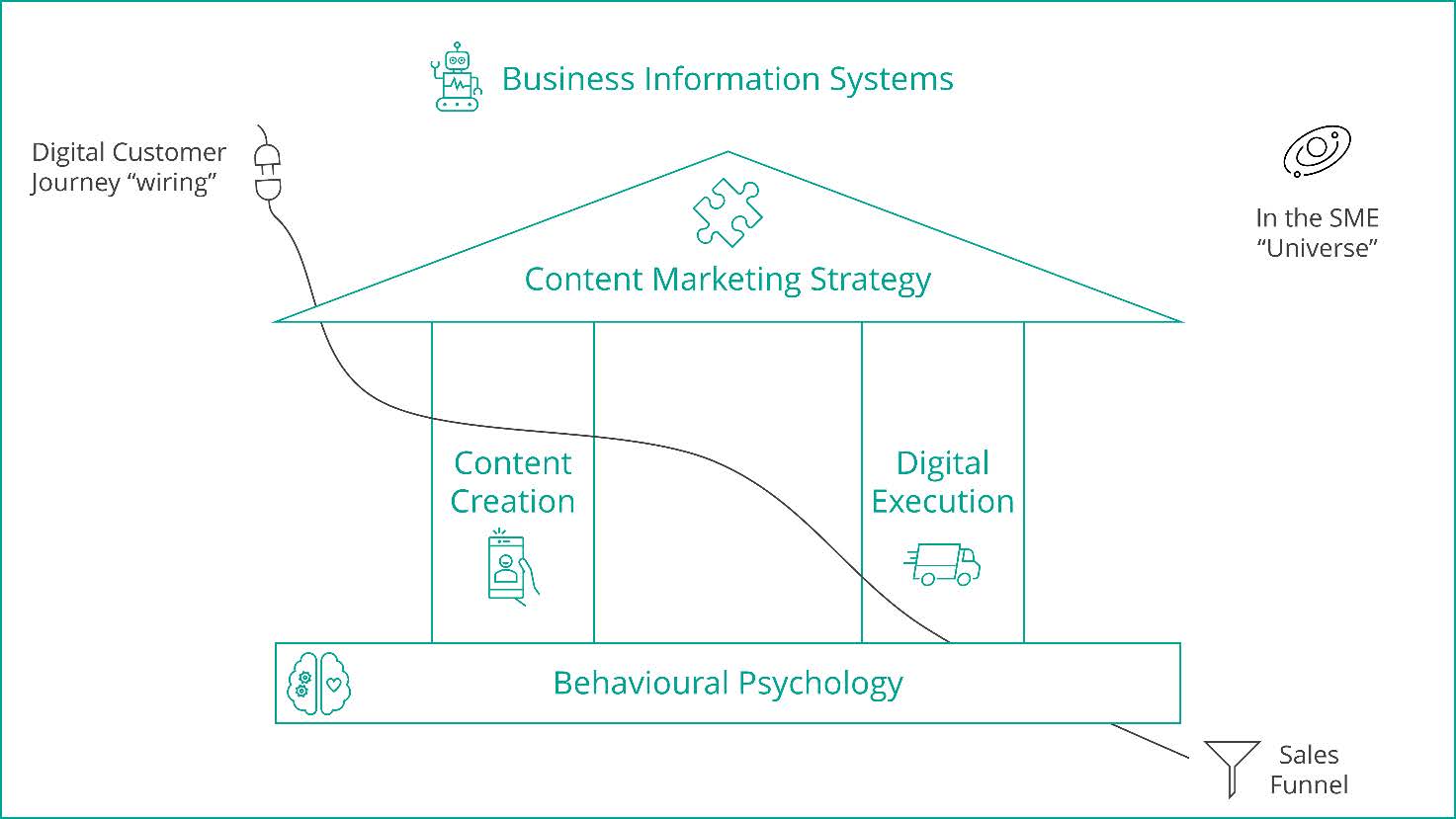
Digital marketing has become essential for small and medium-sized enterprises (SMEs), yet micro-consultancies often struggle to implement effective digital strategies due to limited time, financial resources, and marketing expertise. At the same time, consumer behaviour in digital environments is increasingly influenced by subconscious and behavioural factors rather than purely rational decision-making. This master’s thesis addresses this challenge by examining how business information systems can support behaviourally informed content marketing and digital visibility optimisation in micro-consultancies.
The objective of this study was to explore how business information systems can be leveraged to structure content marketing activities and improve digital visibility, with the aim of supporting customer acquisition. The research followed a design science research approach and combined an interdisciplinary literature review with empirical insights from an expert interview, a survey of marketing agencies, and a field test conducted with a micro-consultancy in the DACH region.The literature review confirmed that behavioural psychology plays a key role in digital consumer behaviour and that structured, funnel-oriented content strategies are essential for visibility and engagement. Business information systems were identified as critical enablers that allow SMEs to operationalise these insights in a scalable and resource-efficient manner. Based on these findings, a practical artefact was developed that integrates behavioural principles into content planning, creation, and execution, supported by readily available digital tools.
The artefact was evaluated through a field test with a micro-consultancy. The results show that the framework improved execution capability, content consistency, and strategic clarity, enabling structured multi-channel content publishing despite limited resources. Business information systems were particularly effective in supporting scheduling, coordination, and operational efficiency. Behavioural principles were applied selectively and contributed to clearer audience orientation.However, no direct customer acquisition outcomes, such as conversions, were observed during the short evaluation period. As a result, the assumed impact on customer acquisition could not be empirically confirmed. Instead, the findings indicate that the artefact strengthens key preconditions for customer acquisition, including digital visibility, execution discipline, and content coherence.In conclusion, this study demonstrates that business information systems can effectively support behaviourally informed content marketing in micro-consultancies, even if customer acquisition effects are not immediately measurable. The research provides a realistic, practice-oriented contribution by translating interdisciplinary theory into an applicable framework, while clearly defining its empirical limits and directions for future research.
Studiengang: Business Information Systems (Master)
Keywords
Vertraulichkeit: öffentlich
Art der Arbeit
Master Thesis
Autorinnen und Autoren
Rrezarta Maksutaj
Betreuende Dozierende
Johan Paul Lindeque
Publikationsjahr
2025
Sprache der Arbeit
Englisch
Vertraulichkeit
öffentlich
Studiengang
Business Information Systems (Master)
Standort Studiengang
Olten