
GraphRAG-Enhanced Digital Twin of Organization: A Design Science Approach for Leadership Decision Support in Organizational AI Adoption
Siro Bühlmann, 2025
Art der Arbeit Master Thesis
Auftraggebende
Betreuende Dozierende Emanuele Laurenzi
Views: 21 - Downloads: 39
This thesis addresses this challenge through the Design Science Research methodology, developing a GraphRAGenhanced Digital Twin of the Organization that delivers contextualized, stakeholder aware recommendations for leadership navigating AI transformation. Through a systematic literature review and expert interviews with seven organizational leaders, this study identifies critical decision-making needs: stakeholder-specific communication strategies, capability assessment across organizational units, risk evaluation balancing technical and human factors, and implementation planning accommodating distributed readiness levels.
The conceptual contribution establishes a three-layer knowledge representation Architecture that separates organizational facts, domain knowledge, and contextual information, realized through ArchiMEO ontology extensions for digital leadership, AI capabilities, and digital twin concepts. The architectural implementation integrates SPARQL-based graph retrieval with GPT-4 generation, demonstrating that structured knowledge Graphs can enhance large language model outputs beyond vector-based retrieval approaches. The functional prototype validates the approach through a synthetic medical device company scenario modeling customer service chatbot adoption.
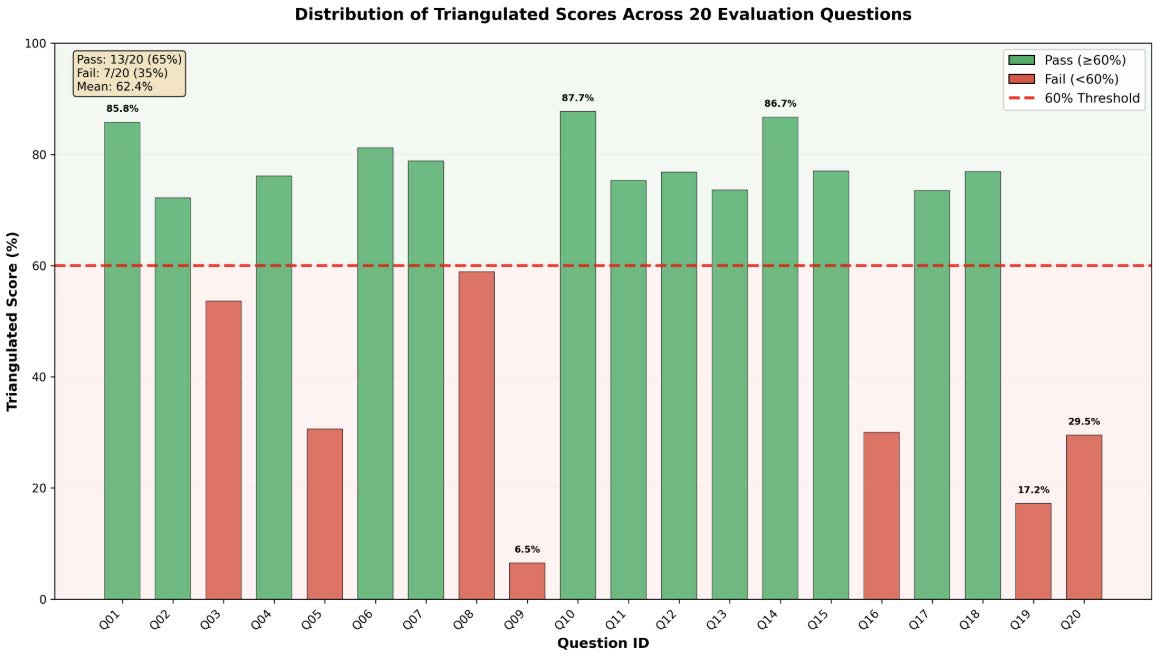
The evaluation achieved a 62.4% triangulated score through multi-method assessment across 20 leadership questions, exceeding the predetermined 60% proof-of-concept threshold. Strong performance in multi-stakeholder awareness (90.0%) and practical utility (82.0%) validates that the knowledge graph-based organizational representation successfully addresses distributed stakeholder perspectives. However, inconsistent entity Grounding (51.0%) and systematic content depth limitations (46.2%) reveal that technical capabilities require enhancement before operational deployment.This study demonstrates that GraphRAG-enhanced Digital Twins of Organization can deliver nuanced leadership support by acknowledging organizational complexity. The proof-of-concept validation establishes both promise and limitations, with identified improvement priorities representing tractable engineering challenges rather than fundamental conceptual barriers to be overcome. Knowledge graph-based organizational representation offers advantages in explicit relationship modeling and architectural flexibility, while integration with large language model generation yields natural language synthesis, transforming structured data into narrative decision support.
Studiengang: Business Information Systems (Master)
Keywords
Vertraulichkeit: öffentlich
Art der Arbeit
Master Thesis
Autorinnen und Autoren
Siro Bühlmann
Betreuende Dozierende
Emanuele Laurenzi
Publikationsjahr
2025
Sprache der Arbeit
Englisch
Vertraulichkeit
öffentlich
Studiengang
Business Information Systems (Master)
Standort Studiengang
Olten