
Ethnomarketing: Communication on Recycling in Switzerland for People Who Do Not Speak a National Language
Hawa Al Raedh & Steffiya Pushpanathan, 2026
Art der Arbeit Bachelor Thesis
Auftraggebende Swiss Recycle
Betreuende Dozierende Mark Moser
Views: 40
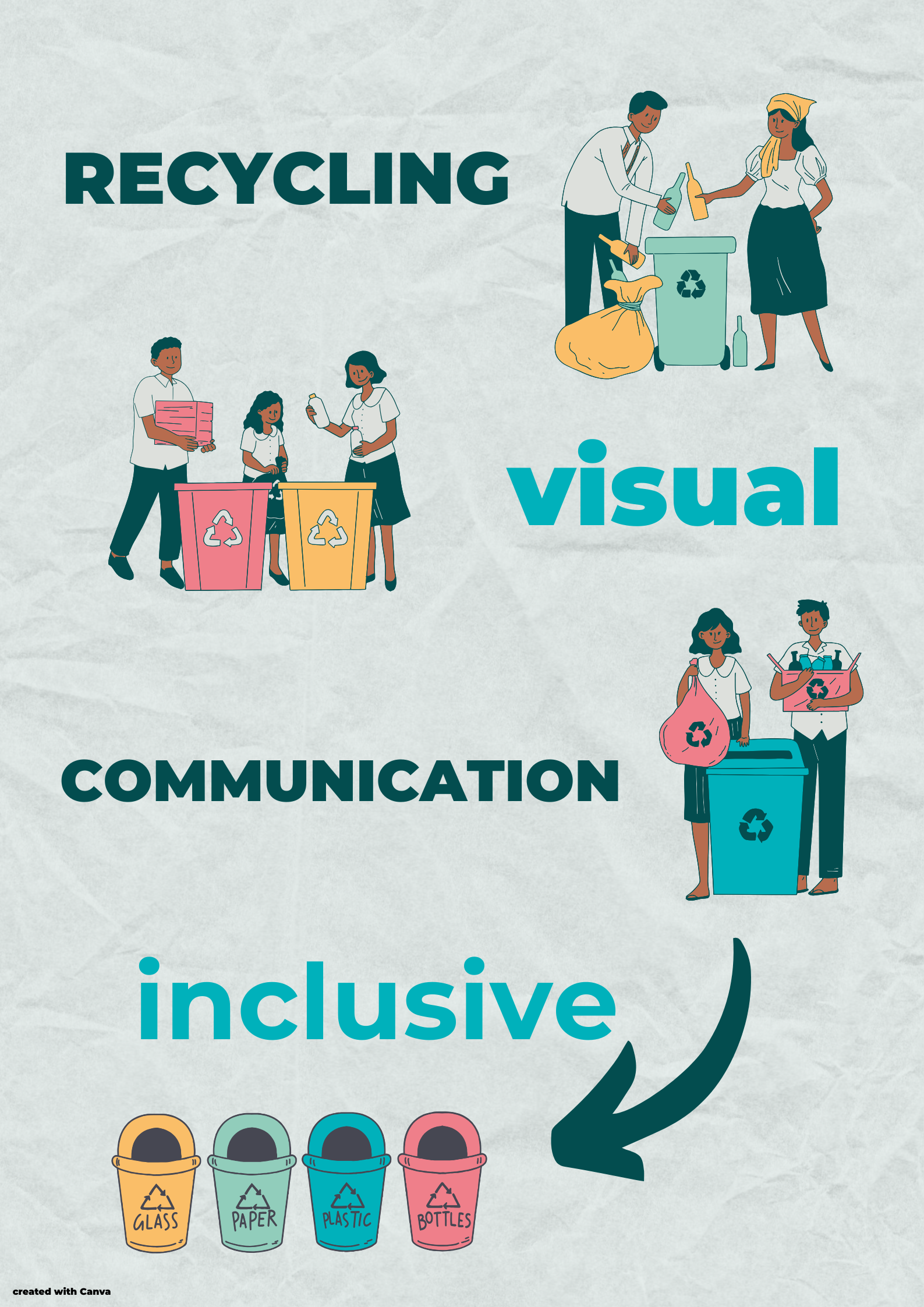
Switzerland's recycling system is organised through a decentralized municipal structure. While effective for long-term residents, this creates challenges for newcomers due to differing local rules and disposal practices. Recycling information is text-heavy and provided mostly only in the national languages. International residents therefore struggle to access and apply the information, particularly after arrival. Although municipalities and Swiss Recycle consider their materials clear, resident experiences reveal language barriers, fragmented information and limited visual guidance.
The thesis follows a qualitative and exploratory research design. Data was collected through surveys and interviews with international residents, interviews with immigrants, a survey of municipalities and a questionnaire with Swiss Recycle. The findings were analysed using acculturation theory, ethnomarketing and behavioural communication approaches, allowing user experiences and institutional constraints to be systematically compared.
The findings show that international residents are generally motivated to recycle but lack clear, consistent and understandable information, especially during their first months in Switzerland. Many rely on informal learning through neighbours and trial-and-error. At the same time, municipalities and Swiss Recycle face budgetary and personnel constraints that limit targeted communication efforts. Swiss Recycle nevertheless recognises the need for a more inclusive approach.
Based on these insights, the thesis develops a communication plan centred on visual aids and a language-independent strategy. Core elements include standardised pictograms for waste categories, visual instructions, short videos and onboarding materials for municipalities. The concept is scalable, cost-efficient and compatible with existing channels from Swiss Recycle. Implementation follows four phases: development of visual standards, roll-out to municipalities, integration into onboarding processes for newcomers and continuous evaluation. The concept strengthens inclusion, improves recycling behaviour and reinforces Swiss Recycle’s role as a national coordination organisation.
Studiengang: Business Administration International Management (Bachelor)
Keywords Recycling communication, language-independent, ethnomarketing
Vertraulichkeit: vertraulich
Art der Arbeit
Bachelor Thesis
Auftraggebende
Swiss Recycle, Zürich
Autorinnen und Autoren
Hawa Al Raedh & Steffiya Pushpanathan
Betreuende Dozierende
Mark Moser
Publikationsjahr
2026
Sprache der Arbeit
Englisch
Vertraulichkeit
vertraulich
Studiengang
Business Administration International Management (Bachelor)
Standort Studiengang
Brugg-Windisch
Keywords
Recycling communication, language-independent, ethnomarketing