
Assessment of the Indian Alloy Wheel Market
Edris Sediq, 2026
Art der Arbeit Bachelor Thesis
Auftraggebende
Betreuende Dozierende Pieter Jan Perrett
Views: 154 - Downloads: 61
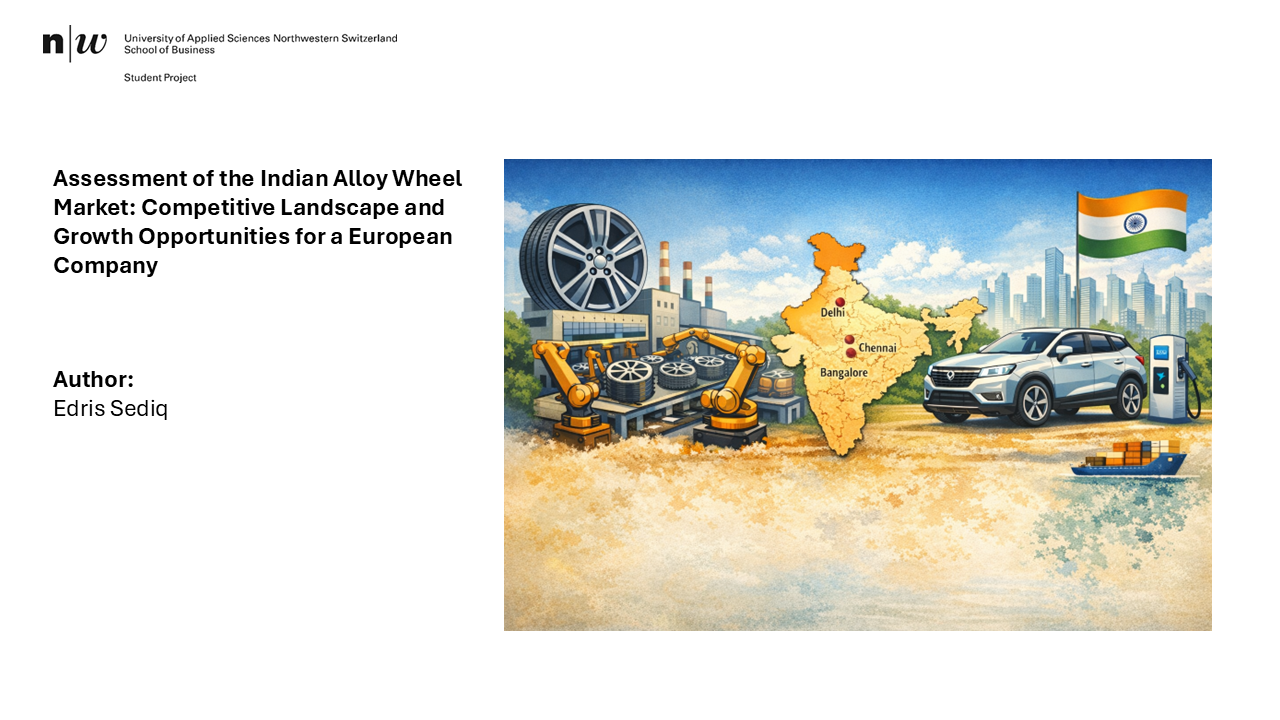
India is now the fourth-largest automotive market worldwide. Passenger vehicle production is rising, SUVs are gaining popularity, and alloy wheels are replacing steel wheels in many models. At the same time, the market is highly price-driven and dominated by strong local suppliers. Electrification and stricter efficiency standards are accelerating change, while OEMs demand local sourcing and competitive costs. India’s growing middle class supports long-term demand. The key question is whether this growth can lead to sustainable success under local conditions.
To answer this question, the study combines theory and practice. Market attractiveness theory and the PESTEL framework were used to analyse economic, political and competitive conditions. In addition, entry mode theory helped compare different market entry options. Secondary data from industry reports and internal documents were combined with expert interviews from consultants and automotive purchasing professionals in India.
The analysis shows that the Indian alloy wheel market offers strong long-term potential. Demand is expected to grow significantly, especially due to SUVs and electrification. While the market is currently characterised by price pressure and strong local competition, projections indicate that today’s overcapacity could turn into a supply shortage by 2031. This would improve the overall market attractiveness. However, entry barriers remain high. A small number of OEMs control most of the market and act as powerful gatekeepers. Success therefore depends on strong local relationships, cost competitiveness, and long-term commitment.
When comparing entry modes, both joint ventures and greenfield investments show clear advantages and risks. A joint venture can enable faster access but creates dependency. A greenfield investment allows full control but requires significant resources and local expertise.
Overall, India is an attractive but demanding market. Sustainable success will not come from simply transferring a European business model, but from adapting to local cost structures, market dynamics and relationship-driven business culture.
Studiengang: Betriebsökonomie (Bachelor)
Keywords Indian Market Access, Entry Strategy, Market Analysis
Vertraulichkeit: öffentlich
Art der Arbeit
Bachelor Thesis
Autorinnen und Autoren
Edris Sediq
Betreuende Dozierende
Pieter Jan Perrett
Publikationsjahr
2026
Sprache der Arbeit
Englisch
Vertraulichkeit
öffentlich
Studiengang
Betriebsökonomie (Bachelor)
Standort Studiengang
Brugg-Windisch
Keywords
Indian Market Access, Entry Strategy, Market Analysis