
Identification of Optimal Batch Blending
Burak Dögen & Dejan Gajic & Leon Vukoja & Bader Rahil & Malek El Darsi, 2025
Art der Arbeit Projektarbeit/Praxisprojekt
Auftraggebende Pharmaceutical Company
Betreuende Dozierende Radovan Simic
Views: 57
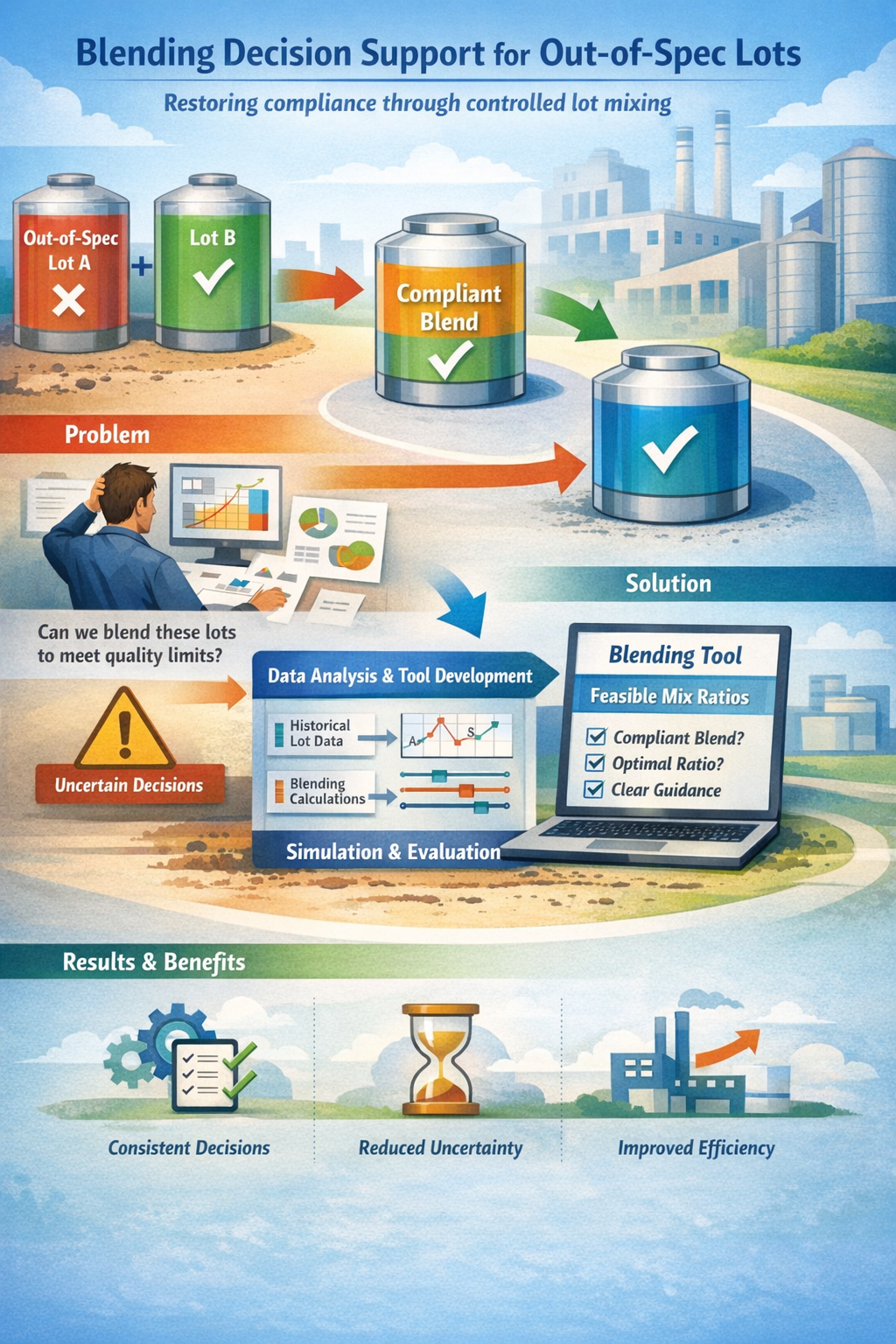
In regulated production environments, lots must meet defined quality limits before they can be released. When a lot is outside these limits, blending it with another lot may restore compliance. In practice, however, planners often lack a clear and structured way to determine whether blending is feasible and which mixing ratios would result in a compliant lot.
The project started with an analysis of historical lot data and relevant quality parameters. These parameters were transformed into mixable characteristics to ensure mathematically correct blending calculations. Based on this foundation, a tool was developed to simulate two-lot blending scenarios, evaluate feasible mixing ratios against predefined constraints, and make decision logic transparent through iterative validation cycles.
The result is a tool that systematically evaluates two-lot blending options and identifies whether a compliant blend is achievable, including feasible ratio ranges. The approach replaces manual trial-and-error with a transparent, repeatable decision process, reducing uncertainty and improving consistency in planning decisions. It supports more efficient handling of out-of-spec lots and provides a solid foundation for future extensions, such as additional constraints or more complex blending scenarios.
Studiengang: Business Information Technology (Bachelor)
Keywords Lot blending, Quality compliance, Decision support, Process optimization, Tool development
Vertraulichkeit: vertraulich
Art der Arbeit
Projektarbeit/Praxisprojekt
Auftraggebende
Pharmaceutical Company
Autorinnen und Autoren
Burak Dögen & Dejan Gajic & Leon Vukoja & Bader Rahil & Malek El Darsi
Betreuende Dozierende
Radovan Simic
Publikationsjahr
2025
Sprache der Arbeit
Englisch
Vertraulichkeit
vertraulich
Studiengang
Business Information Technology (Bachelor)
Standort Studiengang
Basel
Keywords
Lot blending, Quality compliance, Decision support, Process optimization, Tool development