
From Innovation to Commercialization: AI and Quantum-AI Time Series Forecasting at A Swiss Innovation Centre - A Marketing Approach for Customer Adoption Study
Gabriela Meléndez, 2026
Art der Arbeit Bachelor Thesis
Auftraggebende Swiss Innovation Centre
Betreuende Dozierende Barbara Therese Miller
Views: 33
A Swiss innovation centre developing advanced AI- and quantum-AI forecasting capabilities faces uncertainty about how these emerging technologies can be positioned and adopted by business users. While forecasting is widely used across industries, organisations struggle to integrate new forecasting methods into existing systems and decision processes. This thesis aims to help the client to understand customers' perceptions of emerging forecasting technologies and based on this pilot study provides recommendations for a customer adoption strategy.
This pilot study is based on a literature review examining forecasting benefits, limitations of existing methods, and adoption barriers for advanced approaches, complemented by seven semi-structured expert interviews from the energy, retail, logistics, manufacturing, and insurance sectors. To analyse how organisations evaluate advanced forecasting technologies, the SAVE framework (Solution, Access, Value, Education) was applied to structure the findings and derive implications for customer adoption.
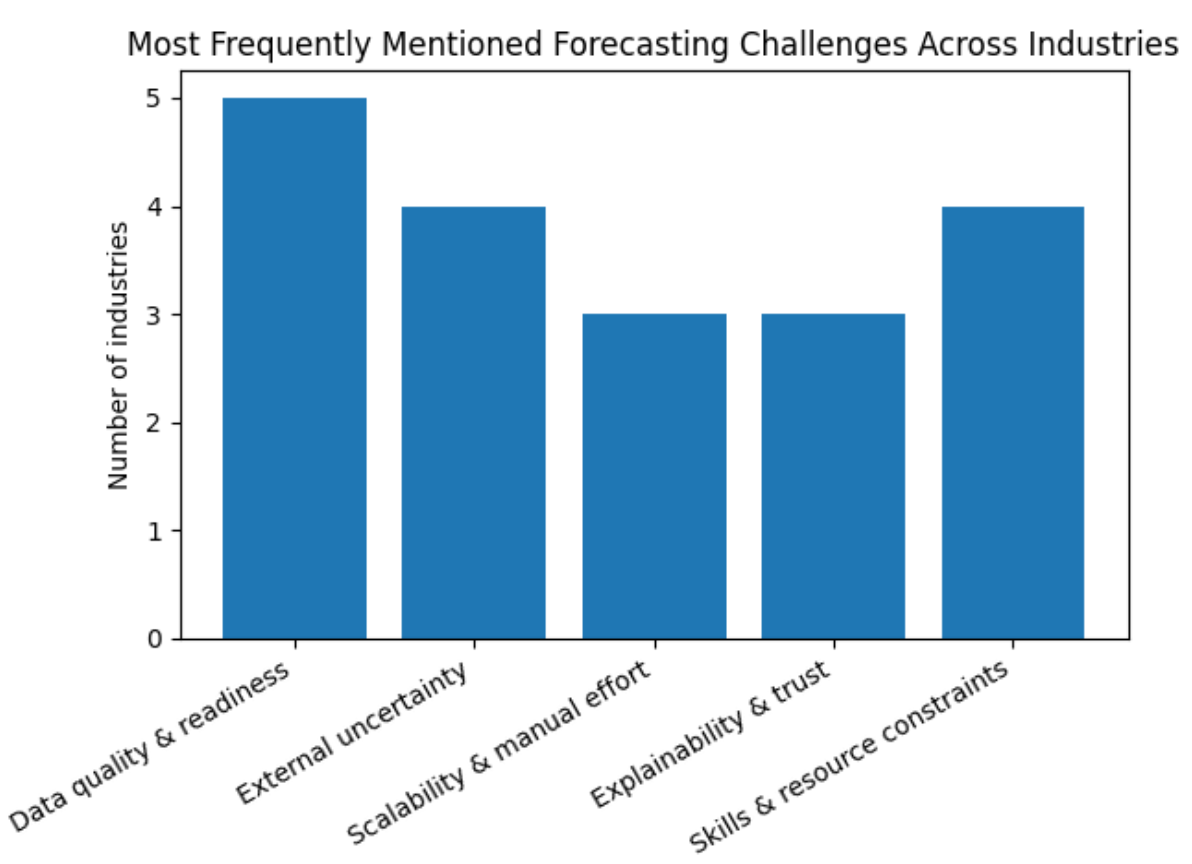
The interviews show that limited adoption of advanced forecasting is mainly driven by organisational factors. Although the literature highlights that AI and quantum–AI methods can deliver higher performance by modelling complex demand patterns and scaling across large forecasting portfolios, interviewees evaluated new solutions primarily based on explainability (transparent outputs), integration (compatibility with existing systems), and usability (fit with daily workflows).
Four key findings across interviews align with the literature: (S)olution must address concrete tasks: energy and insurance interviewees emphasised expert review and auditability, while retail and logistics relies on manual adjustments for promotions, capacity limits, and short-term demand changes. (A)ccess depends on low-risk trials alongside existing systems. (V)alue is assessed through reduced manual effort, faster updates, and improved scalability. (E)ducation emerged as critical, as quantum forecasting was largely perceived as exploratory. This preliminary study should provide the client with a clear basis for enabling customer adoption and creating decision-relevant value.
Studiengang: Business Administration International Management (Bachelor)
Keywords Artificial Intelligence (AI), Time Series Forecasting, Machine Learning, Data Analytics, Marketing, Commercialization of Innovation, Technology Transfer, Innovation Management, Swiss Innovation
Vertraulichkeit: vertraulich
Art der Arbeit
Bachelor Thesis
Auftraggebende
Swiss Innovation Centre, Arlesheim
Autorinnen und Autoren
Gabriela Meléndez
Betreuende Dozierende
Barbara Therese Miller
Publikationsjahr
2026
Sprache der Arbeit
Englisch
Vertraulichkeit
vertraulich
Studiengang
Business Administration International Management (Bachelor)
Standort Studiengang
Olten
Keywords
Artificial Intelligence (AI), Time Series Forecasting, Machine Learning, Data Analytics, Marketing, Commercialization of Innovation, Technology Transfer, Innovation Management, Swiss Innovation