
Optimization of a Swiss Industrial Manufacturing Company’s European Transport Network
Len Gygax & Jack Itten & Ray Lenz & Son La & Obada Omar, 2025
Art der Arbeit Projektarbeit/Praxisprojekt
Auftraggebende Swiss industrial manufacturing company
Betreuende Dozierende Ganesh Nathan
Views: 34
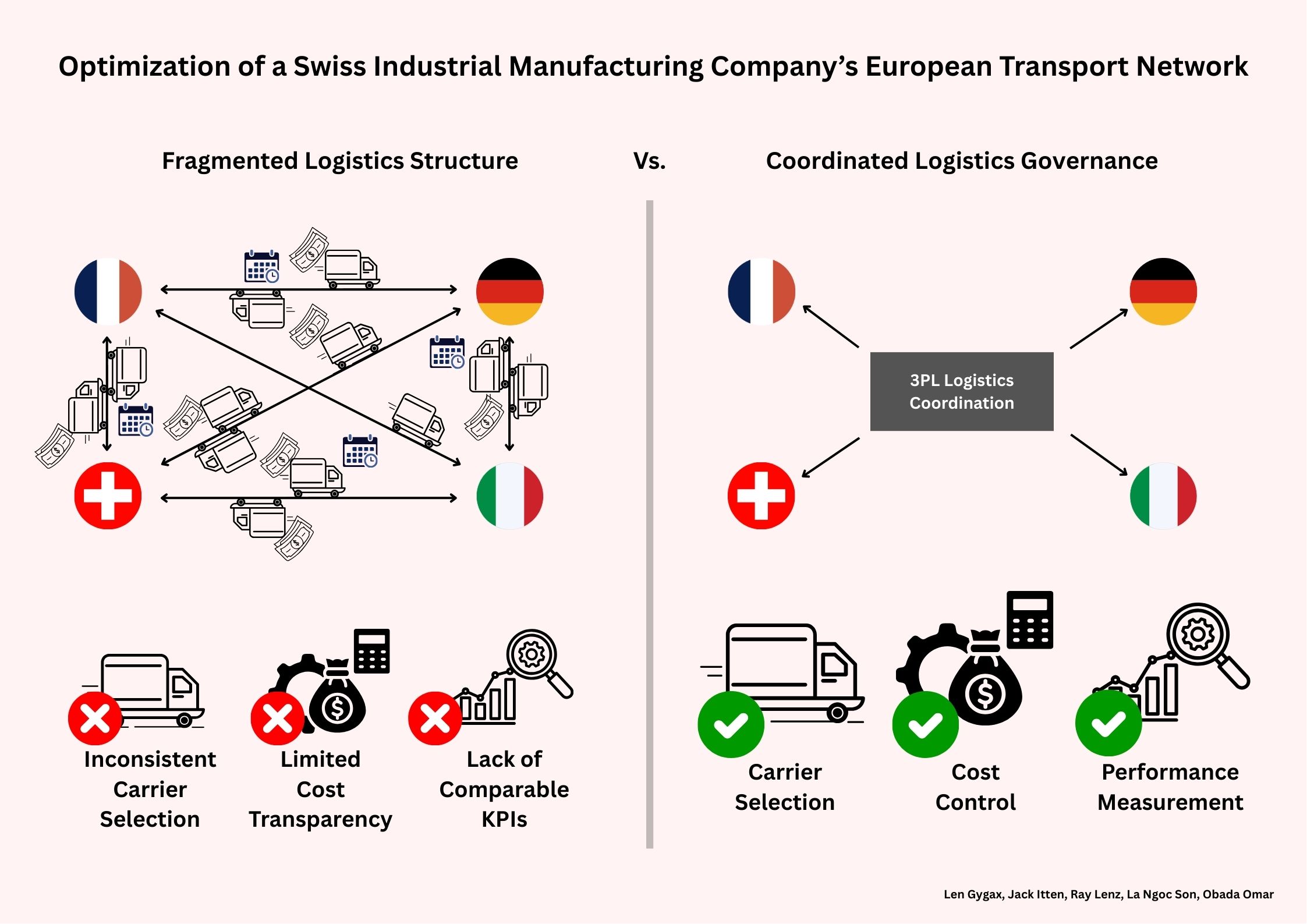
Decentralized logistics structures allow local flexibility and responsiveness but often lead to fragmented processes, limited transparency, and difficulties in comparing transport costs and performance across countries. In the analyzed company, transport operations are organized independently at each European site, resulting in heterogeneous carrier structures, data formats, and performance measures. This limits group-level visibility and constrains strategic oversight of the European transport network.
The project applies a mixed-method approach combining quantitative shipment and cost data with qualitative interviews conducted with local logistics and administrative managers. The quantitative analysis examines shipment volumes, carrier structures, and cost patterns, while the interviews provide insights into operational processes, decision-making practices, and country-specific constraints. This integrated approach enables a comprehensive understanding of the existing transport setup across all locations.
The analysis shows that logistics operations are largely managed locally, with different transport partners, processes, and performance measures in place at each site. Although these setups function reliably in daily operations and are well adapted to local requirements, the lack of standardized data structures and coordinated carrier management limits transparency at group level. As a result, transport costs, service performance, and efficiency cannot be systematically compared across countries.
Based on these findings, the project recommends the introduction of a third-party logistics (3PL) partner to support group-wide coordination of transport planning, carrier management, and performance monitoring. The proposed 3PL model would not replace local logistics operations but would integrate transport execution, improve data visibility, and enable consolidated reporting across countries. This approach strengthens transparency and comparability while maintaining local autonomy and operational flexibility, thereby providing a stronger basis for informed logistics management and structured transport governance.
Studiengang: Business Administration International Management (Bachelor)
Keywords Transport logistics, European transport network, Cross-border logistics, Intercompany shipments, Logistics governance, Data standardization, RFQ, RFI, 3PL/4PL evaluation, Logistics optimization
Vertraulichkeit: vertraulich
Art der Arbeit
Projektarbeit/Praxisprojekt
Auftraggebende
Swiss industrial manufacturing company
Autorinnen und Autoren
Len Gygax & Jack Itten & Ray Lenz & Son La & Obada Omar
Betreuende Dozierende
Ganesh Nathan
Publikationsjahr
2025
Sprache der Arbeit
Englisch
Vertraulichkeit
vertraulich
Studiengang
Business Administration International Management (Bachelor)
Standort Studiengang
Olten
Keywords
Transport logistics, European transport network, Cross-border logistics, Intercompany shipments, Logistics governance, Data standardization, RFQ, RFI, 3PL/4PL evaluation, Logistics optimization