
Client-Based Digital Twin: A Model Built on the Use Case of Workforce Integration
Ghina Kassem, 2025
Art der Arbeit Master Thesis
Auftraggebende
Betreuende Dozierende Arianna Fedeli & Stella Gatziu Grivas
Views: 35
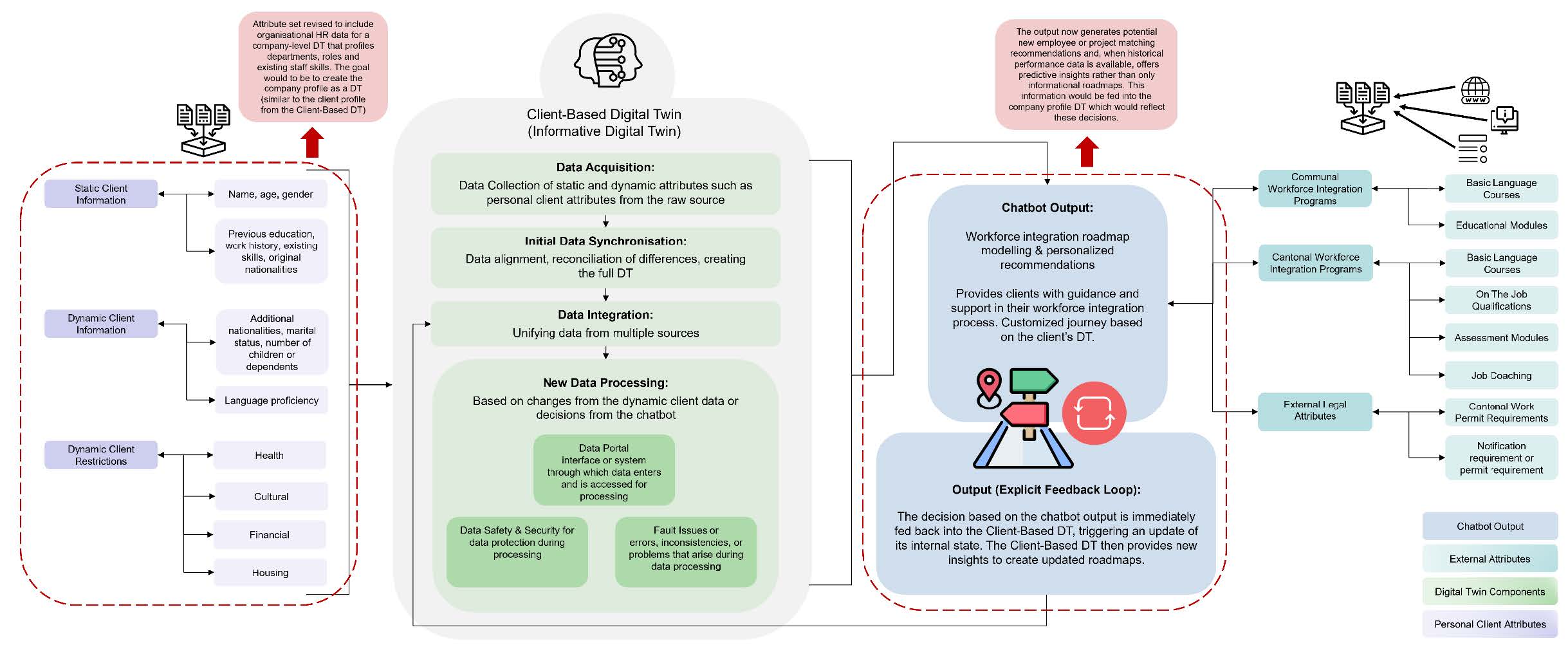
This thesis begins by exploring the theoretical foundations of digital twins, chatbots, and work-force integration processes. The research differentiates Client-Based DTs from other types by emphasizing dynamic and static attributes that model individual behaviour, background, and support needs. The research identifies a gap in existing e-government services where current systems lack the capability to offer personalized and adaptive integration support. Drawing from interviews with integration coaches and clients, the thesis maps out current challenges and expectations within the workforce integration landscape, particularly in dealing with heterogeneous client needs and evolving labour market demands.
Through an iterative approach, the ABILI chatbot tool was tested based on the use case of workforce integration. The evaluation criteria included user trust, task efficiency, personalization, and reduction of manual effort. Integration coaches, clients, and domain experts participated in the evaluation interviews, offering feedback that informed subsequent iterations. The results indicate that the tool significantly reduces time spent on repetitive tasks, improves alignment with client needs, and supports the standardization of procedures without undermining professional autonomy. The interview participants emphasized the value of real-time adaptation, structured decision support, and accessible output formats. Ethical concerns, particularly regarding data privacy and algorithmic transparency, were addressed throughout the design and evaluation process. The conclusion highlights the strengths and weaknesses of the re-search process and provides learnings based on the authors reflection, a summary of the re-search questions and answers and areas for future research. The Client-Based DT is not con-fined to the field of workforce integration but can be applied in any context where the persona of a client, individual or organization is central and affected by specific external changes.
The thesis shows that the Client-Based DT and chatbot tool can improve workforce integration in the public sector through personalized and efficient support. It offers practical value for adoption and scalability while highlighting the role of technology in complementing human expertise.
Studiengang: Business Information Systems (Master)
Keywords
Vertraulichkeit: vertraulich
Art der Arbeit
Master Thesis
Autorinnen und Autoren
Ghina Kassem
Betreuende Dozierende
Arianna Fedeli & Stella Gatziu Grivas
Publikationsjahr
2025
Sprache der Arbeit
Englisch
Vertraulichkeit
vertraulich
Studiengang
Business Information Systems (Master)
Standort Studiengang
Olten