
Digitalisation of Production at Frank Türen AG
Burak Dögen, 2026
Type of Thesis Bachelor Thesis
Client Frank Türen AG
Supervisor Uwe Leimstoll
Views: 8
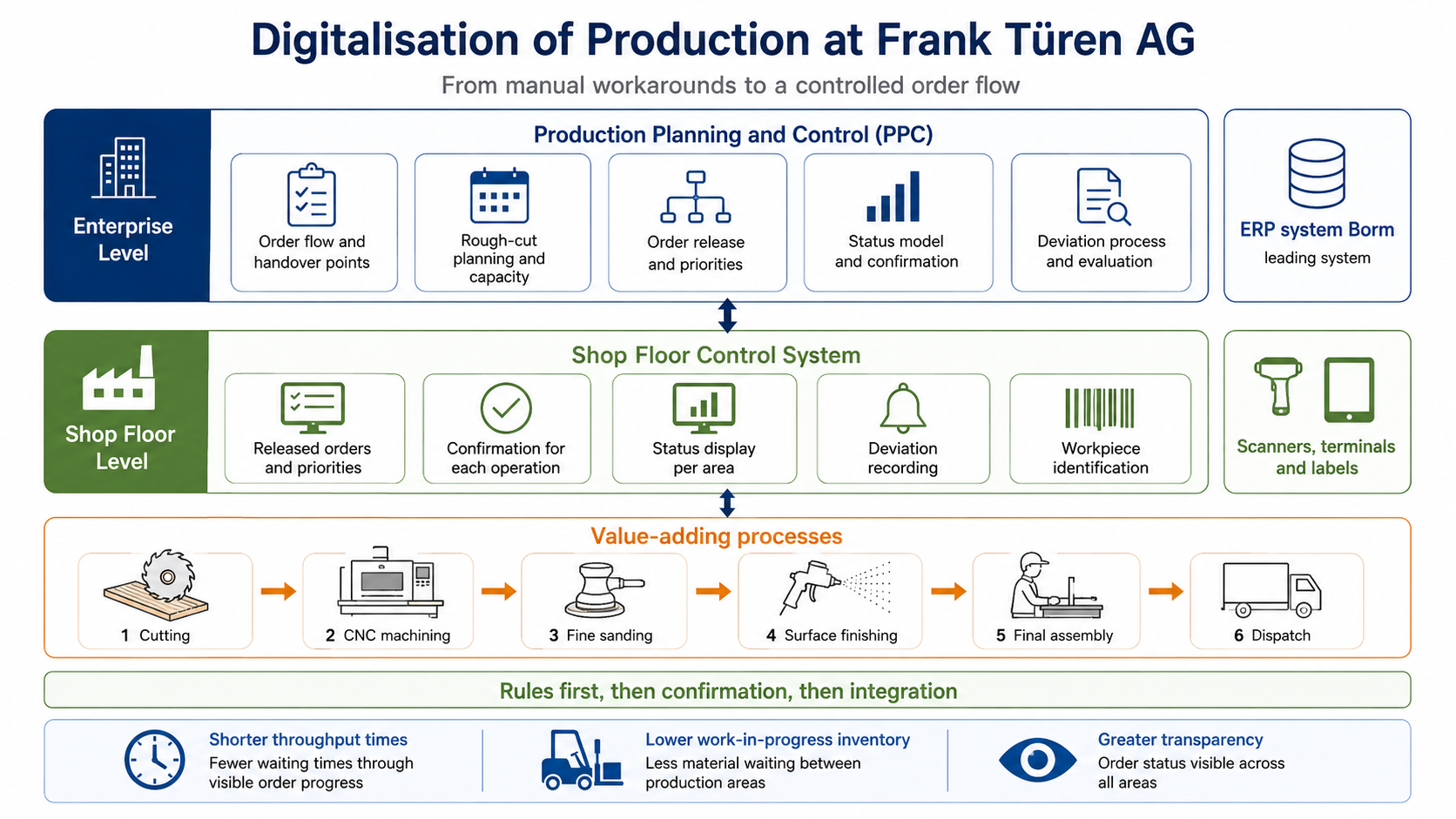
Frank Türen AG manufactures doors, service riser units and door surrounds in high-variety make-to-order production, where large project orders and one-off items pass through the same production areas at the same time. The ERP system Borm is well established and was set as a fixed condition for the project, yet a great deal of control information still travels on routing slips, sign-offs and verbal arrangements. The goals were to define a concept for production planning and control and for a shop floor control system for the value-adding processes within the existing system landscape.
The state of the art on production planning and control, shop floor control and deviation management under lot size one was derived from literature and standards. The current situation in the company was surveyed through four guided interviews with three people, two on site and two by telephone, several plant walkthroughs between April and July 2026 and five internal process documents. The findings were validated with production management in a concluding walkthrough. Comparing both across fourteen topic areas produced twenty requirements, from which the concepts and solutions were derived.
Not all manual work is a deficiency. The thesis distinguishes functional interventions, which carry a professional decision, from compensatory interventions, which replace information that is missing or unreliable. Only the second group justifies action.The result is a concept for production planning and control and for a shop floor control system. Fifteen solution approaches fulfil the requirements. Five criteria decide not whether they are implemented but in which order: effect, feasibility, effort, organisational fit and risk.This gives a roadmap of three phases over eighteen months. (1) Stabilise and standardise, months one to four: binding rules that need no investment, complete handovers, cleaned-up templates and clear roles. (2) Pilot and learn, months five to ten: confirmation per operation, structured deviation records and a paint-proof marking, tested in the door leaf line. (3) Extend and embed, months eleven to eighteen: roll-out beyond the pilot.Phases one and two carry the benefit and hold their value without technical additions. After every phase, eight key figures let Frank Türen AG decide whether to continue.
Studyprogram: Business Information Technology (Bachelor)
Keywords production planning and control, shop floor control system, make-to-order production, lot size one, ERP, Borm, deviation management, order transparency, digitalisation of production
Confidentiality: vertraulich
Type of Thesis
Bachelor Thesis
Client
Frank Türen AG, Buochs
Authors
Burak Dögen
Supervisor
Uwe Leimstoll
Publication Year
2026
Thesis Language
English
Confidentiality
Confidential
Studyprogram
Business Information Technology (Bachelor)
Location
Basel
Keywords
production planning and control, shop floor control system, make-to-order production, lot size one, ERP, Borm, deviation management, order transparency, digitalisation of production