
Solving Inventory Routing Problems with the Walking Palmtree Optimizer
Jan Locher, 2026
Type of Thesis Master Thesis
Client
Supervisor Thomas Hanne
Views: 8 - Downloads: 3
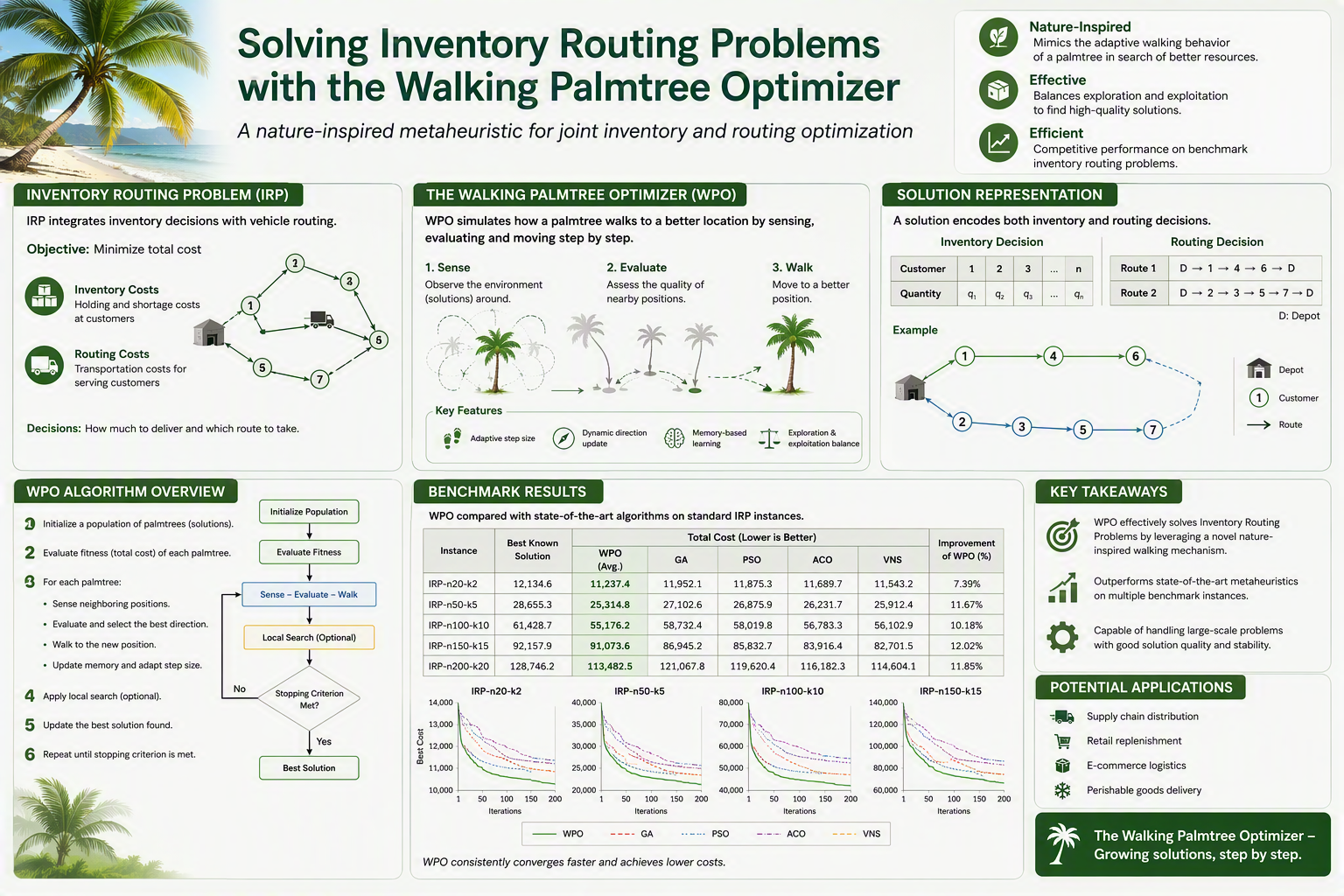
This thesis investigates whether the Walking Palmtree Optimizer (WPT), a novel population-based algorithm introduced by Zitouni et al. (2024) and inspired by the movement behaviour of the Socratea exorrhiza palm tree, is a competitive choice for the IRP.
Following a Design Science Research methodology, all WPT and the comparison algorithms Genetic Algorithm (GA) and Particle Swarm Optimizer (PSO) were re-implemented from scratch in Python and evaluated on 50 randomly generated IRP scenario instances spanning five complexity levels. Each algorithm was executed 15 times per instance with independent random seeds, producing 2250 individual runs in total. To ensure a fair comparison, all three algorithms were allocated an approximately equal number of objective function evaluations rather than an equal number of iterations, since one WPT iteration consumes roughly twenty times more evaluations than one PSO or GA iteration. Performance differences were tested for statistical significance using the Friedman test and pairwise Wilcoxon signed-rank tests at α = 0.05, in line with the protocol used in the original WPT benchmark study.
The results show that the GA consistently outperforms both WPT and PSO on the IRP. On the simplest two scenario levels, the three algorithms tie. On the intermediate, advanced, and complex levels, the GA wins on every one of the ten instances, with mean cost improvements of approximately 11, 15, and 13.3 percent over the next-best algorithm, respectively. WPT performs comparably to PSO across most scenarios and marginally outperforms it only on the most complex instances.Beyond the experiment comparison, the thesis contributes a documented, performance-optimised Python implementation of WPT in which eight successive steps reduce the algorithm's per-iteration cost. The overall conclusion is that WPT is not yet a practical alternative to a well-tuned real-coded GA for solving the IRP. The implementation, the experimental data, and the documented limitations together provide a foundation on which future work can investigate parameter-tuned, hybridised, or problem-specific variants of WPT.
Studyprogram: Business Information Systems (Master)
Keywords Inventory Routing Problem (IRP), Metaheuristics, Walking Palmtree Optimizer (WPT), Genetic Algorithm, Particle Swarm Optimisation, Supply Chain Management, Comparative Study, Statistical Analysis
Confidentiality: öffentlich
Type of Thesis
Master Thesis
Authors
Jan Locher
Supervisor
Thomas Hanne
Publication Year
2026
Thesis Language
English
Confidentiality
Public
Studyprogram
Business Information Systems (Master)
Location
Olten
Keywords
Inventory Routing Problem (IRP), Metaheuristics, Walking Palmtree Optimizer (WPT), Genetic Algorithm, Particle Swarm Optimisation, Supply Chain Management, Comparative Study, Statistical Analysis