
Investigating the Application of Lean Principles in Manufacturing for Product Innovation: A case study from a Thai B2B Firm
Siraporn Khunsamitpanya, 2026
Type of Thesis Master Thesis
Client
Supervisor Teresa Freiburghaus
Views: 6 - Downloads: 2
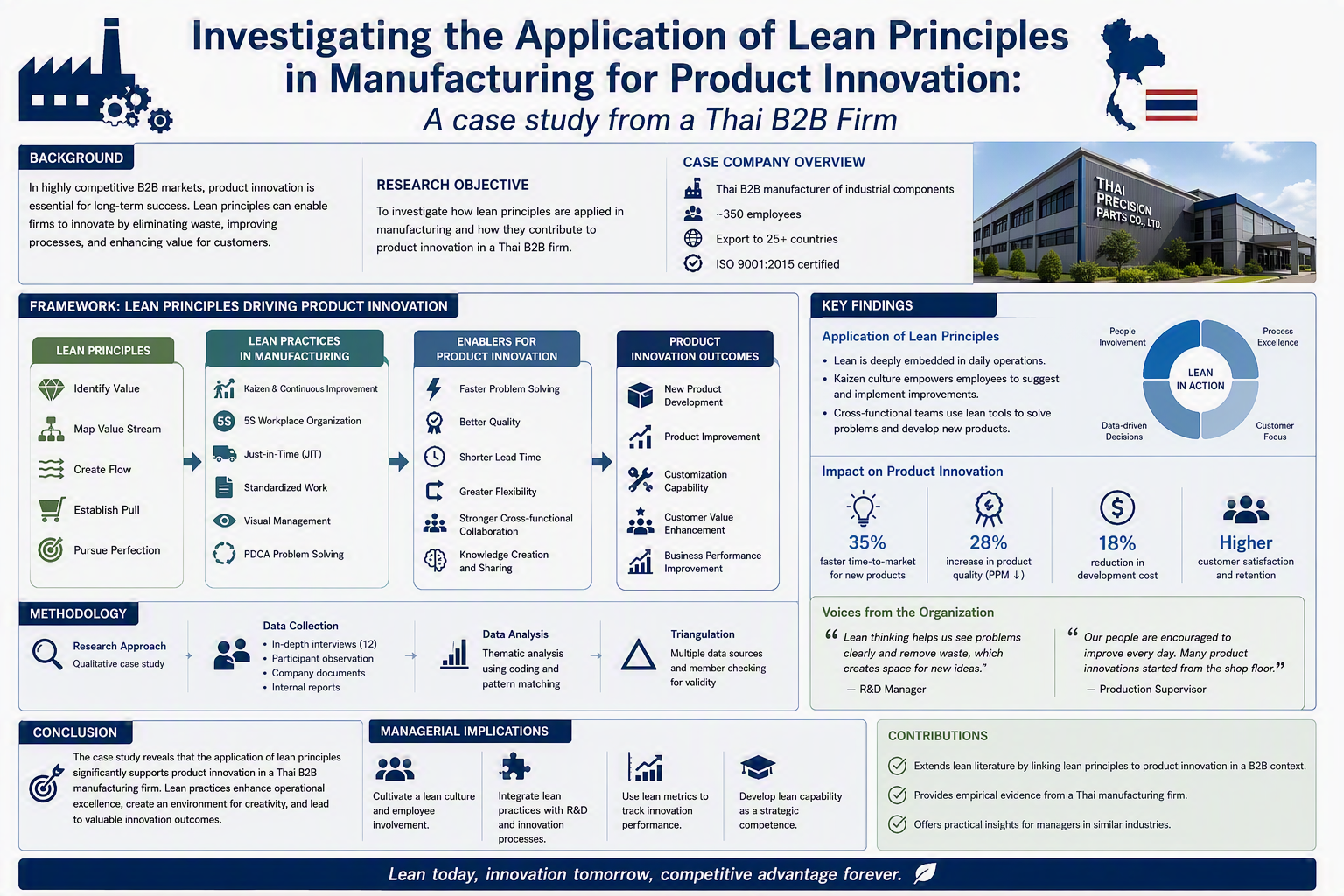
Lean Management provides a strong foundation for process stability, waste reduction, and continuous improvement, but its emphasis on standardization may limit experimentation and exploratory learning. In contrast, Lean Startup practices emphasize customer feedback, iterative experimentation, and validated learning. This thesis investigates how feedback-driven Lean Startup practices can be integrated with established Lean Management principles to improve product innovation in a B2B manufacturing context.
The study applies a qualitative case study design based on three semi-structured interviews. Two participants were selected from a Thai enamel wire manufacturer operating under Japanese parent-company governance: an Engineering Manager and a Sales Engineering Manager. A third participant, a Sales Director from a German B2B manufacturing organization, was included as a secondary comparative reference. The data were analyzed using thematic analysis and the Gioia methodology to identify first-order concepts, second-order themes, and aggregate dimensions.
The findings show that Lean Management is deeply embedded in the primary case organization’s production operations but is not systematically extended into exploratory product development. Product innovation is predominantly incremental and occurs through customer-driven trials, specification adjustments, and process improvements. The organization already practices an informal form of Build-Measure-Learn logic through trial production, customer testing, feedback analysis, and adjustment. However, this learning process is constrained by governance structures, resource limitations, customer approval requirements, and cultural decision-making norms. The German secondary case shows that similar validated learning mechanisms exist in B2B manufacturing, but flatter governance enables faster decision-making.The thesis concludes that Lean Startup integration in established manufacturing firms should be understood as formalization rather than adoption. The organization does not need to replace its Lean Management system; instead, it should make existing informal learning practices more explicit, measurable, and actionable. The study contributes to Lean Management, Lean Startup, and organizational ambidexterity literature by identifying the boundary conditions under which validated learning can complement Lean-based manufacturing systems.
Studyprogram: Business Information Systems (Master)
Keywords
Confidentiality: öffentlich
Type of Thesis
Master Thesis
Authors
Siraporn Khunsamitpanya
Supervisor
Teresa Freiburghaus
Publication Year
2026
Thesis Language
English
Confidentiality
Public
Studyprogram
Business Information Systems (Master)
Location
Olten