
Multi-Agent Systems for Ecosystem Mapping Under Non-Commensurable Performance
Anna Geiser, 2026
Type of Thesis Bachelor Thesis
Client FHNW - University of Applied Sciences and Arts Northwestern Switzerland
Supervisor Joachim Ehrenthal
Views: 11
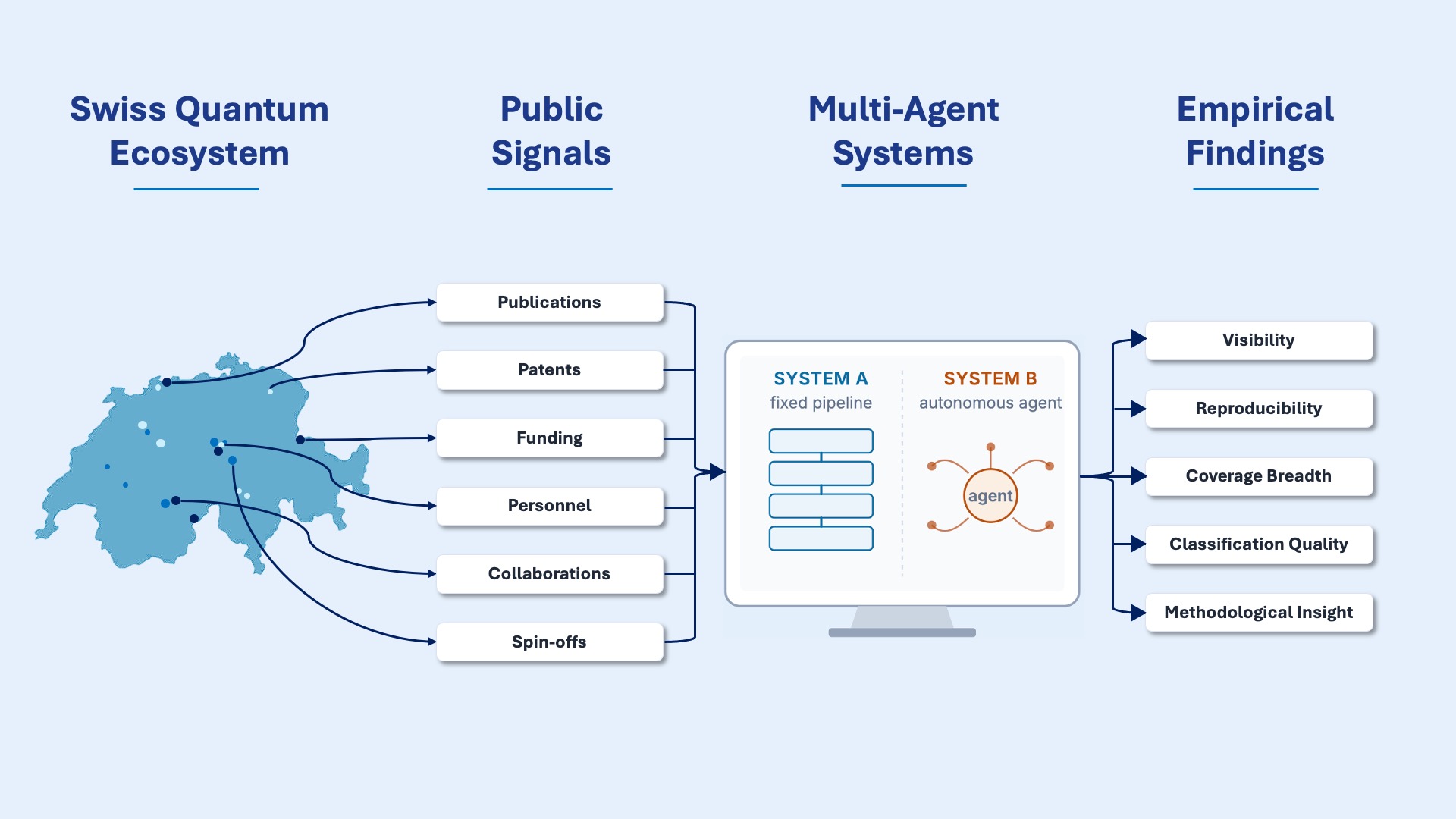
The quantum computing industry emits many small and hard-to-compare signals, such as papers, patents, funding decisions, hires and spin-offs. Because technologies differ fundamentally, these signals are often non-commensurable and cannot be reduced to a common performance scale. Maintaining a strategic overview therefore requires piecing together evidence from many sources. Agentic AI may help, but system design, evaluation, and comparison are open research topics.
Two contrasting systems were built and run in parallel for ninety days on the same task. System A uses a graph-based workflow with defined sources and classification steps. System B uses a single autonomous agent that chooses its own web searches. Both share the actor list, taxonomy, primary language model, search space and database. Their outputs are compared on overlap, reproducibility, token efficiency and classification quality, complemented by qualitative analysis of observed failure patterns.
The two agentic systems produced different results despite operating towards the same goal. While the extent to which these discrepancies can be attributed to architecture, prompts, tools or retrieval choices remains open for further research, the practical implication is clear: agentic AI can make non-commensurable deep-tech ecosystems more observable by systematically collecting and structuring signals that would otherwise have to be assembled manually. At the same time, the results show that the quality of such an overview depends not only on the underlying model, but also on how the surrounding system is designed and evaluated.
Studyprogram: Business Information Technology (Bachelor)
Keywords AI, Quantum Computing, Agentic AI, Signalling Theory
Confidentiality: öffentlich
Type of Thesis
Bachelor Thesis
Client
FHNW - University of Applied Sciences and Arts Northwestern Switzerland, Windisch
Authors
Anna Geiser
Supervisor
Joachim Ehrenthal
Publication Year
2026
Thesis Language
English
Confidentiality
Public
Studyprogram
Business Information Technology (Bachelor)
Location
Brugg-Windisch
Keywords
AI, Quantum Computing, Agentic AI, Signalling Theory