
Performance Management in Debt Collection: Designing a KPI-Based Management Framework
Alec Madea, 2026
Type of Thesis Bachelor Thesis
Client Swiss Automotive Leasing Company
Supervisor Nico Sütterle
Views: 9
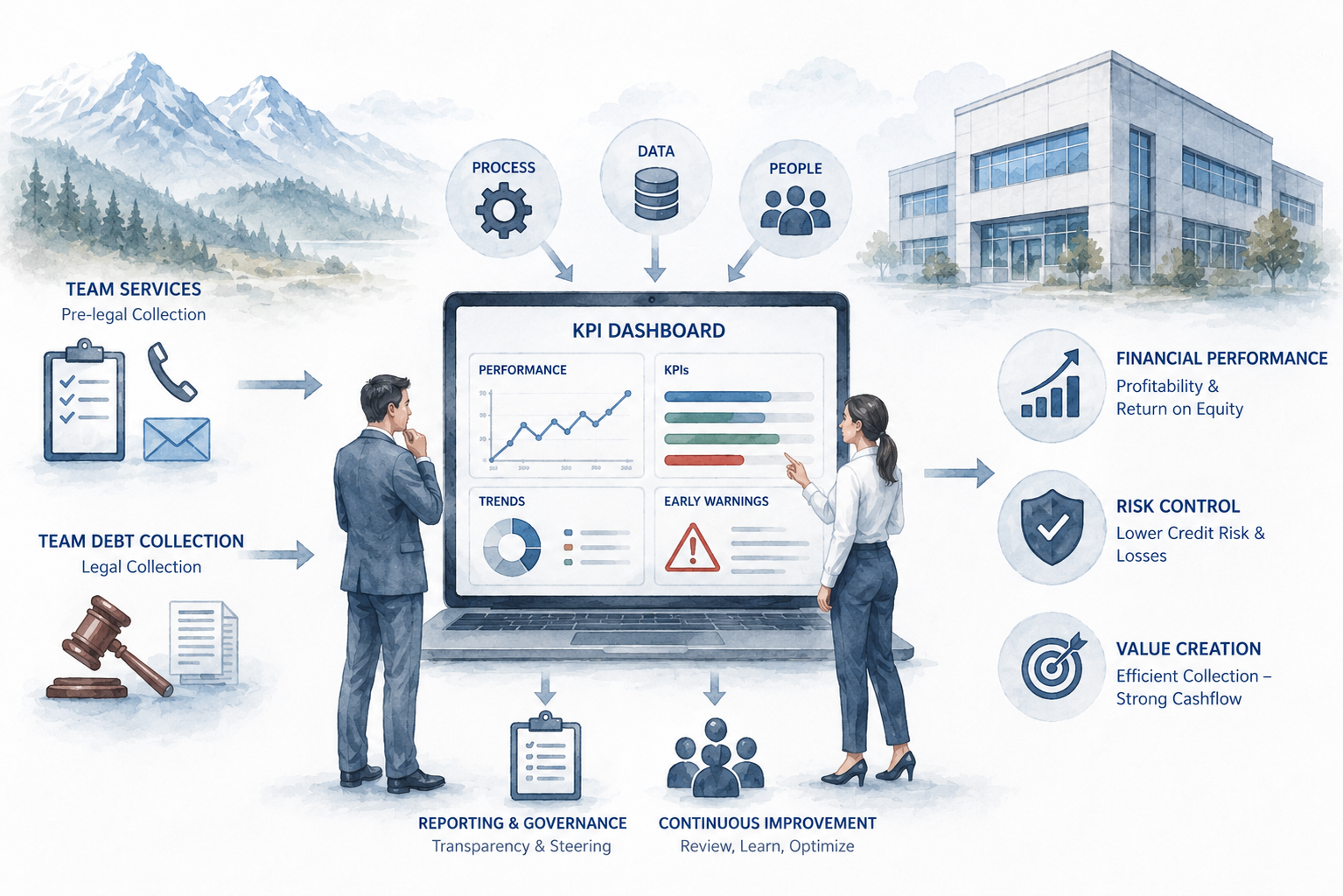
In a capital-intensive leasing business, debt collection plays a central role in liquidity, credit risk and profitability. Following the introduction of a new Target Operating Model, the function was divided into two specialized teams for pre-legal and legal debt collection. However, performance measurement remained largely manual and backward-looking: the key figures reported on a monthly basis capture financial outcomes, but provide only limited support for the operational management of the teams.
The thesis is designed as a qualitative, design-oriented single case study. A literature review on performance management, the Balanced Scorecard, the DuPont model and working capital management was combined with an analysis of process documentation, existing reports and operational system data. Based on this foundation, operational and financial key figures were defined for both teams, classified according to Parmenter’s typology and linked within a multi-level management model. The practical applicability of the results was subsequently reviewed together with the responsible stakeholders.
The central finding is diagnostic: the key figures currently in use are exclusively outcome measures reflecting results already realized. They are useful for overall control but insufficient for operational management, as they exclude controllable drivers a team can actively influence.The framework developed here does not replace the existing reporting system but complements it with an additional layer of non-financial, weekly measured and team-owned management indicators. A second finding concerns value creation: since the receivable remaining after contract termination is usually only recoverable to a limited extent, the economically decisive lever lies not in downstream enforcement but in preventing contract terminations.Using the Balanced Scorecard and the DuPont model, the operational key figures are transparently linked to their financial impact. The thesis recommends a two-level management model that separates a weekly operational review from the monthly management perspective, follows a traffic-light logic, focuses resources on upstream preventive levers and replaces manual reporting with an automated data pipeline.
Studyprogram: Business Administration International Management (Bachelor)
Keywords Key Performance Indicators / Performance Management / Debt Collection / Receivables Management / Risk Management / Balanced Scorecard
Confidentiality: vertraulich
Type of Thesis
Bachelor Thesis
Client
Swiss Automotive Leasing Company, Cham
Authors
Alec Madea
Supervisor
Nico Sütterle
Publication Year
2026
Thesis Language
English
Confidentiality
Confidential
Studyprogram
Business Administration International Management (Bachelor)
Location
Brugg-Windisch
Keywords
Key Performance Indicators / Performance Management / Debt Collection / Receivables Management / Risk Management / Balanced Scorecard