
Multi-purpose building concept for Viva Kirche Frick
Ahmad Soroush Rosta & Aziza Souissi, 2026
Type of Thesis Bachelor Thesis
Client Viva Kirche Frick
Supervisor Pieter Jan Perrett
Views: 20
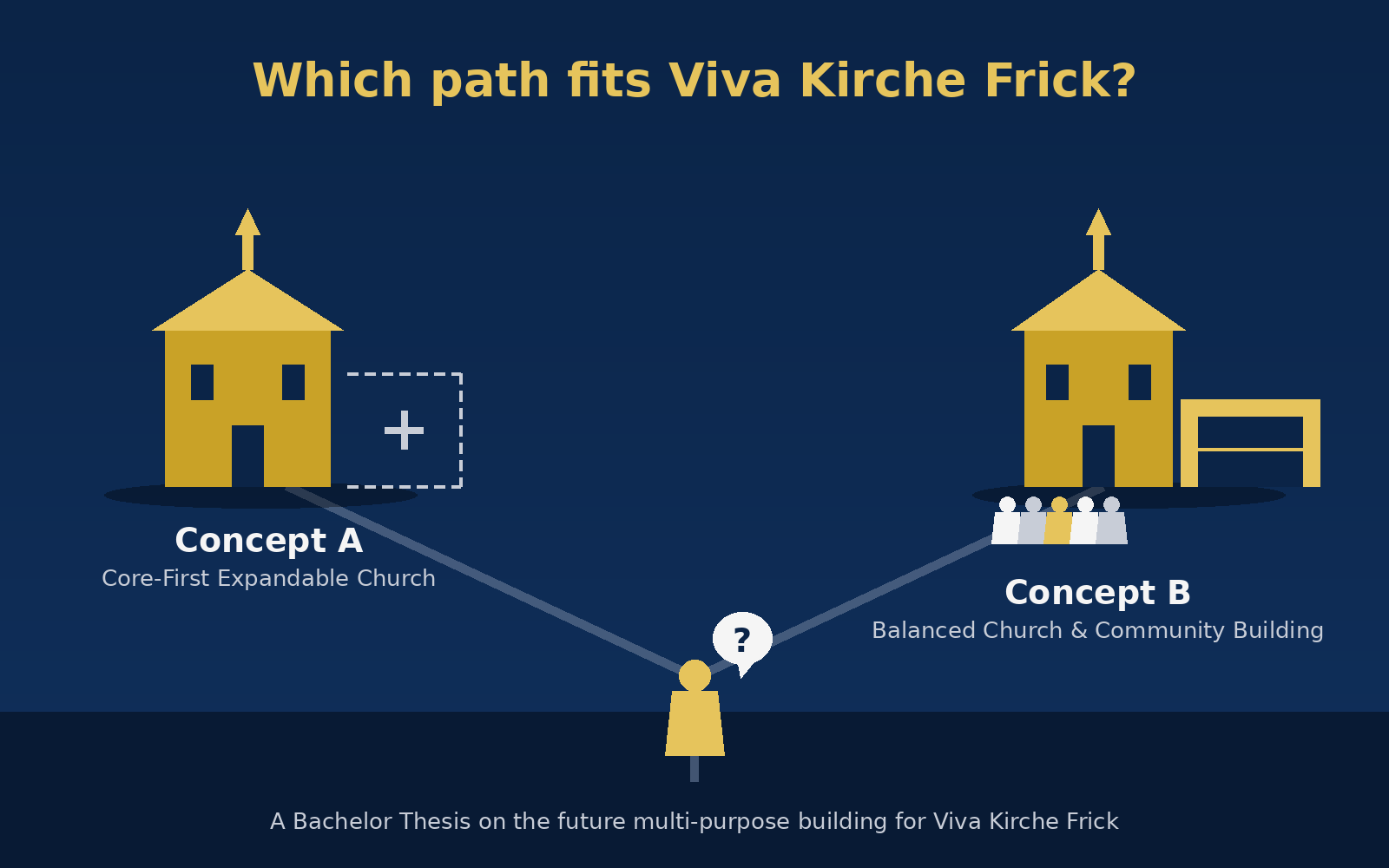
Founded in 1987, Viva Kirche Frick has grown far beyond a worship space, now hosting children's and youth ministry, community gatherings and events. Because its facilities evolved through incremental, short-term extensions rather than a coherent plan, they can no longer support today's activities. Capacity, flexibility and technical infrastructure are limited, stakeholder priorities differ, and financing is constrained, leaving no evidence-based basis for deciding how a future multi-purpose building should be structured.
An exploratory single-case study combined an internal congregation survey (42 responses), semi-structured interviews with a local business owner and an internal church stakeholder, and a written interview with the municipality of Frick. This evidence shaped the church's requirements, which informed two building concept alternatives. Both were assessed with an adapted TELOS framework covering technical, economic, legal, operational and schedule feasibility, allowing a systematic, criteria-based comparison rather than a purely intuitive choice.
The survey revealed strong demand for accessibility, flexible social and gathering space, sufficient storage and a properly equipped worship hall, while 69% of respondents named construction cost as a key concern. Two concepts were developed: Concept A scored higher overall (3.10 vs. 2.85), mainly due to lower initial financial exposure and legal simplicity, while Concept B performed better for parallel community use. Concept A is therefore the more suitable and realistically achievable option on current evidence. This recommendation is provisional: no professional cost estimate has been prepared for either concept, so affordability within the available project budget remains unconfirmed; and a validated cost plan could raise Concept B's score above Concept A's and reverse the ranking. Stakeholders identified the requirements but did not evaluate the completed concepts.
Studyprogram: Business Administration International Management (Bachelor)
Keywords Feasibility study (TELOS), Stakeholder analysis, Church and community building, Nonprofit real estate development, Case study research
Confidentiality: öffentlich
Type of Thesis
Bachelor Thesis
Client
Viva Kirche Frick , Frick
Authors
Ahmad Soroush Rosta & Aziza Souissi
Supervisor
Pieter Jan Perrett
Publication Year
2026
Thesis Language
English
Confidentiality
Public
Studyprogram
Business Administration International Management (Bachelor)
Location
Olten
Keywords
Feasibility study (TELOS), Stakeholder analysis, Church and community building, Nonprofit real estate development, Case study research