
Capacity-Based Prioritisation in Resource-Intensive Project Portfolios
Jasmin Bajwa, 2026
Type of Thesis Bachelor Thesis
Client F. Hoffmann-La Roche AG
Supervisor Joachim Ehrenthal
Views: 19
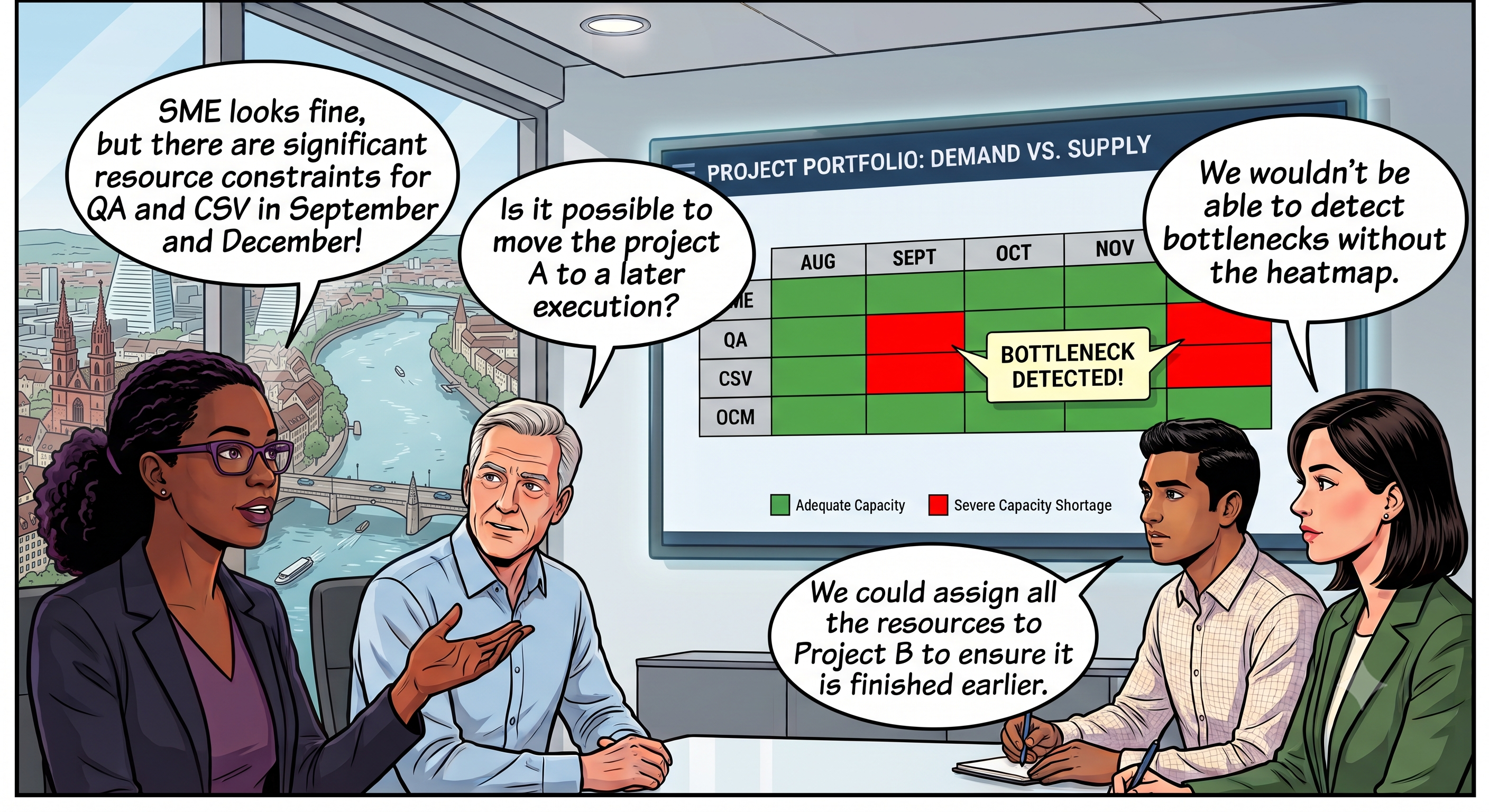
As project portfolios continue to grow, resource constraints are becoming a critical factor in the successful execution of projects. Project delivery is not only limited by available staff, but also by the number of highly specialised capabilities required for multiple initiatives, all while maintaining daily operations. Furthermore, resource management is often driven by a partial, and not site-wide view of capacity constraints, and individual knowlegde, experience and conflicting availabilities of capabilities hinders cross-collaboration in portfolio management.
The study employed a design science research framework, using iterative build, design and evaluation cycles to develop the IT artefact. Qualitative interviews were conducted with relevant units to gain an understanding of their resource planning processes. These insights were analysed using root cause analysis and MoSCoW prioritisation in order to identify the artefact's objectives and filter out surface-level symptoms. A visual decision support system was then developed within Monday.com and evaluated using real-world portfolio data.
This thesis proposes a model for implementing a lightweight, role-based approach to managing resource capacity. This approach enables the site to proactively identify resource bottlenecks. The visual DSS developed for this study successfully generated a heatmap to identify capacity conflicts. However, evaluation revealed that, in its current state, Monday.com has several technical limitations that prevent it from fully satisfying the complex needs of a dynamic, site-wide capacity resource model. A key finding is that attempting to track all personnel is counterproductive. The model should therefore focus exclusively on critical bottleneck roles to minimise the significant administrative overheads associated with data collection.
Studyprogram: Business Information Technology (Bachelor)
Keywords Project Portfolio Management (PPM), Design Science Research, Resource Capacity Planning, Decision Support System (DSS), Proactive Resource Management
Confidentiality: vertraulich
Type of Thesis
Bachelor Thesis
Client
F. Hoffmann-La Roche AG, Kaiseraugst
Authors
Jasmin Bajwa
Supervisor
Joachim Ehrenthal
Publication Year
2026
Thesis Language
English
Confidentiality
Confidential
Studyprogram
Business Information Technology (Bachelor)
Location
Brugg-Windisch
Keywords
Project Portfolio Management (PPM), Design Science Research, Resource Capacity Planning, Decision Support System (DSS), Proactive Resource Management