
Evaluating a Production-Support RAG Chatbot: Task-Level Efficiency, Output Quality, and Technology Acceptance in a Highly Automated Manufacturing Environment
Aaron Lutz, 2026
Type of Thesis Bachelor Thesis
Client Industrial company with a highly automated manufacturing environment
Supervisor Martin Sterchi
Views: 12
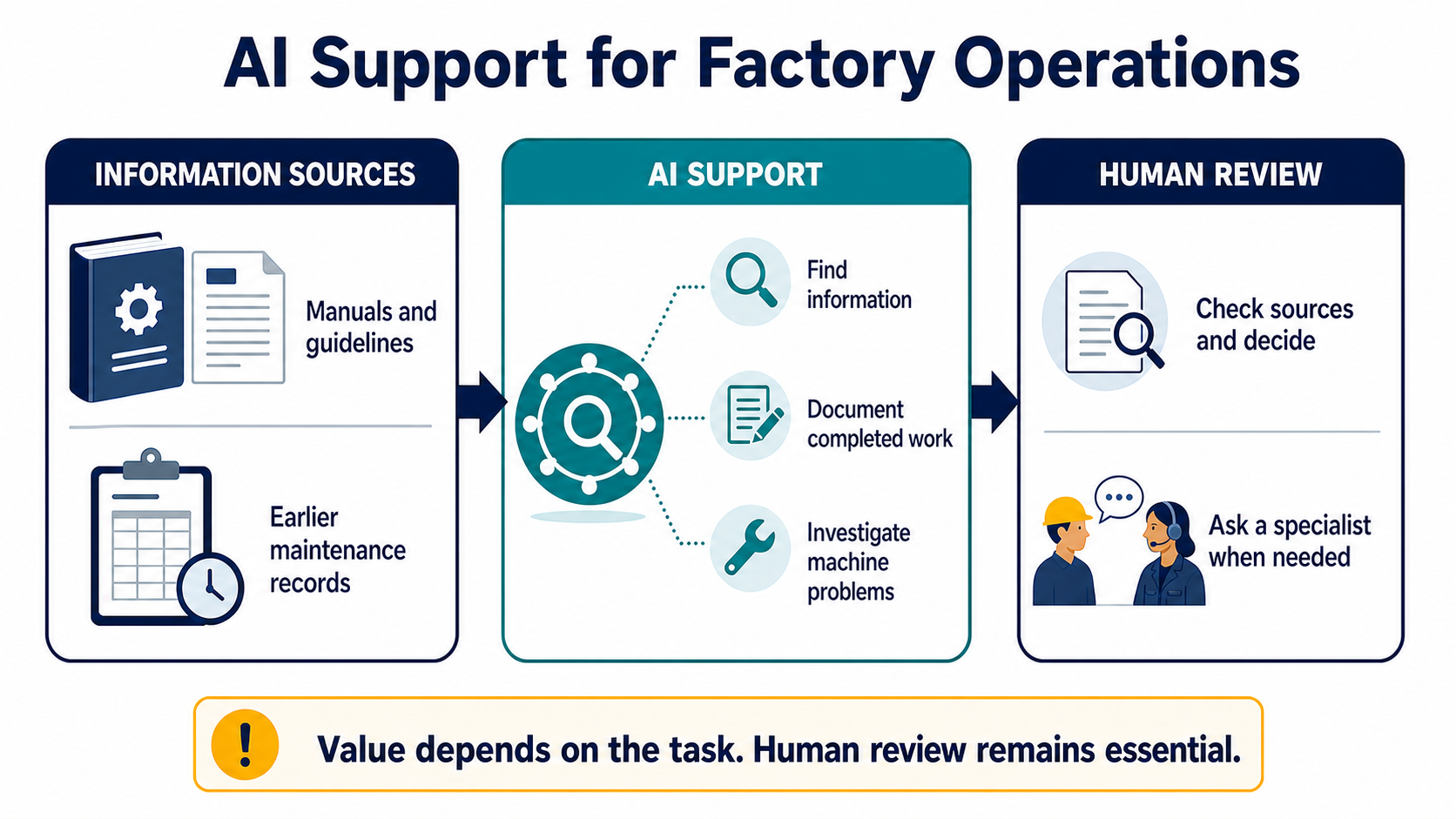
In a highly automated manufacturing environment, employees who support factory operations draw on several sources of information: manuals from machine manufacturers, internal instructions and guidelines, and records of earlier maintenance work. Finding and combining the right information can take time. The company therefore uses an AI chatbot that searches selected internal sources before preparing an answer. The aim was to understand which activities the tool supports well, and when employees must still search independently, apply their own judgement or ask a specialist for help.
Nine employees completed 36 practical tasks, half using their usual manual methods and half with the chatbot. The tasks covered four common support activities: finding instructions in documents, locating and summarising records of earlier maintenance work, documenting newly completed maintenance work, and outlining how to investigate a machine problem. The study compared the time required, observed how employees approached each task, collected their feedback, and asked independent domain experts to assess the quality of every resulting answer or record.
The chatbot did not make the work faster overall. The clearest time-saving potential appeared when employees used it to document completed maintenance work; it was faster in three of four comparisons for this activity. For the other activities, the faster method depended on the task and the information available. Independent domain experts rated more answers and records created with the chatbot as usable in practice after routine review than those created without it. Even so, most answers and records from both methods still required checking or correction. Employees generally found the chatbot useful and felt it could save time and effort, although information found without it was sometimes easier to trust and verify. The chatbot should therefore support employees' judgement rather than replace it. The manufacturer should initially focus on improving how the chatbot documents maintenance work, the information available to it, and how easily employees can open and verify its sources. Employees should remain responsible for important decisions and seek specialist help when needed.
Studyprogram: Business Administration International Management (Bachelor)
Keywords Retrieval-augmented generation (RAG); AI chatbot; production support; manufacturing; maintenance; efficiency; quality; technology acceptance
Confidentiality: vertraulich
Type of Thesis
Bachelor Thesis
Client
Industrial company with a highly automated manufacturing environment
Authors
Aaron Lutz
Supervisor
Martin Sterchi
Publication Year
2026
Thesis Language
English
Confidentiality
Confidential
Studyprogram
Business Administration International Management (Bachelor)
Location
Olten
Keywords
Retrieval-augmented generation (RAG); AI chatbot; production support; manufacturing; maintenance; efficiency; quality; technology acceptance