
Structured Knowledge for Busy Teams - Collecting Fragmented Content and Designing Visual Pathways to Insights
Michelle Jane Liva, 2026
Type of Thesis Bachelor Thesis
Client Novartis Pharma AG
Supervisor Terry Inglese
Views: 13
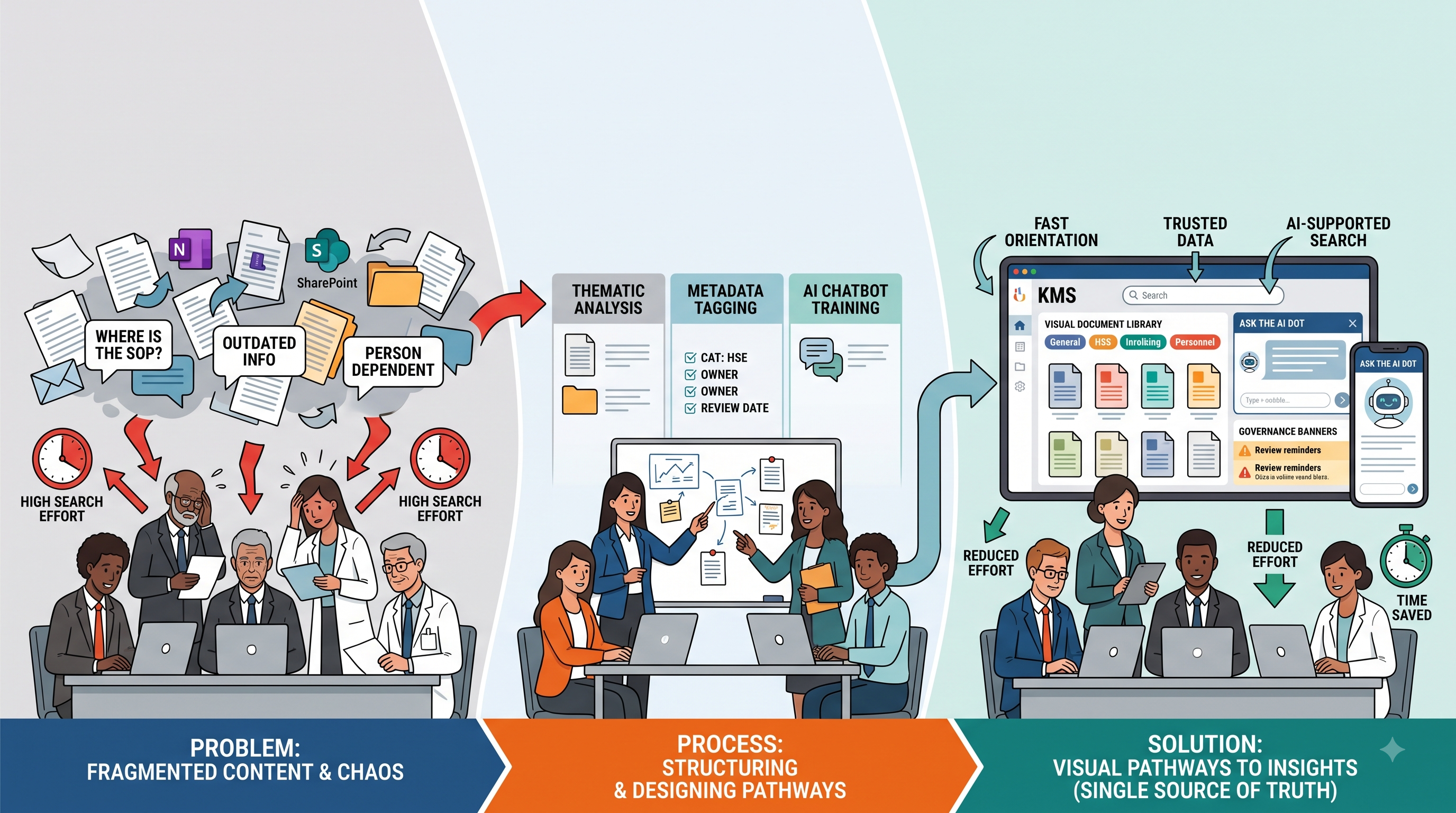
The GDC Basel Operations Team relied on information distributed across various channels, including SharePoint, OneNote, emails and shared or individual storage. This fragmented landscape increased search effort, made it difficult to identify reliable sources and created uncertainty about the accuracy and timeliness of information or documents. As a result, employees often depended on colleagues who held relevant knowledge, delaying work when these individuals were unavailable. Hence, the team needed a central, structured and reliable way to store, retrieve and maintain operational knowledge.
The project followed a qualitative, user-centered approach. The GDC Basel Operations Team members were interviewed, the existing SharePoint environment and relevant information sources were analyzed and the thematic analysis was used to identify main challenges and design requirements, which were later translated with the Kano framework. The end users then contributed to backend design decisions, frontend sketches and iterative prototype evaluation. Finally, the final SharePoint-based prototype was evaluated by the GDC Basel Operations Team using rating and qualitative feedback.
The thesis delivered a functional SharePoint-based knowledge management system prototype for the GDC Basel Operations Team. The solution combines a category-driven document library, related metadata, team-specific views, documented ownership, review dates, automated reminders and AI-supported search, which replaces deep folder structures with a clearer architecture supporting findability, accountability and maintenance. Additionally, user evaluations showed high satisfaction with navigation, layout, readability, AI-supported search and backend performance, with average ratings between 4.25 to 4.75 out of 5. Users particularly also valued the clear category structure, limited interface elements and simplified document access. In practice, the prototype can reduce search effort, decrease dependency on individual knowledge holders and increase employee confidence in current documents or information, also supporting faster onboarding by streamlining access to clear operational knowledge. Hence, with continued adoption, clear content ownership and regular reviews, the solution provides a scalable model for other operational teams facing similar knowledge management challenges.
Studyprogram: Business Information Technology (Bachelor)
Keywords knowledge management system, knowledge sharing, knowledge management, system design, thematic analysis, user-centered method, visual pathways, operational knowledge
Confidentiality: vertraulich
Type of Thesis
Bachelor Thesis
Client
Novartis Pharma AG, Basel
Authors
Michelle Jane Liva
Supervisor
Terry Inglese
Publication Year
2026
Thesis Language
English
Confidentiality
Confidential
Studyprogram
Business Information Technology (Bachelor)
Location
Basel
Keywords
knowledge management system, knowledge sharing, knowledge management, system design, thematic analysis, user-centered method, visual pathways, operational knowledge