
Determinants of Deal Failure: An Empirical Analysis of Factors Leading to the Termination of M&A Transactions
Manuel Beck & Loris Kunz, 2026
Type of Thesis Bachelor Thesis
Client A consulting firm in the M&A sector
Supervisor Fabian Schmid
Views: 110
A substantial minority of announced mergers and acquisitions is never completed. When a transaction collapses between announcement and closing, the parties bear break-up fees, unrecoverable advisory costs, reputational damage and months of management attention. Academic evidence on why announced deals fail rests almost entirely on large listed U.S. transactions; for Europe and especially the Swiss mid-market, dedicated evidence is scarce. This thesis addresses that gap and examines which factors are associated with the failure of announced transactions.
The study follows a mixed-method design. Two samples of transactions announced between 2013 and 2026 were extracted from the Mergermarket database: 8,090 decided deals with Swiss involvement and 25,947 decided European deals. Both samples were analysed with logistic regression models suited to rare events. The statistical results were complemented by a descriptive analysis of 63 anonymised mandates of an M&A advisory firm and by five semi-structured interviews with six M&A practitioners. All sources were systematically triangulated.
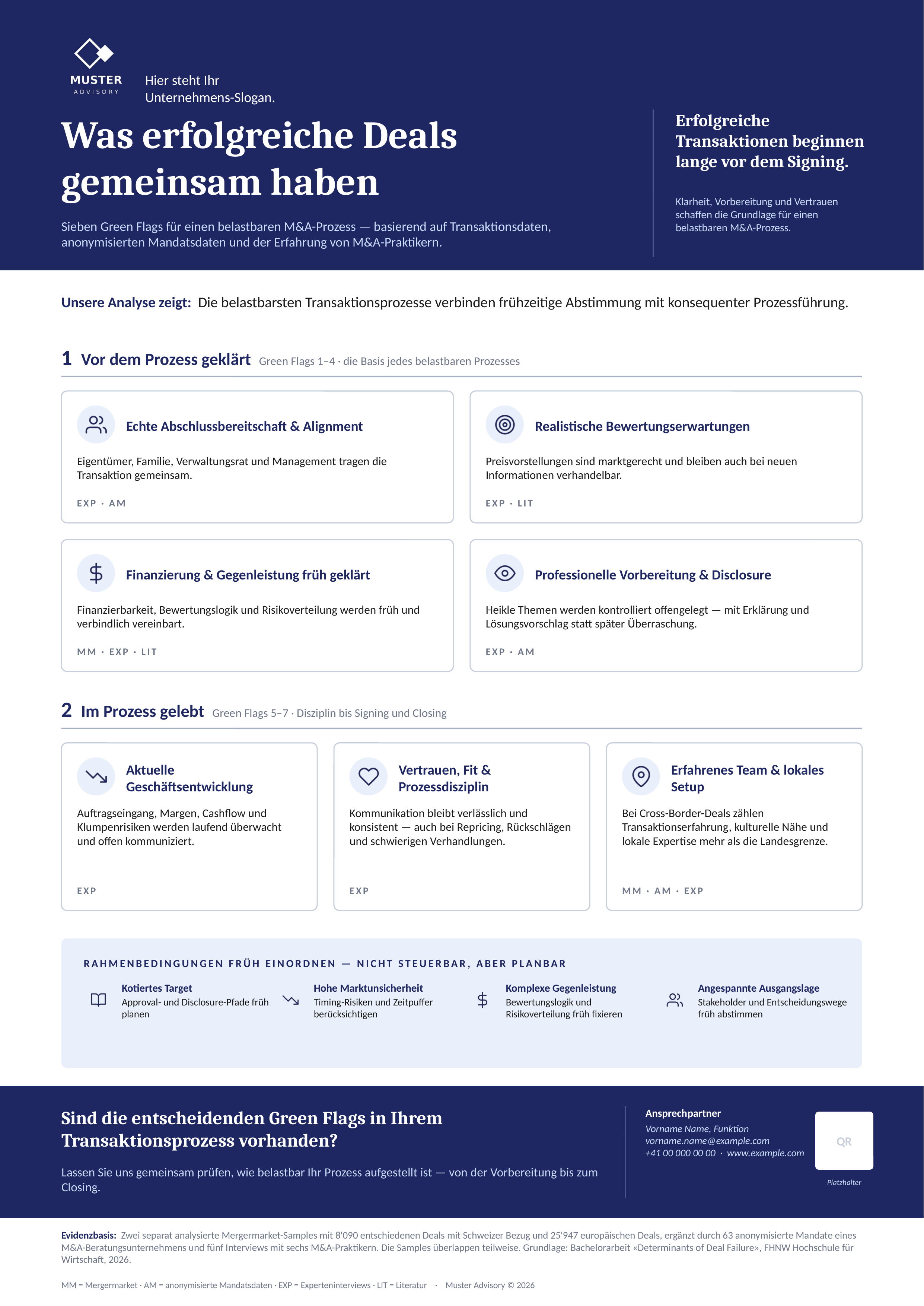
Four of the five hypothesised risk factors are supported. Deal attitude is the dominant one: hostile or contested transactions fail far more often than friendly ones, with failure rates of 41 and 57 percent against two to three percent overall. A listed target roughly quintuples the odds of failure; higher market volatility and stock rather than cash consideration are also linked to elevated risk. Contrary to the initial hypothesis, cross-border deals do not generally fail more often. A plausible, untested interpretation is that international deals reaching announcement are pursued by experienced, committed buyers. The interviews add process factors that databases miss: insufficient seller readiness, stakeholder misalignment, eroding trust, deteriorating current trading and late disclosure of sensitive issues. The thesis condenses this evidence into a two-level red-flag framework for advisory practice. It helps advisers spot risks earlier, assess completion prospects in a structured way, address financing and sensitive issues early, verify seller readiness and alignment before a process starts, and judge cross-border deals by buyer experience and financing, not by a blanket label.
Studyprogram: Business Administration International Management (Bachelor)
Keywords Mergers & Acquisitions (M&A), Deal Failure, Deal Completion, Transaction Risk, M&A Advisory, Market Volatility, Cross-Border Transactions
Confidentiality: öffentlich
Type of Thesis
Bachelor Thesis
Client
A consulting firm in the M&A sector
Authors
Manuel Beck & Loris Kunz
Supervisor
Fabian Schmid
Publication Year
2026
Thesis Language
English
Confidentiality
Public
Studyprogram
Business Administration International Management (Bachelor)
Location
Brugg-Windisch
Keywords
Mergers & Acquisitions (M&A), Deal Failure, Deal Completion, Transaction Risk, M&A Advisory, Market Volatility, Cross-Border Transactions