
A Digital Sovereignty Self-Assessment Tool for Swiss Municipal Administrations with a Focus on the Aargau
David Duran, 2026
Type of Thesis Bachelor Thesis
Client Fachhochschule Nordwestschweiz FHNW, Hochschule für Wirtschaft, Institut für Wirtschaftsinformatik
Supervisor Barbara Eisenbart
Views: 13
Local Swiss public administrations are digitally transforming their operations, while facing limited resources and a shortage of specialist staff to effectively control and govern their digital tools and infrastructure. Research identifies foreign legal access to government data, vendor lock-ins, weak portability and a dependence on IT-providers during crisis situations, as major risks for the fulfillment of public tasks. The challenge for municipalities will be to maintain public trust, while adhering to legal requirements and an increase in demand for local public services.
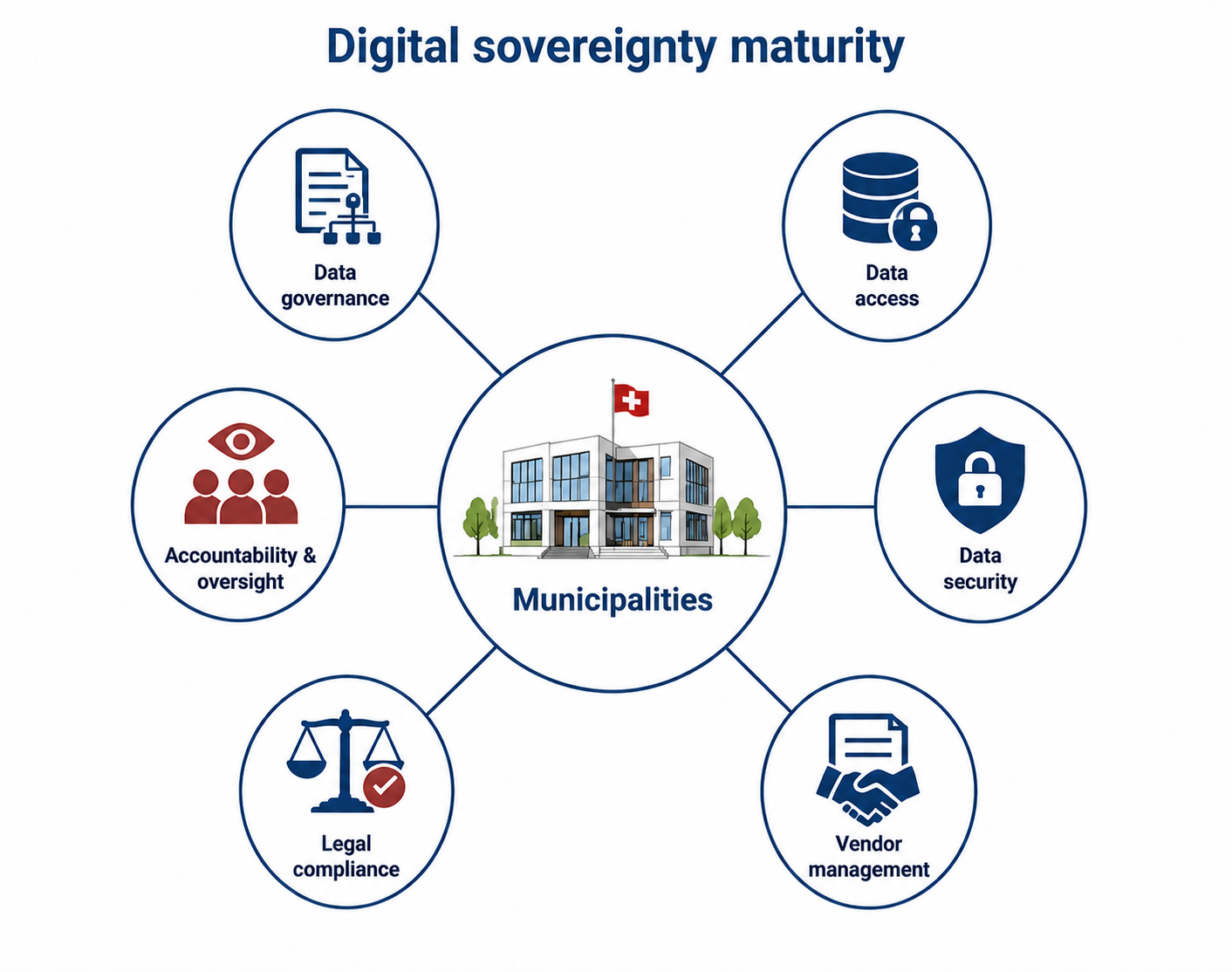
An extensive literature review and analysis of three existing frameworks was preformed, which resulted in a gap for developing a context-specific tool for Swiss municipal digital sovereignty. To close this gap, primary data was gathered through interviews with municipal employees, IT-providers, cantonal representatives and subject matter experts. The combination of research resulted in a framework centered around six dimensions for assessing a municipality's digital sovereignty: data governance, data access, data security, vendor management, legal compliance, accountability and oversight.
The resulting framework and tool help municipalities identify their most critical dependencies, understand how much control they have over their data, systems and providers, and decide which improvements to prioritize. Using cloud services, external IT-providers or shared cantonal infrastructure does not necessarily mean that a municipality loses its digital sovereignty. However, they need to understand their dependencies, retain meaningful control over key decisions, have effective safeguards in place, and be able to recover or adapt when circumstances change. The tool is therefore does not determine whether a municipality is completely independent of external providers. Instead, it helps municipalities reflect systematically on whether they can manage their digital dependencies and continue delivering public services within their legal, financial and organizational constraints.
Studyprogram: Business Information Technology (Bachelor)
Keywords Digital Sovereignty, Public Administration, Cybersecurity, Data Sovereignty, Maturity, Self-assessment
Confidentiality: öffentlich
Type of Thesis
Bachelor Thesis
Client
Fachhochschule Nordwestschweiz FHNW, Hochschule für Wirtschaft, Institut für Wirtschaftsinformatik, Basel
Authors
David Duran
Supervisor
Barbara Eisenbart
Publication Year
2026
Thesis Language
English
Confidentiality
Public
Studyprogram
Business Information Technology (Bachelor)
Location
Brugg-Windisch
Keywords
Digital Sovereignty, Public Administration, Cybersecurity, Data Sovereignty, Maturity, Self-assessment