
Skill-to-Course Matching with Prompt Engineering
Mihriban Ermis, 2026
Type of Thesis Bachelor Thesis
Client FHNW University of Applied Sciences and Arts Northwestern Switzerland
Supervisor Elzbieta Pustulka
Views: 12
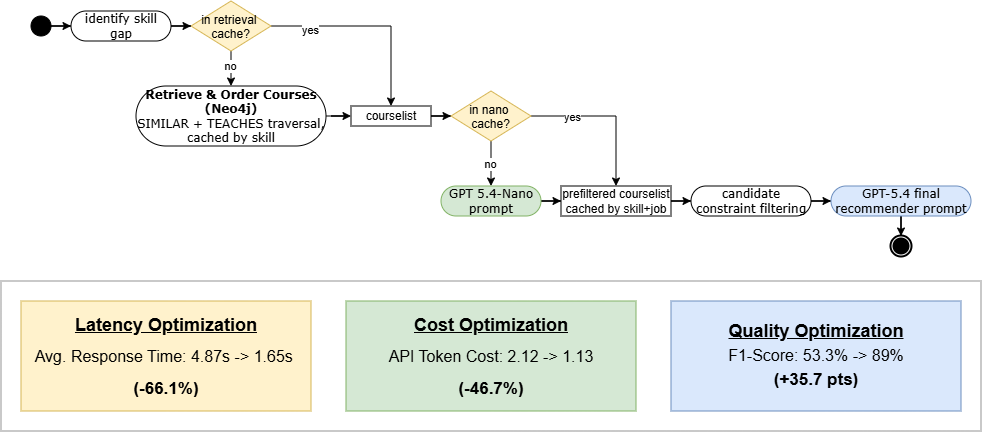
Organizations need training recommendations that reflect a candidate's actual skill gaps, not generic course lists. Talent Track Pro, an Innosuisse-funded collaboration between Scrambl AG and FHNW, extends an existing skill-matching platform with LLM-based course recommendations built on a Neo4j knowledge graph of skills, jobs, and courses. Before this thesis, the recommendation stage relied on an unrefined prototype prompt that had never been systematically benchmarked, leaving recommendation quality, operational cost, and runtime unknown and unoptimized.
Following an empirical, iterative process, this thesis built familiarity with the Neo4j knowledge graph, then refined the query to improve course retrieval. A benchmark of 131 manually labeled rows, each one candidate skill gap for a target job, was used to refine and evaluate the recommendation prompt via precision, recall, and F1. The final prompt was validated on a second benchmark. A staged prompting approach was introduced and its API cost measured by comparing single-stage and staged runs, and a caching mechanism was evaluated by comparing runtime with caching enabled and disabled.
The final recommendation prompt achieved an F1 score of 89.0 percent (90.1 percent precision, 88.0 percent recall) on the primary SBB benchmark, a clear improvement over the baseline. On an independent banking benchmark, the same prompt kept comparable performance, showing good generalization. The final prompt's combination of structured reasoning, explicit selection criteria, and domain-aware context sharply reduced wrong-domain, different-skill, and scope-mismatch errors versus the baseline, but level-mismatch errors increased slightly, a trade-off linked to a balance rule favoring retention of borderline courses to protect recall. A GPT-5.4-nano prefilter before the main GPT-5.4 model (staged prompting) cut API costs by 46.7 percent, from $2.12 to $1.13 per benchmark run, with only a minor F1 drop (89 to 87 percent). A shared cache for repeated results further cut average runtime by about 66 percent, from 4.87 to 1.65 seconds, without affecting quality. Overall, high-quality, cost-efficient, fast LLM-based recommendations require combining prompt engineering with retrieval and architectural optimization.
Studyprogram: Business Information Technology (Bachelor)
Keywords Prompt Engineering, Large Language Models, Recommender Prompt, Neo4j Knowledge Graph, Staged Prompting, Skill-to-Course Matching, Caching
Confidentiality: vertraulich
Type of Thesis
Bachelor Thesis
Client
FHNW University of Applied Sciences and Arts Northwestern Switzerland, Olten
Authors
Mihriban Ermis
Supervisor
Elzbieta Pustulka
Publication Year
2026
Thesis Language
English
Confidentiality
Confidential
Studyprogram
Business Information Technology (Bachelor)
Location
Basel
Keywords
Prompt Engineering, Large Language Models, Recommender Prompt, Neo4j Knowledge Graph, Staged Prompting, Skill-to-Course Matching, Caching