
Ethical Implications and Acceptance of AI-Generated Reconstructions in Cultural Heritage using the Speculative Design Approach
Sibylle Knecht, 2026
Type of Thesis Bachelor Thesis
Client Fachhochschule Nordwestschweiz FHNW Hochschule für Wirtschaft Institut für Wirtschaftsinformatik
Supervisor Faruk Doganci & Safak Korkut
Views: 17
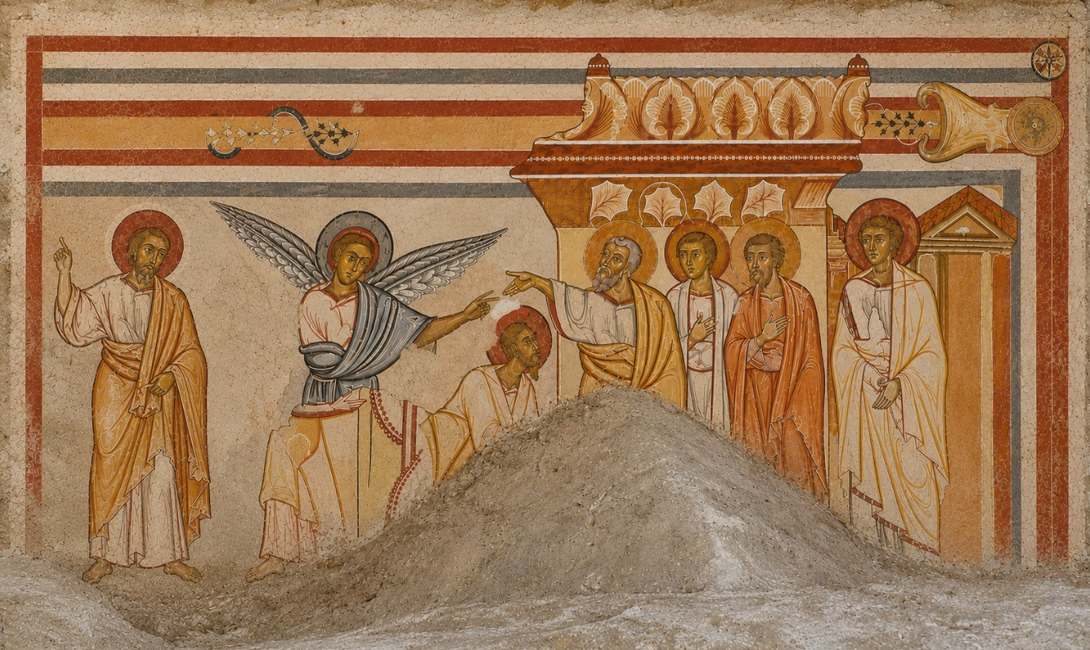
Artificial intelligence can visualize damaged or incomplete cultural heritage and may support research, education, interpretation and public engagement. However, convincing reconstructions can conceal uncertainty, introduce unsupported details or be mistaken for historical evidence. This thesis therefore investigates how cultural heritage experts perceive AI-generated reconstructions and which ethical considerations influence their acceptance.
A structured narrative review of 21 academic and institutional sources established the conceptual foundation. Two speculative AI reconstructions of damaged Carolingian frescoes from the Convent of St. John in Müstair were created with ChatGPT 5.5 and used as visual prompts in semi-structured expert interviews. Thirteen interviews were conducted, of which 12 were transcribed and thematically analyzed. The interview findings were compared with the literature and interpreted using technology acceptance and speculative design perspectives.
The findings indicate that visual plausibility alone was not sufficient for professional trust or acceptance. The interviewed experts assessed the reconstructions in relation to surviving evidence, historical and material knowledge, source quality, stylistic consistency, transparency, uncertainty, intended use and professional validation. They identified possible uses in education, public communication, hypothesis generation, documentation and interdisciplinary discussion. Acceptance was conditional and was stronger when reconstructions were presented as provisional interpretations, surviving and generated elements remained distinguishable, sources and decisions were documented, uncertainty was communicated, and qualified professionals retained responsibility. The thesis provides the client with literature-based and expert-informed insights into perceptions of AI-generated cultural heritage reconstruction. It identifies considerations for future projects, particularly transparent presentation, documentation of uncertainty and continued human oversight.
Studyprogram: Business Information Technology (Bachelor)
Keywords Artificial intelligence, cultural heritage, AI-generated reconstruction, digital heritage, AI ethics, authenticity, transparency, technology acceptance, expert interviews, speculative design
Confidentiality: öffentlich
Type of Thesis
Bachelor Thesis
Client
Fachhochschule Nordwestschweiz FHNW Hochschule für Wirtschaft Institut für Wirtschaftsinformatik, Basel
Authors
Sibylle Knecht
Supervisor
Faruk Doganci & Safak Korkut
Publication Year
2026
Thesis Language
English
Confidentiality
Public
Studyprogram
Business Information Technology (Bachelor)
Location
Basel
Keywords
Artificial intelligence, cultural heritage, AI-generated reconstruction, digital heritage, AI ethics, authenticity, transparency, technology acceptance, expert interviews, speculative design