
Evaluation of NFC and RFID-Based IT Asset Identification
Francesco Leone, 2026
Type of Thesis Bachelor Thesis
Client Novartis
Supervisor Rainer Telesko
Views: 19
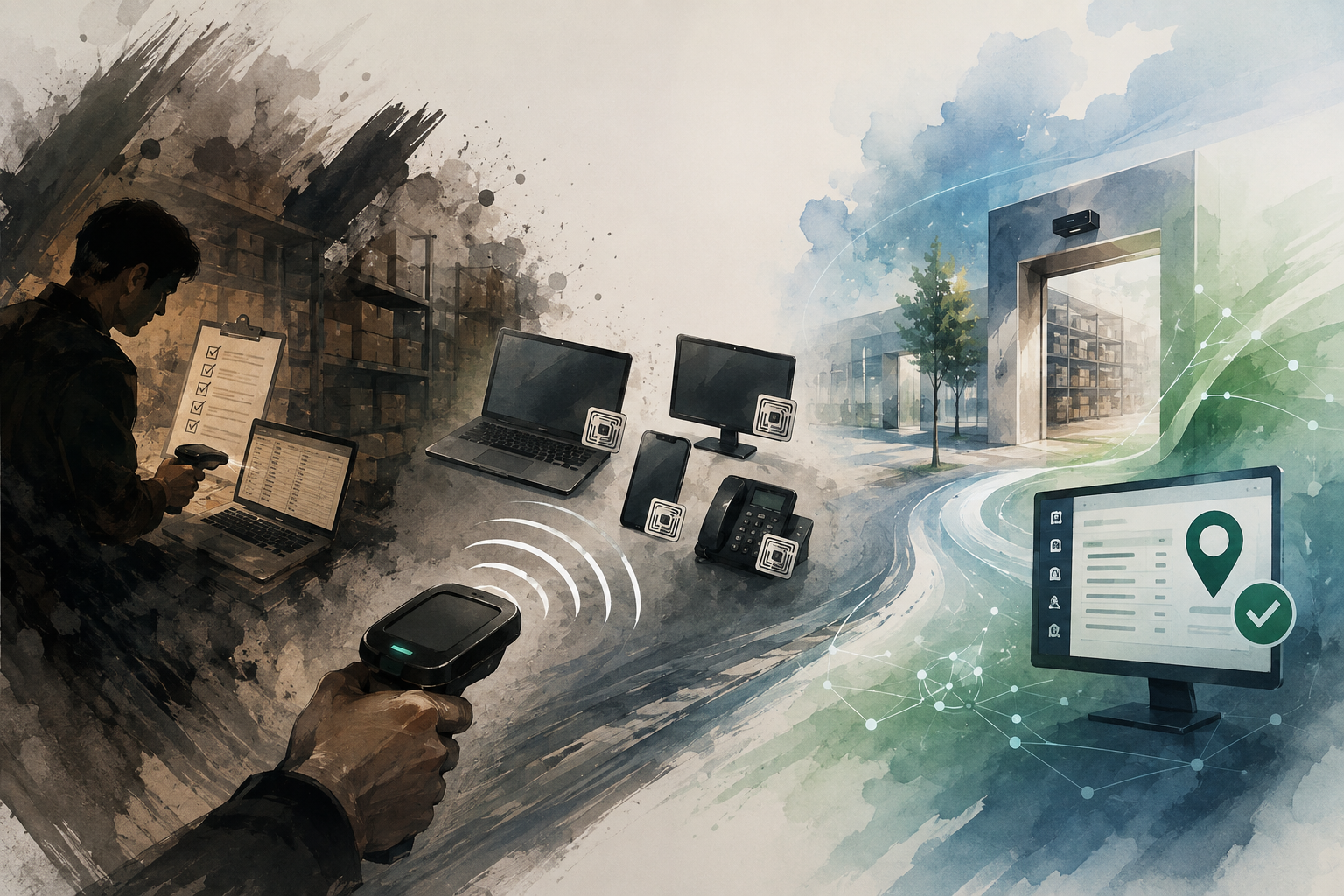
IT assets such as laptops and smartphones are currently identified using barcode labels. During physical inventory audits, each asset must be located and scanned individually, making the process time-consuming, particularly in warehouses with large numbers of devices. This thesis investigates whether RFID can improve this process by enabling multiple assets to be detected simultaneously without requiring direct line of sight, while maintaining the existing IT asset management platform.
The current asset management and inventory process was analysed through a stakeholder interview and a review of relevant identification technologies. Based on the identified requirements, an RFID proof of concept was developed using a Zebra UHF RFID reader, passive RFID tags and Snipe-IT as a test asset management system. The prototype was used to evaluate bulk asset detection, automated location updates and the practical suitability of RFID for different IT devices.
The proof of concept demonstrated that RFID can significantly simplify physical inventory audits. Up to 100 tagged assets could be detected within seconds, and the prototype successfully matched scanned RFID tags with assets in the asset management system and automatically updated their location. RFID was particularly effective for bulk inventory, while barcodes remain more practical for identifying individual assets during processes such as assignment to users.Testing also identified limitations. Standard RFID tags did not work reliably on devices with metal surfaces, requiring suitable on-metal tags. For an enterprise implementation, RFID should therefore complement rather than replace the existing barcode process. Integration with the existing ServiceNow environment and the use of enterprise RFID middleware should be evaluated for production deployment. Fixed RFID readers at selected locations could additionally enable automated asset movement and location tracking.
Studyprogram: Business Information Technology (Bachelor)
Keywords ITAM, RFID
Confidentiality: vertraulich
Type of Thesis
Bachelor Thesis
Client
Novartis, Basel
Authors
Francesco Leone
Supervisor
Rainer Telesko
Publication Year
2026
Thesis Language
English
Confidentiality
Confidential
Studyprogram
Business Information Technology (Bachelor)
Location
Basel
Keywords
ITAM, RFID