
Measuring What Matters: Evaluating HR Digital Transformation with the Balanced Scorecard
Céline Saphire Koch, 2026
Type of Thesis Bachelor Thesis
Client Swiss Financial Institution
Supervisor Nico Sütterle
Views: 12
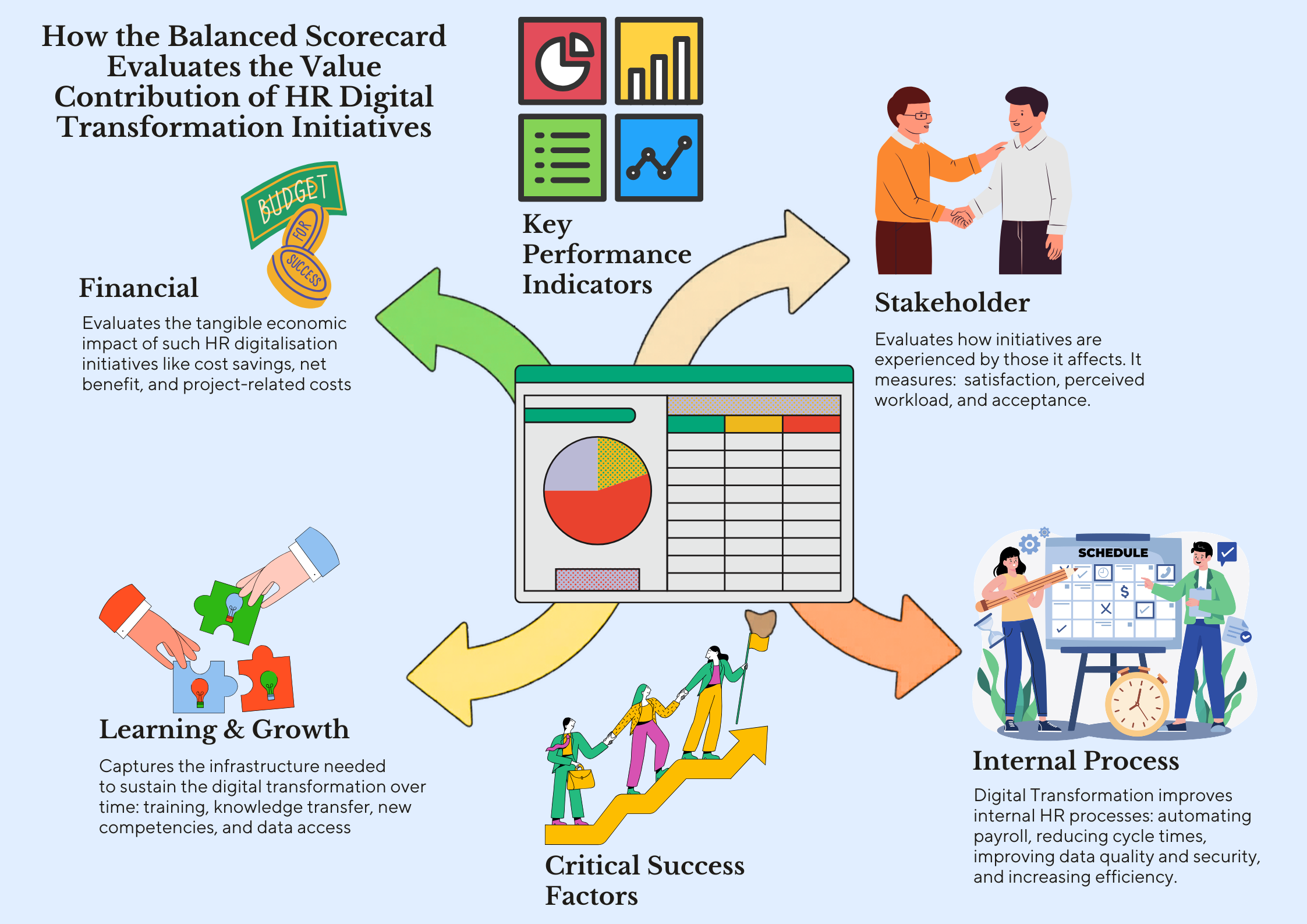
A Swiss financial institution digitalised its Compensation Management process in 2025, replacing manual, Excel-based salary and bonus reviews. While the initiative promised efficiency gains, its actual value contribution has not been formally assessed. Organisations often measure such projects only through financials, overlooking process efficiency, employee experience and strategic impact. This thesis addresses that gap by measuring to what extent the Balanced Scorecard can identify and evaluate the value contribution of digital transformation initiatives, using this HR case as an example.
A mixed-method, single case study design was applied. A literature review established the Balanced Scorecard framework (Kaplan & Norton) and relevant KPIs for digital HR initiatives. A before-after comparison measured financial, process, and adoption metrics such as administrative cost reduction and payback period in years. Qualitative interviews with 3 stakeholder groups captured employee experience and usability. Findings were structured across the four BSC dimensions: Financial, Stakeholder, Internal Process, and Learning & Growth to identify critical success factors.
Results show measurable improvements across all four Balanced Scorecard dimensions: administrative costs were reduced by 59%, with an investment payback period of 4,2 years. System usability and knowledge transfer among HR staff also improved, contributing to smoother adoption of the new process. Beyond the numbers, the thesis identifies critical success factors, such as data quality, sufficient resources, and data security & compliance, that influenced the initiative's success and can guide future digital rollouts. For the client, this provides a transparent, evidence-based evaluation grid to justify the initiative's cost-benefit trade-offs and to support decision-making on further HR digitalisation projects. More broadly, the study shows how the Balanced Scorecard can be adapted to capture both tangible and intangible benefits of digital transformations.
Studyprogram: Business Administration International Management (Bachelor)
Keywords Balanced Scorecard, HR Scorecard, Digital Transformation, Human Resource Management, Compensation Management, Key Performance Indicators, Critical Success Factors, Banking Sector, Performance Measurement, Value Contribution, Case Study Research
Confidentiality: vertraulich
Type of Thesis
Bachelor Thesis
Client
Swiss Financial Institution
Authors
Céline Saphire Koch
Supervisor
Nico Sütterle
Publication Year
2026
Thesis Language
English
Confidentiality
Confidential
Studyprogram
Business Administration International Management (Bachelor)
Location
Brugg-Windisch
Keywords
Balanced Scorecard, HR Scorecard, Digital Transformation, Human Resource Management, Compensation Management, Key Performance Indicators, Critical Success Factors, Banking Sector, Performance Measurement, Value Contribution, Case Study Research