
Potential Analysis of Zero-Knowledge Proofs for Privacy-Preserving Verification using the Example of a Digital Student Credential based on the Midnight Network
Asmir Baftijari, 2026
Type of Thesis Bachelor Thesis
Client Fachhochschule Nordwestschweiz FHNW HSW IWI
Supervisor Walter Dettling
Views: 25
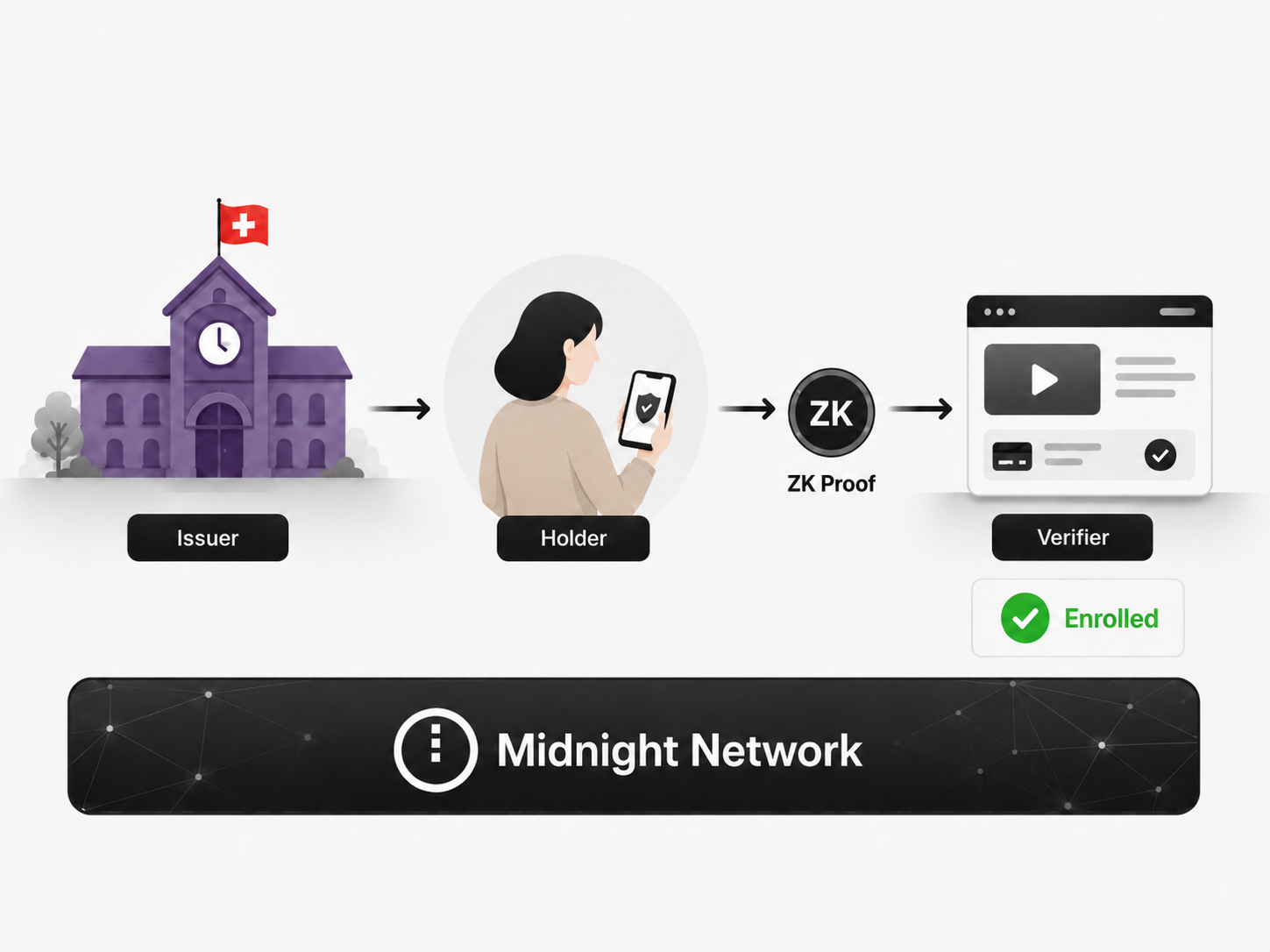
Universities hold student data in central systems. Problems arise when student status must be proven externally, for example to streaming services or banks. This over-disclosure creates privacy risks and allows repeated verifications to be linked to one person. The thesis therefore examined the potential of zero-knowledge proofs on the Midnight Network for privacy-preserving student credential verification.
The thesis combined a literature review of zero-knowledge proofs and digital identity with an analysis of the verification mechanisms Swiss students use today. Based on the findings, an architecture with the roles issuer, holder and verifier was designed and implemented as a prototype. The prototype was then evaluated in different aspects and assessed with regard to its potential for a real implementation.
The prototype demonstrated that the core of the approach works. A credential can be issued and stored locally and its validity can be confirmed on the Midnight test network. The verifying service learns nothing beyond a yes-or-no outcome, needs no contact with the university and cannot link repeated verifications to the same person. This represents a clear advance over current mechanisms, which collect personal data with every verification.At the same time, the evaluation showed the limits of what is possible today. The current smart contract does not enforce all requirements and some steps still rely on the honesty of the prover. Limitations in wallet support and the current technical maturity of the Midnight Network also had to be taken into consideration. The thesis therefore concludes that the potential is real but conditional. Zero-knowledge verification should complement rather than replace SWITCH edu-ID. The Swiss E-ID with its swiyu wallet could potentially provide the missing infrastructure and should be assessed further.
Studyprogram: Wirtschaftsinformatik (Bachelor)
Keywords Zero-knowledge proof, ZKP, Blockchain, Credential, Student, SWITCH edu-ID
Confidentiality: öffentlich
Type of Thesis
Bachelor Thesis
Client
Fachhochschule Nordwestschweiz FHNW HSW IWI
Authors
Asmir Baftijari
Supervisor
Walter Dettling
Publication Year
2026
Thesis Language
English
Confidentiality
Public
Studyprogram
Wirtschaftsinformatik (Bachelor)
Location
Olten
Keywords
Zero-knowledge proof, ZKP, Blockchain, Credential, Student, SWITCH edu-ID