
Aligning Business Intelligence Capabilities and Innovation Orientation in Swiss Firms: Developing a Strategic Fit Framework
Pascal Strebel, 2025
Type of Thesis Master Thesis
Client
Supervisor Mona Meyer
Views: 9 - Downloads: 10
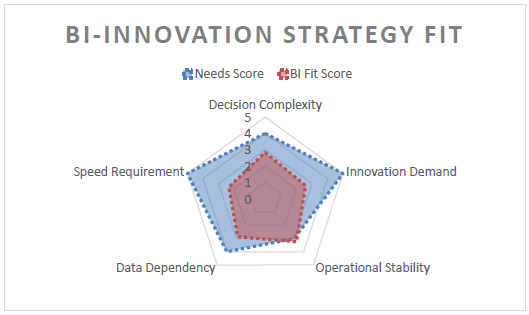
While BI is often linked to competitive advantage, research has given limited attention to how BI configurations should differ for firms that lean more toward innovative versus imitative innovation logics. Grounded in the Resource-Based View (RBV), Dynamic Capabilities View (DCV), and Strategic Alignment Theory, the study tackles this gap by shifting away from treating BI maturity as a uniform, one-size-fits-all concept.
Using a multi-stage Design Science Research (DSR) approach, BIFIT was built and refined through 10 expert interviews, a focus group, and four validation walkthroughs with practitioners from Swiss firms. The findings did not support a strict binary split between “innovative” and “imitative” firms; many organizations combined both logics across domains.
As a result, the framework evolved from v1.0 to v4.0 by replacing static strategy classification with an organizational needs profile. This needs profile assesses BI fit using contextual drivers such as decision complexity, process embeddedness, and data relevance, rather than generic strategic labels. The study delivers a validated, strategy-contingent assessment tool that helps managers diagnose misalignment and prioritize BI investments based on innovation-relevant needs.
Studyprogram: Business Information Systems (Master)
Keywords
Confidentiality: öffentlich
Type of Thesis
Master Thesis
Authors
Pascal Strebel
Supervisor
Mona Meyer
Publication Year
2025
Thesis Language
English
Confidentiality
Public
Studyprogram
Business Information Systems (Master)
Location
Olten