
Optimising Drug Production and Dispatch Planning in Clinical Trials
Delaja Ledermann, 2025
Type of Thesis Master Thesis
Client
Supervisor Emanuele Laurenzi
Views: 14 - Downloads: 14
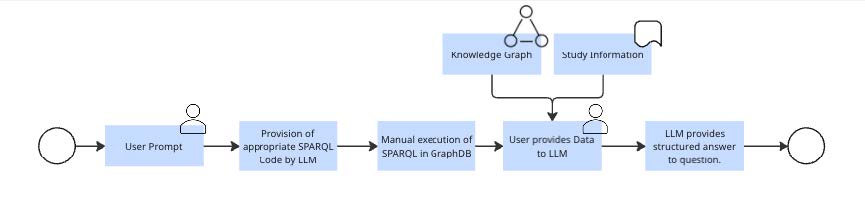
Clinical trial drug production and dispatch planning is a complex and highly regulated activity that requires integrating heterogeneous information sources, including clinical trial protocols, enrolment projections, site activation schedules, and operational constraints such as lead times, expiry dates, and overage policies. In practice, much of this information is available in unstructured or semi-structured formats, making consistent and, transparent planning difficult. While large language models (LLMs) demonstrate strong capabilities for interpreting natural language documents, their probabilistic reasoning, lack of determinism, and limited traceability restrict their direct applicability to regulated decision-support tasks.
This thesis investigates how integrating of a knowledge graph (KG) with a large language model can support clinical trial drug production and dispatch planning by combining structured domain knowledge with flexible natural-language interaction. The research follows a Design Science Research (DSR) methodology and results in the development of a domain-specific KG–LLM artefact. The artefact is designed around competency questions derived from planning needs and uses a knowledge graph to provide structured, validated inputs that constrain and enrich LLM reasoning.The artefact is instantiated using synthetic but realistic clinical trial data and evaluated through scenario-based planning exercises and participatory expert discussion. Two configurations are compared: an LLM-only baseline and a KG-enriched LLM approach. The evaluation results indicate that the KG-enriched configuration produces more consistent, transparent, and reproducible outputs, while reducing ambiguity and perceived hallucination risk. Participants further perceived improved trust, usability, and applicability of the artefact for real-world planning tasks.
These findings are derived from expert-based evaluation scenarios rather than live clinical trial data, which limits direct generalisability but allows controlled assessment of the artefact’s design principles. Overall, the findings demonstrate that knowledge graphs and large language models are complementary rather than competing technologies. When systematically integrated, they can provide explainable and auditable decision support that aligns with the requirements of clinical trial supply planning in regulated pharmaceutical environments.
Studyprogram: Business Information Systems (Master)
Keywords
Confidentiality: öffentlich
Type of Thesis
Master Thesis
Authors
Delaja Ledermann
Supervisor
Emanuele Laurenzi
Publication Year
2025
Thesis Language
English
Confidentiality
Public
Studyprogram
Business Information Systems (Master)
Location
Olten