
Extending Business Process Modelling Languages for Ad Hoc Adaptability - Ensuring Efficiency and Compliance in Dynamic Process Execution
Eliana Felice, 2025
Type of Thesis Master Thesis
Client
Supervisor Knut Hinkelmann
Views: 20 - Downloads: 17
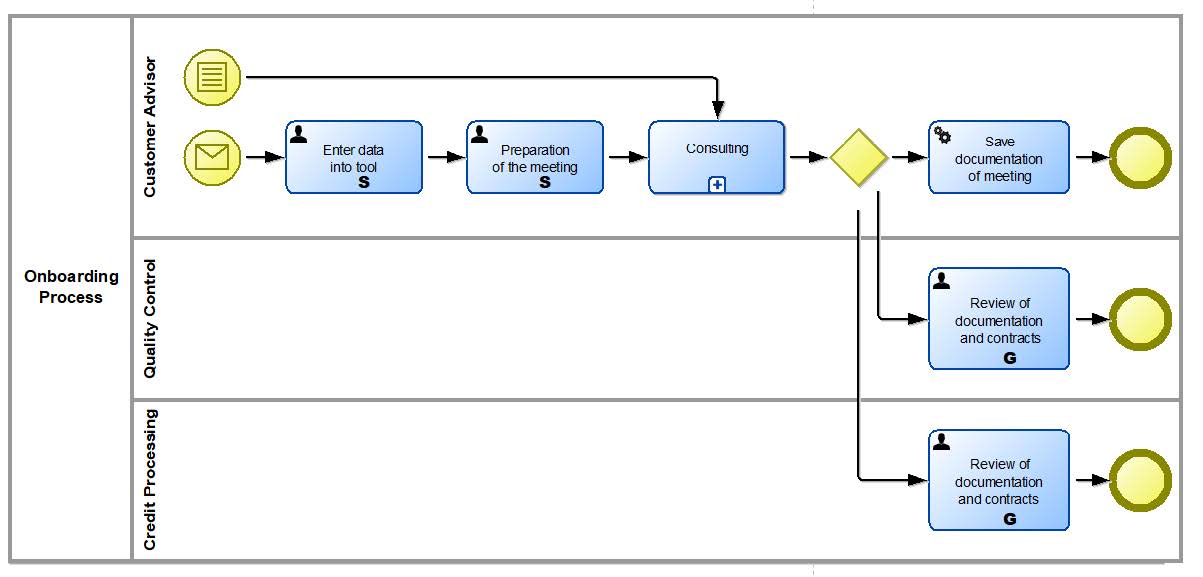
Various approaches attempt to capture different forms and timing of flexibility, yet existing standards still offer only limited mechanisms to support such ad hoc adjustments during execution. While the idea of controlled flexibility aims to provide freedom within defined boundaries, current modelling approaches restrict runtime adaptability when unplanned decisions are needed. The lack of mechanisms to ensure both adaptability and control continues to cause inefficiencies and inconsistencies in process execution. Overcoming these limitations and avoiding inefficient workarounds can foster innovative solutions and better alignment with situational demands.
As the Business Process Model and Notation (BPMN) emerges as the industry standard, this work addresses this limitation by introducing a BPMN-based modelling extension that enables controlled ad hoc process adjustments within structured business processes. The proposed concept allows process executors to change process behaviour at runtime through predefined flexibility attributes, such as Skip, Postpone, Earlier Execution, Goal-Based Earlier Execution and Alternative tasks without compromising compliance or efficiency. The extension integrates adaptive capabilities directly into BPMN models rather than introducing a new modelling paradigm, ensuring compatibility with existing modelling environments.Following the Design Science Research, design principles were derived from an analysis of a concrete case from a financial institution and expert interviews, and a metamodel containing the necessary elements was developed using the ADOxx platform. Additionally, a conceptual proposal for adapting the process execution procedure was designed. The design principles and the BPMN extension were evaluated in a workshop, with a primary focus on usability, applicability, and efficiency.
The results show that the proposed approach improves BPMN's support for ad hoc adaptability while maintaining compliance and efficiency. The design principles developed and the BPMN language extension help to close the gap between flexibility and control in business process management and provide a basis for further refinement and application in practical environments.
Studyprogram: Business Information Systems (Master)
Keywords Business Process Management, Business Process Model and Notation (BPMN), Process Adaptability, Process Flexibility, Metamodeling
Confidentiality: öffentlich
Type of Thesis
Master Thesis
Authors
Eliana Felice
Supervisor
Knut Hinkelmann
Publication Year
2025
Thesis Language
English
Confidentiality
Public
Studyprogram
Business Information Systems (Master)
Location
Olten
Keywords
Business Process Management, Business Process Model and Notation (BPMN), Process Adaptability, Process Flexibility, Metamodeling